Affinity Grouping vs. Planning Poker
Published Dec 1, 2025
⦁
14 min read
Affinity Grouping vs. Planning Poker
Struggling with task estimation in agile projects? Two popular techniques - Affinity Grouping and Planning Poker - can help streamline your process, but they serve different purposes. Here's the quick takeaway:
- Affinity Grouping: Fast and efficient for quickly estimating large backlogs by grouping tasks into effort categories (e.g., small, medium, large).
- Planning Poker: Detailed and precise, using team discussions and numbered cards to reach consensus on task complexity.
When to Use Each?
- Affinity Grouping works best for high-level estimations, unestimated backlogs, or release planning.
- Planning Poker shines when accuracy matters, especially during sprint planning or for smaller, well-defined tasks.
Both methods can complement each other: start with Affinity Grouping for an overview, then refine key tasks with Planning Poker.
Quick Comparison
| Factor | Affinity Grouping | Planning Poker |
|---|---|---|
| Speed | Faster for large backlogs | Slower due to detailed discussions |
| Accuracy | Less precise | More accurate through team consensus |
| Discussion Depth | Minimal | Thorough and detailed |
| Best Use Case | Large backlogs, early project stages | Small, focused tasks, sprint planning |
| Team Collaboration | Limited | Actively involves all team members |
For a deeper dive into how these methods work and when to use them, keep reading!
Agile Estimation Techniques: Estimating Time & Effort in Agile Project Management
What Is Affinity Grouping?
Affinity grouping, sometimes called affinity estimation, is a technique used in agile project management to quickly estimate a large number of user stories by grouping similar tasks together based on the effort required. Instead of analyzing each story in detail, the team compares stories to one another, organizing them into clusters that reflect similar levels of complexity and workload.
The focus here isn’t on assigning precise values to each story right away. Instead, the team asks questions like, "Does this story seem as complex as that one?" or "Is this task clearly more challenging than the others?" This comparative approach allows teams to focus on the big picture without getting bogged down in specifics.
Because of its speed and simplicity, affinity grouping has become one of the go-to estimation methods for agile teams. It’s particularly useful when tackling an unestimated backlog or preparing for an upcoming release. Now, let’s dive into how this process works.
How Affinity Grouping Works
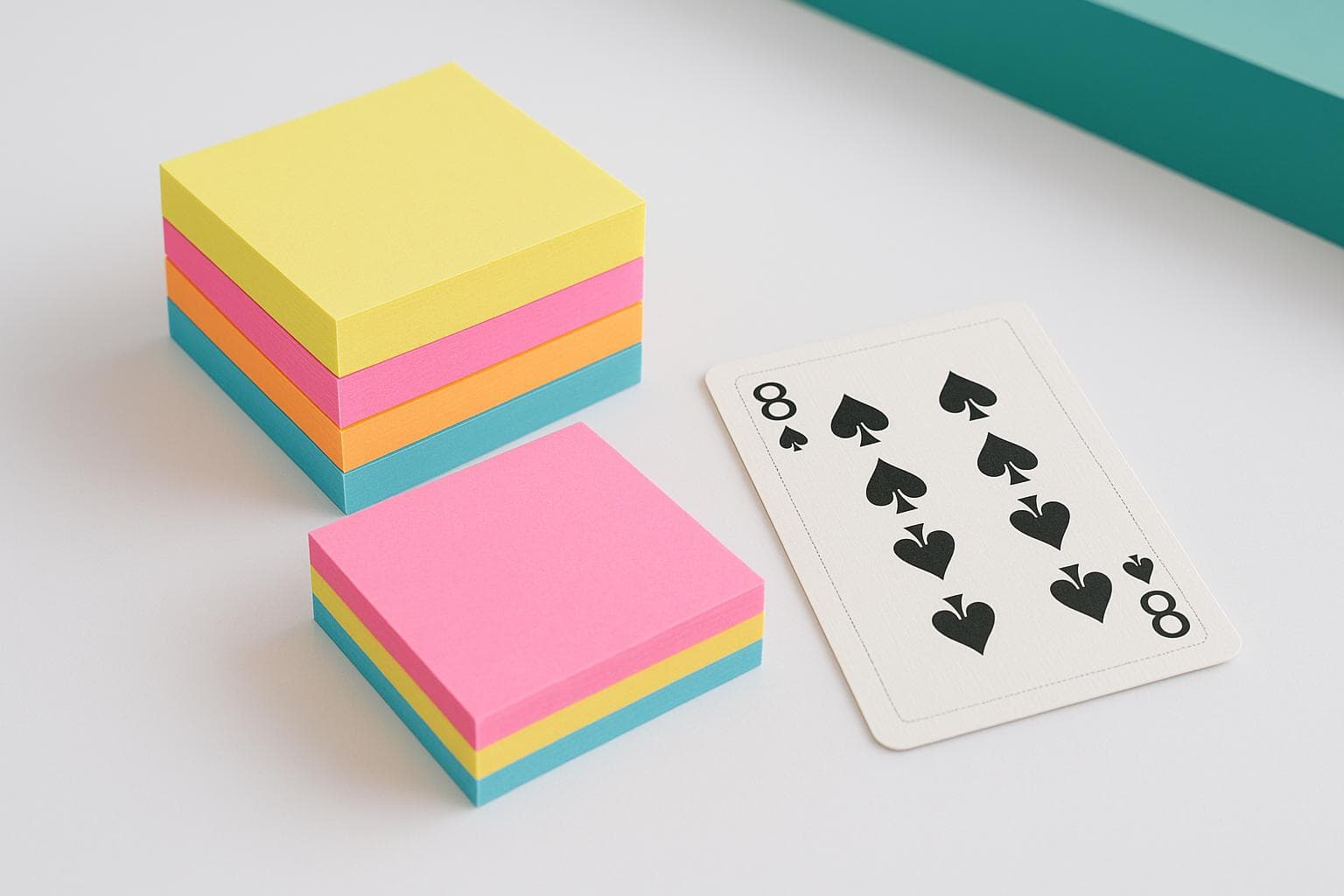
The process begins by gathering all the user stories or tasks that need to be estimated. These tasks are typically displayed visually - on index cards, sticky notes, or digital boards - so the entire team can see them at once.
From there, team members work together to organize the stories into groups that represent varying levels of effort. For example, they might start with general categories like small, medium, large, and extra-large. The key is comparing tasks to each other rather than analyzing them individually. As stories are placed into groups, discussions naturally arise about implementation challenges, leading to adjustments and refinements.
Once the team agrees on the groupings, they assign point values to each category to represent the relative effort involved. A common scale includes labels like XS, S, M, L, and XL. This approach keeps things simple - you're not debating whether a task is a 5 or an 8; instead, you’re deciding if it fits better with "medium" or "large" tasks.
The beauty of this process is that it reduces mental strain. By focusing on broader comparisons, the team avoids getting lost in the weeds of individual story details. This streamlined approach makes affinity grouping a practical choice for agile teams.
Benefits of Affinity Grouping
One of the standout advantages of affinity grouping is its speed. It allows teams to estimate large batches of user stories without spending excessive time on each one. For teams facing dozens - or even hundreds - of stories, this efficiency is invaluable.
Another benefit is how it keeps the team energized. Since the process involves less debate over individual tasks, teams can maintain momentum without experiencing "estimation fatigue". The visual and collaborative nature of the method also ensures transparency - everyone can see how stories are grouped and contribute to the discussion.
Perhaps most importantly, affinity grouping fosters a collaborative atmosphere. Instead of sparking debates over specific numbers, the focus shifts to grouping tasks by similarity. This approach feels less confrontational and encourages participation from all team members.
For teams managing large projects with many user stories, affinity grouping provides a high-level sense of the work involved. It offers enough information for planning decisions without requiring hours of detailed estimation.
When to Use Affinity Grouping
Affinity grouping is especially useful in specific situations. For instance, it’s a great choice when starting a project with an unestimated backlog. It helps teams quickly grasp the scope of work without needing precise estimates for sprint planning.
This technique is also ideal for release planning. Product owners can use it to get a rough idea of how much work fits within a release window. It’s equally effective during early backlog grooming sessions when quick, preliminary estimates are more valuable than detailed assessments.
Team size plays a role in its effectiveness. Affinity grouping works best with small teams and a manageable number of participants - typically when estimating between 2 and 10 items at a time. Larger groups can make the process unwieldy, as too many voices can complicate the collaborative nature of the activity.
For teams dealing with a long list of user stories, affinity grouping can serve as a first pass. Some teams even pair it with Planning Poker for more detailed estimations on high-priority items. This combination allows for efficient categorization of the backlog while reserving deeper discussions for the most critical tasks.
A Scrum Master typically facilitates the process, with input from the product owner and the agile delivery team. The goal isn’t precision - it’s to create a workable estimate that supports planning and prioritization. By offering quick, high-level estimates, affinity grouping aligns perfectly with the fast-paced needs of agile planning.
What Is Planning Poker?
Planning Poker is a collaborative technique that uses numbered cards and team discussions to create consensus-based estimates. The cards feature values from a modified Fibonacci sequence: 0, 1, 2, 3, 5, 8, 13, 20, 40, and 100.
This method transforms what could be a heated debate into a cooperative effort. By following a structured process, it minimizes cognitive biases like anchoring bias, where early suggestions can overly influence others' judgments. The approach has become a favorite among teams familiar with agile development. Its organized framework encourages detailed evaluation of tasks while promoting fairness and inclusivity.
How Planning Poker Works
Planning Poker follows a step-by-step process designed to promote discussion and reach consensus. It begins with the product owner reading a user story aloud and explaining its details to the team.
The team then discusses the story, considering factors like how to complete it, potential challenges, dependencies, and other relevant aspects. These conversations often bring to light critical insights that might not have been shared otherwise. For example, one developer might highlight infrastructure needs, while a quality assurance team member might point out specific testing requirements.
After the discussion, each team member selects a card privately, and all cards are revealed at the same time to avoid bias.
If everyone picks the same card value, that becomes the official estimate for the story. If there’s a wide range of estimates, team members with the highest and lowest values explain their reasoning. This exchange often uncovers overlooked complexities or differing interpretations of the task.
The team then re-estimates, aiming to reach a shared understanding and consensus. If agreement still isn’t possible, the story’s estimation may be deferred until more information is available. The process repeats until all backlog items have been estimated.
Benefits of Planning Poker
Planning Poker provides more accurate and team-driven estimates than methods like affinity estimation. Its accuracy comes from thorough discussions, ensuring estimates are based on shared understanding rather than quick comparisons.
The process encourages equal participation, allowing everyone - from junior developers to senior architects - to contribute their independent assessments. The simultaneous card reveal ensures no one’s opinion dominates the discussion.
Another major advantage is the shared understanding that develops during sessions. Team members gain a clearer picture of complexity, dependencies, and challenges, which not only improves estimates but also strengthens commitment to the project. When people feel their input is valued, they’re more likely to take ownership of the outcomes.
The gamified nature of Planning Poker makes it engaging. Instead of enduring monotonous planning meetings, team members actively participate in a lively and interactive activity.
Additionally, Planning Poker produces specific numerical estimates that can be converted into hours if needed, offering concrete data for sprint planning and resource allocation. These precise numbers help project managers and stakeholders make informed decisions about timelines and workload.
When to Use Planning Poker
Planning Poker works best when precise and collaborative estimates are required. It’s particularly effective for smaller, well-defined backlogs, as well as teams that already have a shared understanding. For those using affinity grouping for high-level estimates, Planning Poker provides the deeper analysis needed for critical tasks. It’s ideal for situations where detailed, accurate estimates are essential for sprint planning.
Established teams often find Planning Poker more productive because they already understand each other’s working styles and perspectives. However, new teams can also adopt it successfully, though they may need time to get comfortable with the discussion-driven approach.
The technique is also well-suited for remote teams, as its card-based structure translates seamlessly to virtual tools. Online platforms can replicate the simultaneous reveal and discussion format, maintaining its effectiveness regardless of location.
Planning Poker is a great choice when the goal is to foster mutual understanding and commitment among team members. The in-depth discussions uncover potential obstacles, dependencies, and technical considerations, helping to create realistic timelines and reduce surprises during execution.
That said, Planning Poker may not be the best fit for very large projects with hundreds of user stories or for large groups, as the time required can become impractical. In such cases, teams often use affinity grouping for initial categorization and reserve Planning Poker for high-priority items needing precise estimates.
Another strength of Planning Poker is its ability to highlight when there isn’t enough information to make a reliable estimate. Instead of guessing, teams can delay estimation until they have the details they need. This honest approach prevents overcommitting and helps set realistic expectations with stakeholders.
Affinity Grouping vs. Planning Poker: Side-by-Side Comparison
Both methods are used to estimate agile work, but they take distinct approaches. Understanding these differences can help teams decide which method suits their needs best.
Comparison Table
Here's a quick breakdown of how these two techniques stack up against each other:
| Factor | Affinity Grouping | Planning Poker |
|---|---|---|
| Estimation Speed | Quick and straightforward - ideal for rapidly estimating large backlogs | Slower due to detailed discussions for each story |
| Accuracy | Less precise overall | Achieves greater accuracy through group consensus |
| Team Engagement | Limits participation from the entire team | Actively involves all team members in the process |
| Discussion Depth | Focuses on broad comparisons with minimal dialogue | Encourages thorough discussions for every story |
| Collaboration | Starts with individual input, reducing joint decision-making | Builds collaboration through shared understanding |
| Cognitive Load | Lower mental effort due to relative comparisons | Higher effort required for detailed analysis of each story |
| Best Project Size | Works well for large projects with extensive backlogs | Better suited for smaller, more focused projects |
| Scalability | Best with smaller groups (2–10 items at a time) | Adapts well to various group sizes, especially for established teams |
| Estimation Detail | Uses broad categories like XS, S, M, L, XL | Relies on specific estimates, often using the Fibonacci sequence |
| Bias Reduction | Can be influenced by order effects or dominant personalities | Simultaneous card reveals reduce anchoring bias |
How to Choose the Right Technique
The differences between these two methods can guide your choice depending on your project's specific needs:
-
Backlog Size:
Affinity grouping is perfect for tackling large backlogs efficiently. Planning poker, with its detailed approach, works better for smaller sets of stories where extended discussions are manageable. -
Precision Needs:
If your project demands highly accurate estimates, planning poker's consensus-driven discussions are the way to go. On the other hand, affinity grouping is a practical option when rough estimates suffice. -
Time Constraints:
Short on time? Affinity grouping is faster and easier to implement. Planning poker, while time-intensive, offers deeper insights through its in-depth discussions. -
Team Experience:
Experienced teams can often achieve solid results with affinity grouping, provided there's skilled facilitation. For less experienced teams, planning poker's structured format is usually more effective. -
Team Size and Engagement:
Choose planning poker if fostering team collaboration and shared understanding is a priority. Affinity grouping tends to shine in smaller, more focused groups. -
Project Phase:
Affinity grouping is ideal for early-stage backlog estimation or release planning. As the project progresses and greater precision is required - like during sprint planning - planning poker becomes the better choice.
Many teams find value in combining these methods. For example, they might use affinity grouping to quickly sort through a large backlog and then switch to planning poker for high-priority items that need more detailed estimates. Additionally, for remote teams, planning poker's card-based approach works well with digital tools, ensuring everyone stays engaged no matter where they are.
Using Tools for Agile Estimation
Digital tools simplify the estimation process by replacing physical cards and sticky notes with software that handles logistics and fosters collaboration. These tools make estimation sessions more efficient and focused.
By automating logistical tasks, teams can concentrate on discussing user stories and reaching agreement without distractions.
For remote or hybrid teams, digital tools enable real-time collaboration, eliminating the need for in-person sessions. Features like simultaneous card reveals ensure independent input while improving the quality of estimates.
Additionally, these tools provide a lasting record of discussions and decisions. This historical data not only helps teams assess their estimation accuracy over time but also highlights work patterns. New members can review past sessions to quickly understand the team's approach, making onboarding smoother.
Some tools even include gamified elements, like automated card reveals, to keep participants engaged while reducing administrative burdens.
How iAmAgile Supports Planning Poker
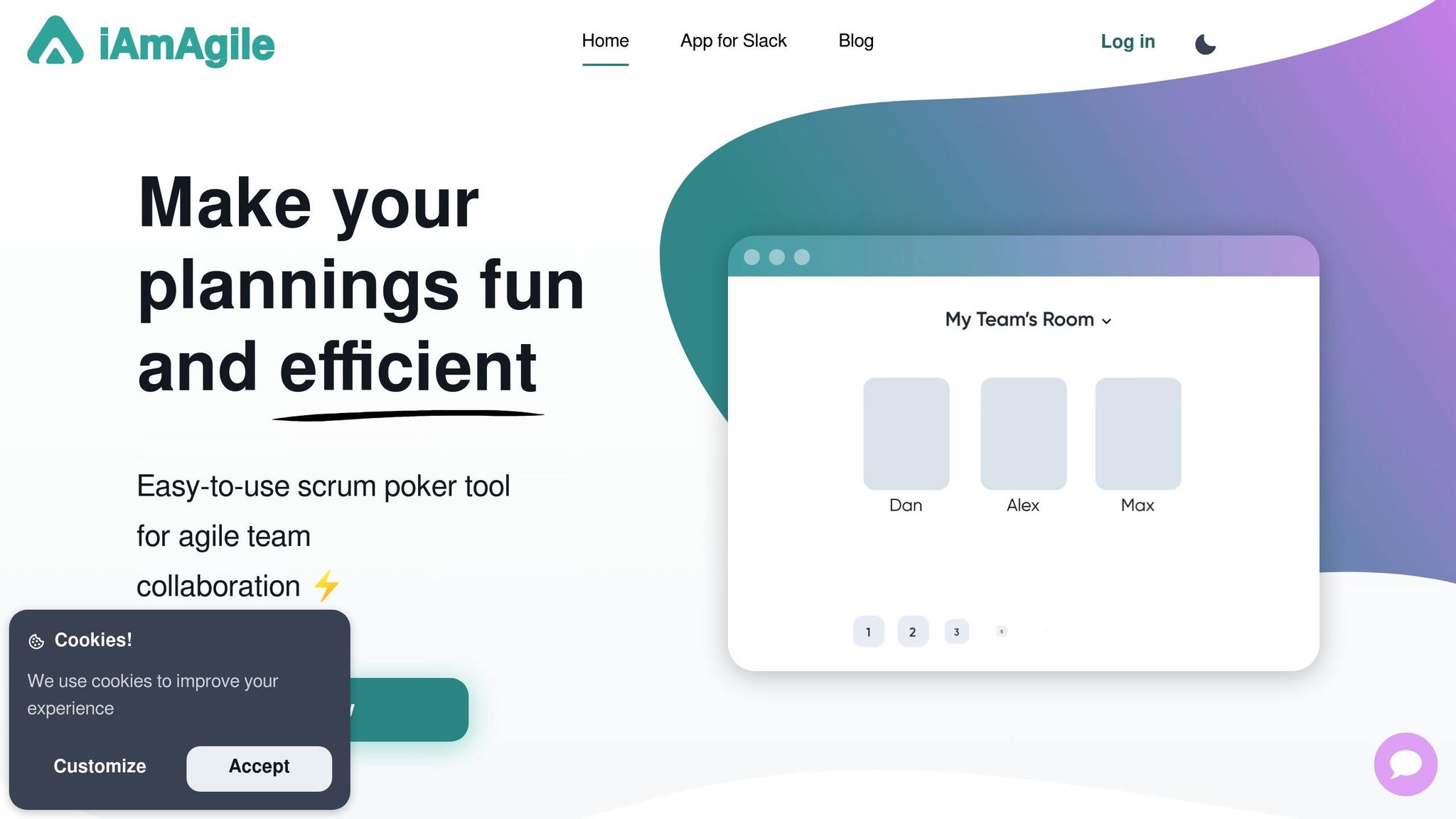
Specialized tools like iAmAgile's Scrum Poker build on these digital advantages to enhance the estimation process further. Designed specifically for agile teams, iAmAgile's Scrum Poker makes planning poker sessions interactive and collaborative, while staying true to the consensus-driven approach.
One standout feature is Slack integration, which allows teams to initiate estimation sessions directly within Slack channels. This eliminates the need to juggle multiple tools, as notifications and session updates appear where the team is already communicating, encouraging greater participation.
The tool's mobile accessibility ensures that all team members can join, whether they're working from home, commuting, or in between meetings. With smartphones or tablets, everyone can actively contribute, making it ideal for teams with diverse schedules and work arrangements.
Another key feature is the use of customizable voting scales. While some teams stick to the traditional Fibonacci sequence (1, 2, 3, 5, 8, 13), others may prefer custom scales based on their experience or the complexity of their projects. iAmAgile accommodates these preferences, allowing teams to tailor the tool to their specific needs.
The platform's interactive design keeps team members engaged throughout the session. Active participation through voting and discussion is essential for achieving the shared understanding that makes planning poker effective - not just for the current sprint, but for improving future estimates as teams align their perspectives.
For stories requiring in-depth discussion, iAmAgile provides a structured framework that ensures all voices are heard and captures the reasoning behind decisions. This approach benefits both seasoned teams with established dynamics and newer teams still building their collaborative foundation. By managing the mechanics of voting and card reveals, iAmAgile allows teams to focus on meaningful conversations, leading to more accurate estimates and stronger teamwork.
Conclusion
Pick the approach that aligns with your team’s goals and the current phase of your project. If you’re looking to organize qualitative data, set priorities, or establish strategic alignment, affinity grouping is your go-to method. On the other hand, if you need to estimate a refined backlog and build consensus, planning poker is a better fit.
Successful teams often combine these techniques, using affinity grouping for quick feature prioritization and planning poker for detailed, consensus-driven estimates. The choice comes down to your primary objective - whether it’s big-picture alignment or precise capacity planning. Consider your data type, project phase, and team needs to find the right balance.
Don’t hesitate to experiment. Trying both methods can help you uncover a workflow that suits your team’s unique dynamics. Hybrid approaches often work better than sticking rigidly to one method, especially when tailored to your team size, complexity, and collaboration style.
To make these processes smoother, tools like iAmAgile can turn estimation sessions into efficient and engaging discussions. With features like Slack integration, customizable voting scales, and mobile accessibility, iAmAgile handles the logistics, freeing your team to focus on meaningful conversations and accurate estimates. Whether your team is spread across time zones or working side-by-side, having the right tools can simplify your agile practices.
Ultimately, estimation is about fostering collaboration, alignment, and delivering value. As your team grows and evolves, so should your estimation process. Start with the method that addresses your current challenges, and adapt as your projects and team dynamics change.
FAQs
How can agile teams use Affinity Grouping and Planning Poker together to enhance task estimation?
In agile projects, Affinity Grouping and Planning Poker work well together to make task estimation smoother and more efficient. Start with Affinity Grouping to organize tasks into categories based on their complexity or size. This step helps the team quickly sort through tasks, spot patterns, and build a shared understanding of the workload.
After tasks are grouped, move on to Planning Poker to estimate each task. This interactive method brings the team together, encouraging collaboration and ensuring everyone’s perspective is included. By combining these approaches, teams can organize their work effectively, stay engaged, and reach estimates that reflect a shared agreement.
How do I decide between using Affinity Grouping and Planning Poker during a project?
When deciding between Affinity Grouping and Planning Poker, it’s all about understanding your project’s needs and how your team works together.
Affinity Grouping shines when you’re brainstorming, refining your backlog, or trying to make sense of a lot of ideas. It’s great for grouping related items, spotting patterns, and prioritizing tasks. This method encourages collaboration and helps your team uncover connections and themes within the data.
Planning Poker, on the other hand, is a go-to strategy for estimating the complexity and effort of tasks. It’s particularly useful during sprint planning sessions. With this approach, team members vote interactively to agree on estimates, making the process both engaging and efficient. Tools like Scrum poker can streamline this activity.
The choice comes down to your session’s purpose: if you need to sort and organize, Affinity Grouping is the way to go. If you’re focused on estimating and planning, Planning Poker will serve you better.
How can digital tools like iAmAgile improve the Planning Poker experience for remote or hybrid teams?
Digital tools like iAmAgile simplify and enhance the Planning Poker process, especially for remote or hybrid teams. With features like Slack integration for effortless communication, customizable voting scales to match your team’s preferences, and mobile access for on-the-go participation, everyone can stay involved no matter where they are.
These tools also bring an interactive and engaging twist to task estimation, keeping teams connected and productive, even when working apart.
Ready to improve your team's planning?
Put what you've learned into practice! Make your next planning session more engaging and accurate.
Try for free - no signup required