Agile Estimation for Cross-Functional Teams
Published Dec 22, 2025
⦁
15 min read

Agile Estimation for Cross-Functional Teams
Agile estimation helps teams predict effort, complexity, and risks for tasks without relying on fixed timeframes. Instead, it uses relative effort metrics like story points or T-shirt sizes. This collaborative approach involves all team members - developers, designers, QA, and more - to ensure diverse perspectives are considered, making planning more accurate and transparent.
Key takeaways:
- Relative estimation focuses on comparing tasks rather than assigning hours, reducing overcommitment and unrealistic expectations.
- Cross-functional teams bring varied expertise but may initially struggle with differing perspectives during estimation.
- Techniques like Planning Poker, Story Points, and T-shirt Sizing streamline the process and encourage team alignment.
- Effective estimation requires clear user stories, historical benchmarks, and regular refinement to improve accuracy over time.
Agile estimation isn’t about perfection - it’s about fostering collaboration and setting realistic goals for better sprint planning and delivery outcomes.
Agile Estimation Tips for scrum Teams
Core Principles of Agile Estimation
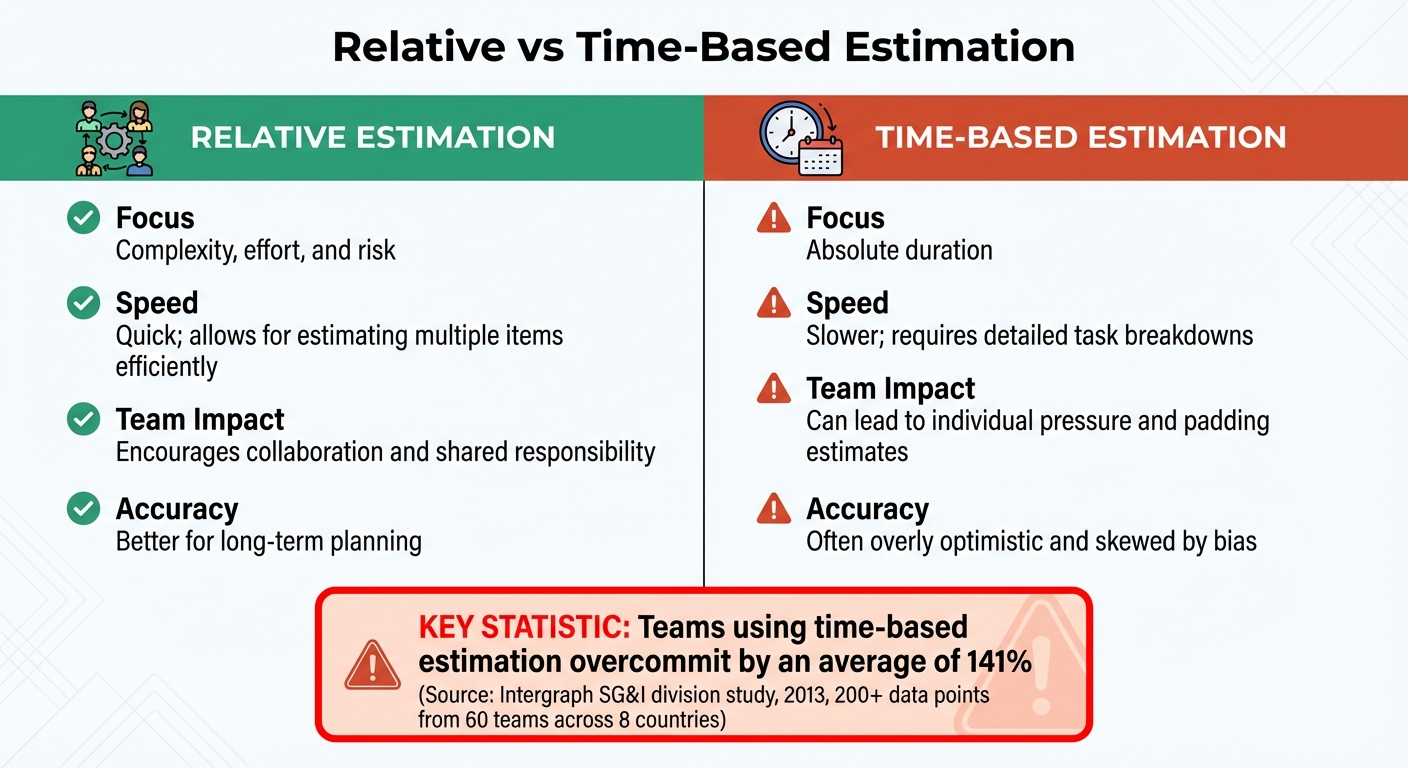
Relative vs Time-Based Estimation in Agile Teams
Agile estimation moves the focus away from estimating tasks in hours and instead emphasizes comparing tasks relative to one another. This approach helps teams estimate more quickly and consistently, fostering collaboration across all functions. Let’s dive into the core principles that make this method effective.
Relative Estimation vs. Time-Based Estimation
Relative estimation is all about comparing tasks rather than predicting exact durations. For instance, while a developer and a designer may take different amounts of time to complete their parts of a feature, they can still agree that one task is about twice as complex as another. This method uses abstract units like story points or T-shirt sizes to account for effort, complexity, and risk.
Time-based estimation, in contrast, relies on hours or days. While it might seem more precise, this method often leads to overcommitment. A study conducted in 2013 by Intergraph's SG&I division analyzed over 200 data points from 60 teams across 8 countries. They found that teams were overcommitting by an average of 141%. One reason? Teams were second-guessing their story point estimates, trying to convert them into hours during sprint planning. By refocusing on relative estimation and trusting the points system, the division saw a 7% reduction in overcommitment shortly after making the adjustment.
A key takeaway here is that teams should estimate the size of tasks first and then use historical velocity to forecast duration. This method avoids the "commitment trap", where estimates are mistaken for hard deadlines. It also ensures that everyone on the team - whether a developer, QA, or designer - can contribute to the process without the biases of fixed time metrics.
| Feature | Relative Estimation | Time-Based Estimation |
|---|---|---|
| Focus | Complexity, effort, and risk | Absolute duration |
| Speed | Quick; allows for estimating multiple items efficiently | Slower; requires detailed task breakdowns |
| Team Impact | Encourages collaboration and shared responsibility | Can lead to individual pressure and padding estimates |
| Accuracy | Better for long-term planning | Often overly optimistic and skewed by bias |
These differences highlight why relative estimation is better suited for agile teams, setting the stage for understanding the scales often used in this process.
Common Estimation Scales
Agile teams frequently use the Fibonacci sequence (1, 2, 3, 5, 8, 13, 20, 40, 100) for task estimation. This scale reflects the increasing uncertainty that comes with larger tasks. Data shows that tasks exceeding 5 points tend to have much greater variability in delivery times.
Another popular approach is T-shirt sizing (XS, S, M, L, XL), which works well for high-level planning when details are sparse. To use this effectively, teams should calibrate their estimates by agreeing on a baseline story that serves as a reference for future comparisons.
One critical rule: avoid converting points into hours. Creating fixed conversions like "1 point = 8 hours" undermines the purpose of relative estimation. As Hans Samios, Scrum Master at Intergraph, explains:
"Just because you cannot quantify risk in hours doesn't mean there is no risk".
Story points are designed to capture complexity and uncertainty - factors that linear time metrics simply can’t measure.
Requirements for Effective Estimation
For estimation to work well, teams need a few essential ingredients:
- Clear User Stories: Stories should have detailed acceptance criteria, often formalized through a Definition of Ready (DoR). This ensures everyone understands the task before estimating.
- Benchmark Stories: Having a few well-understood stories from past sprints helps teams calibrate their estimates for new tasks.
- Aligned Workflows: Estimation sessions should involve the entire cross-functional team. As Magne Jørgensen, Ph.D. at Simula Research Lab, puts it:
"The people most competent in solving the task should estimate it".
Without these elements - clear stories, reference points, and team alignment - estimation becomes little more than guesswork. To refine their process, teams should use sprint retrospectives to review completed tasks, comparing actual effort to estimates. This feedback loop helps improve accuracy over time.
Agile Estimation Techniques for Cross-Functional Teams
Agile estimation relies on relative estimation principles to help teams plan effectively, no matter their discipline. The following techniques cater to different stages of the planning process and the level of information available about upcoming tasks.
Planning Poker for Team Consensus
Planning Poker is a lively, team-oriented method where members use cards to assign story points to backlog items. Introduced in 2002 by James Grenning, this approach offers a faster and more engaging alternative to traditional estimation techniques.
Here’s how it works: team members reveal their estimates simultaneously to avoid "anchoring" - a bias where quieter or less experienced members are influenced by stronger voices. If estimates vary, the highest and lowest scorers explain their reasoning, sparking discussions that often uncover hidden complexities or risks specific to certain roles. The team then votes again until they reach a consensus.
Interestingly, a study published in ScienceDirect found that Planning Poker tends to produce higher and more accurate estimates than those made individually. For remote teams, tools like iAmAgile simplify the process with features like Slack integration and customizable voting scales, ensuring everyone can contribute - even on the go.
To keep the process efficient, appoint a moderator (usually the Product Owner or Scrum Master) to read the stories and clarify requirements without participating in the voting. Use an egg timer to limit discussion time, and avoid averaging scores - the real value lies in the conversation, not the arithmetic. If consensus remains elusive after several rounds, set the item aside until more information becomes available.
Next, let’s dive into how story points bring consistency to measuring effort across different roles.
Story Points for Measuring Effort Across Roles
Story points offer a shared framework for assessing effort across various disciplines. Unlike hours, which can vary depending on individual skills, story points evaluate the "bigness" of a task - factoring in complexity, uncertainty, and risk. This method shifts focus away from time and toward effort.
As Atlassian explains:
"Story points reward team members for solving problems based on difficulty, not time spent. This keeps team members focused on shipping value, not spending time."
By emphasizing effort over time, story points reduce emotional pressure. Estimating in hours or dates can feel like a binding commitment, often leading to inflated estimates and unnecessary stress. Relative estimation, on the other hand, encourages honest assessments.
To use story points effectively, involve all relevant roles in the discussion. Compare new stories to a completed "baseline" story to determine whether they are larger, smaller, or about the same size. Avoid the temptation to convert story points into hours (e.g., 1 point = 8 hours), as doing so undermines the method’s ability to account for uncertainty and complexity.
While story points provide detailed insights, T-Shirt Sizing offers a broader, high-level approach that’s perfect for early planning stages.
T-Shirt Sizing for High-Level Estimation
T-Shirt Sizing uses simple labels - XS, S, M, L, XL, XXL - to estimate effort and complexity when details are still vague. This technique works best during early discovery, roadmap creation, and release planning. Its straightforward scale allows diverse teams to quickly align on the size of a feature. T-Shirt Sizing is particularly useful for identifying large tasks (epics) that need further breakdown before sprint-level estimation.
To make the process even smoother, calibrate estimates using historical examples. For instance, agree on one completed task for each size (e.g., "Task X was a Medium"). Use silent voting to prevent dominant voices from skewing the results. If the team struggles to agree on a size after a few minutes, mark the item as "Uncertain" and plan a technical spike to gather more details.
As Parabol notes:
"T-shirt sizing excels at sparking team collaboration, creativity, and fun! It's ideal for new teams, large backlogs, or early-stage estimation."
Once tasks are more clearly defined, teams often transition to Story Points for sprint planning. T-Shirt Sizing helps with the big picture, while Story Points tackle the finer details.
How to Run Effective Estimation Sessions
Running an estimation session isn’t just about getting everyone together to assign numbers to tasks. To get useful results, you need preparation, structure, and a plan for handling disagreements that naturally arise when different perspectives come into play.
Preparing for Estimation
Preparation starts long before the team gathers to estimate. A well-refined backlog is key. The Product Owner should focus on prioritizing tasks, adding details to high-priority items, and clearing out anything irrelevant. As noted in The Scrum Guide 2020:
"Product Backlog refinement is the act of breaking down and further defining Product Backlog items into smaller more precise items. This is an ongoing activity to add details, such as a description, order, and size."
Large user stories should be broken into smaller, more manageable pieces. It’s also helpful for QA and development leads to review tasks ahead of time, adding technical insights or flagging dependencies.
To streamline the process, distribute the selected stories to the team in advance. This gives everyone time to review and align their understanding. Establishing reference stories - tasks from the past with agreed-upon estimates - can also help create a consistent baseline for comparison. For example, if the team agrees that "Task X was a 5", it provides a shared point of reference for evaluating new tasks. Finally, decide on your estimation method - like Planning Poker or T-Shirt Sizing - and the scoring scale (such as the Fibonacci sequence) before the session begins.
It’s worth noting that early in a project, estimates can vary widely, with an accuracy range of +/- 100%. The goal isn’t to nail down exact numbers but to build a shared understanding of relative effort.
Running the Estimation Session
Once prepared, it’s time to run the session. Start with a neutral facilitator - often the Scrum Master - who can guide the discussion without influencing the team’s estimates. The facilitator should read each story aloud, clarify any questions, and ensure everyone has a clear understanding of what’s being estimated.
To avoid anchoring bias, use anonymous voting. For remote or hybrid teams, tools like iAmAgile’s Slack integration with customizable voting scales can ensure everyone participates.
When the estimates vary significantly, focus on the outliers. Ask the individuals with the highest and lowest estimates to explain their reasoning. This often uncovers hidden complexities, technical risks, or assumptions that others might have missed. Keep discussions brief - 1 to 2 minutes per item is usually enough. If a story takes too long to estimate, consider refining or splitting it. If the team still can’t agree, re-vote, further split the story, or defer it until more information is available.
James Grenning, the creator of Planning Poker, offers this advice:
"If you can't get consensus, don't sweat it. It is only one story out of many. Defer the story, split it, or take the low estimate."
Consistency is also important. Scheduling estimation sessions at the same time and day every sprint ensures the team is available and prepared.
Handling Disagreements and Bias
Even with a well-structured session, disagreements are inevitable. These differences aren’t a problem - they’re a signal that a task may involve hidden complexities or risks. The key is to manage these discussions productively while avoiding common cognitive biases.
Anchoring bias, where early estimates influence the rest, can be avoided with anonymous voting. Groupthink, where team members suppress dissenting opinions to maintain harmony, can be countered by fostering psychological safety. As Sanjay Saini from Scrum.org explains:
"Psychological safety is the belief that one can speak up without risk of punishment or humiliation."
Encourage quieter team members or those with less experience to share their thoughts. Their perspectives can reveal risks or challenges that might otherwise go unnoticed.
Using historical data can help counter underestimation. Reviewing similar past tasks provides a reality check and prevents over-reliance on gut feelings. For tasks with high uncertainty, consider the Three-Point Method, which involves estimating optimistic (best-case), pessimistic (worst-case), and most likely scenarios to produce a more balanced estimate.
Avoid confirmation bias, which can lead teams to stick with initial estimates despite new information. Involving developers, testers, and designers in the session ensures a variety of viewpoints are considered.
Finally, keep sessions short. Schedule them when the team is alert - fatigue can lead to rushed or careless estimates. If discussions start to go in circles, table the item and revisit it later. Tackling biases together not only improves estimates but also strengthens the team’s collaboration and trust.
Using Estimates to Improve Project Outcomes
Once you've nailed down solid estimation practices, the real benefit comes from putting those estimates to work - whether it's planning your sprints, balancing team capacity, or fine-tuning your process over time.
Using Estimates in Sprint Planning
Sprint velocity - essentially the number of story points your team has completed in past sprints - forms the backbone of effective sprint planning. Instead of guessing how much work you can handle, rely on the "Yesterday's Weather" method: base your commitments on what your team actually delivered in recent sprints.
By averaging your velocity over the last three sprints, you set a realistic boundary for planning. If your historical velocity is lower than the points you’re planning, you risk overloading the team. Remember, story points aren’t about time - they measure complexity, effort, and risk. Your velocity helps translate these abstract measures into something practical. As Bryan Stallings, Chief Evangelist at Lucid, puts it:
"Estimation is not a static agreement but rather an evolving and ongoing conversation that's part of the work".
Use your velocity to check if your team has enough capacity to meet the sprint goals. But don’t fall into the trap of converting points into hours - it’s about effort and complexity, not clock time.
Now, let’s look at how estimates can help balance workloads across different roles.
Managing Dependencies and Role-Specific Capacity
After planning a realistic sprint, estimation data becomes a tool for balancing workloads and managing dependencies. In cross-functional teams, bottlenecks can arise when one role - like QA or design - gets overloaded while others have downtime. Estimates can highlight these imbalances early. During estimation sessions, note which roles are involved in each story. If a critical role is stretched too thin, consider breaking tasks into smaller pieces that can move forward independently.
Tracking cycle time - the amount of time a story spends "in progress" - can also reveal bottlenecks in specific roles . If certain tasks consistently take longer than expected, it could indicate a capacity issue. Address this by redistributing tasks, tweaking workflows, or even bringing in additional resources.
Using T-shirt sizing during backlog refinement is another way to flag oversized stories that might cause problems . Breaking these down prevents one story from hogging the capacity of a key role while others sit idle. The idea is to ensure that the "size" of a task accounts for everything - development, design, testing, and even architectural reviews .
Improving Estimation Over Time
As your team gains experience, your estimates naturally get better. Early on, you might see wide variations, but over time, historical data helps smooth things out. A great way to refine your estimates is by following the Plan-Do-Study-Act (PDSA) Cycle: estimate the work, complete it, review the actual effort, and apply those lessons moving forward.
During retrospectives, try "estimate vs. actual" reviews. Pick a few completed stories with the same point value and discuss whether they required a similar amount of effort. If there are big differences, dig into what might have been overlooked. This process helps the team better understand what each point value really represents.
Consistency is key. Keep using the same sizing scale throughout the project to maintain the accuracy of your velocity tracking. As Jessica Guistolise, Evangelist at Lucid, points out:
"Estimation metrics are a tool to help make decisions; they are not strict goals to meet".
Conclusion
Agile estimation isn’t about predicting the future with pinpoint precision - it’s about fostering a shared understanding within your team. When developers, designers, and QA professionals estimate together, they can uncover hidden dependencies, technical risks, and complexities that might otherwise go unnoticed.
Teams that use relative estimation techniques, like Planning Poker or T-shirt sizing, often see benefits such as improved prioritization, more manageable workloads, and better forecasting. In fact, research shows that Planning Poker not only leads to more accurate estimates but also reduces the time spent refining backlogs. These advantages translate to fewer surprises, less burnout, and more reliable delivery timelines.
It’s important to remember that estimates are tools - not hard commitments. Historical velocity can guide sprint planning, but flexibility is key as new insights emerge. As Jessica Guistolise from Lucid wisely notes:
"Estimation metrics are a tool to help make decisions; they are not strict goals to meet".
If your estimation sessions feel drawn out or inconsistent, tools like iAmAgile can help streamline the process. Its Scrum poker feature uses anonymous voting to reduce anchoring bias, integrates with Slack, and offers customizable voting scales. Plus, its mobile-friendly design allows your team to estimate anytime, anywhere, keeping sessions efficient and engaging.
The best way to start? Choose one collaborative technique, involve the whole team, and fine-tune the process as you go. Over time, consistent practice will lead to better estimates and more valuable sprints.
FAQs
How does relative estimation help agile teams work better together?
Relative estimation shifts the focus from calculating exact timelines to comparing tasks based on their effort and complexity. Instead of asking, "How long will this take?" the team considers, "How does this compare to something we've done before?" This method builds a shared understanding of task sizes and avoids drawn-out debates over precise durations. It also encourages the team to prioritize collaborative decision-making.
By using simple size labels like XS, S, M, L, and XL - or even Fibonacci numbers - teams can quickly find alignment through activities like planning poker. These discussions help uncover hidden assumptions, clarify dependencies, and ensure that everyone, from developers to product owners, is on the same page about the work ahead. The result? Better communication, stronger trust, and a deeper sense of shared responsibility for the backlog.
Tools such as iAmAgile make the estimation process engaging and interactive. Features like real-time voting, Slack integration for smooth discussions, and mobile access ensure that every team member can join in. By transforming estimation into a collaborative effort, teams not only create more accurate forecasts but also build stronger connections across roles.
What makes Planning Poker a better choice than traditional estimation methods?
Planning Poker brings several advantages compared to traditional estimation methods. By including the entire cross-functional team - developers, testers, designers, analysts, and the product owner - it ensures that estimates are built collaboratively and reflect a shared understanding. This approach minimizes the chances of hidden assumptions or biases influencing the process. Plus, the interactive and game-like structure keeps the sessions engaging, encourages open communication, and clears up uncertainties, resulting in estimates that are both accurate and practical.
This technique also promotes transparency and efficiency, helping teams align on the complexity and size of tasks while fostering a collective sense of ownership over the backlog. Whether your team is in the same room or working remotely, Planning Poker fits modern workflows effortlessly. For a simple and enjoyable way to run Planning Poker sessions, iAmAgile offers a digital tool packed with features like Slack integration, customizable voting scales, and mobile access to boost teamwork and simplify estimation.
How can cross-functional teams resolve disagreements during estimation sessions?
When disagreements pop up during estimation sessions, it’s a good idea to hit pause and dig into the reasons behind the differing opinions. A facilitator - like a Scrum Master or Product Owner - can steer the conversation by encouraging team members to share their perspectives. Referring to agreed-upon examples or reference stories often helps uncover potential knowledge gaps, such as hidden technical risks or business-related dependencies, that could be affecting the estimates.
If the team still finds it hard to align, a consensus-building method like Planning Poker can be a game-changer. Here’s how it works: each team member privately selects an estimate, everyone reveals their choice at the same time, and the team discusses any major differences. This cycle continues until a shared agreement is reached. Tools like iAmAgile simplify the process, offering features like anonymous voting, Slack integration for real-time discussions, and customizable scales to suit the team’s preferences. By encouraging open conversations and iterative collaboration, teams can transform disagreements into learning moments and produce more accurate estimates.
Ready to improve your team's planning?
Put what you've learned into practice! Make your next planning session more engaging and accurate.
Try for free - no signup required