Dependency Mapping: A Guide for Agile Teams
Published Dec 29, 2025
⦁
11 min read

Dependency Mapping: A Guide for Agile Teams
Dependency mapping helps Agile teams spot task relationships and potential blockers early, ensuring smoother sprint planning and delivery. It visually lays out how tasks, teams, and systems depend on one another, enabling better coordination and more accurate estimation. Here's what you need to know:
- What it is: A method to map task dependencies, showing which tasks must happen in sequence or can run in parallel.
- Why it matters: Dependencies increase delays. Mapping them helps reduce risks, improve planning, and avoid surprises mid-sprint.
- Key types of dependencies:
- Internal: Within the team (e.g., waiting for a teammate's input).
- External: Outside the team (e.g., vendor approvals, third-party APIs).
- Mandatory: Non-negotiable sequences (e.g., backend before frontend).
- Discretionary: Flexible sequences based on best practices.
- How it helps estimation: Accounts for constraints like availability and external timelines, leading to more realistic task durations.
- Tools and techniques: Use visual maps, red string diagrams, or software tools to track dependencies during backlog refinement, sprint planning, and retrospectives.
Dependency mapping empowers teams to plan better, manage risks, and deliver on time by addressing bottlenecks before they disrupt progress.
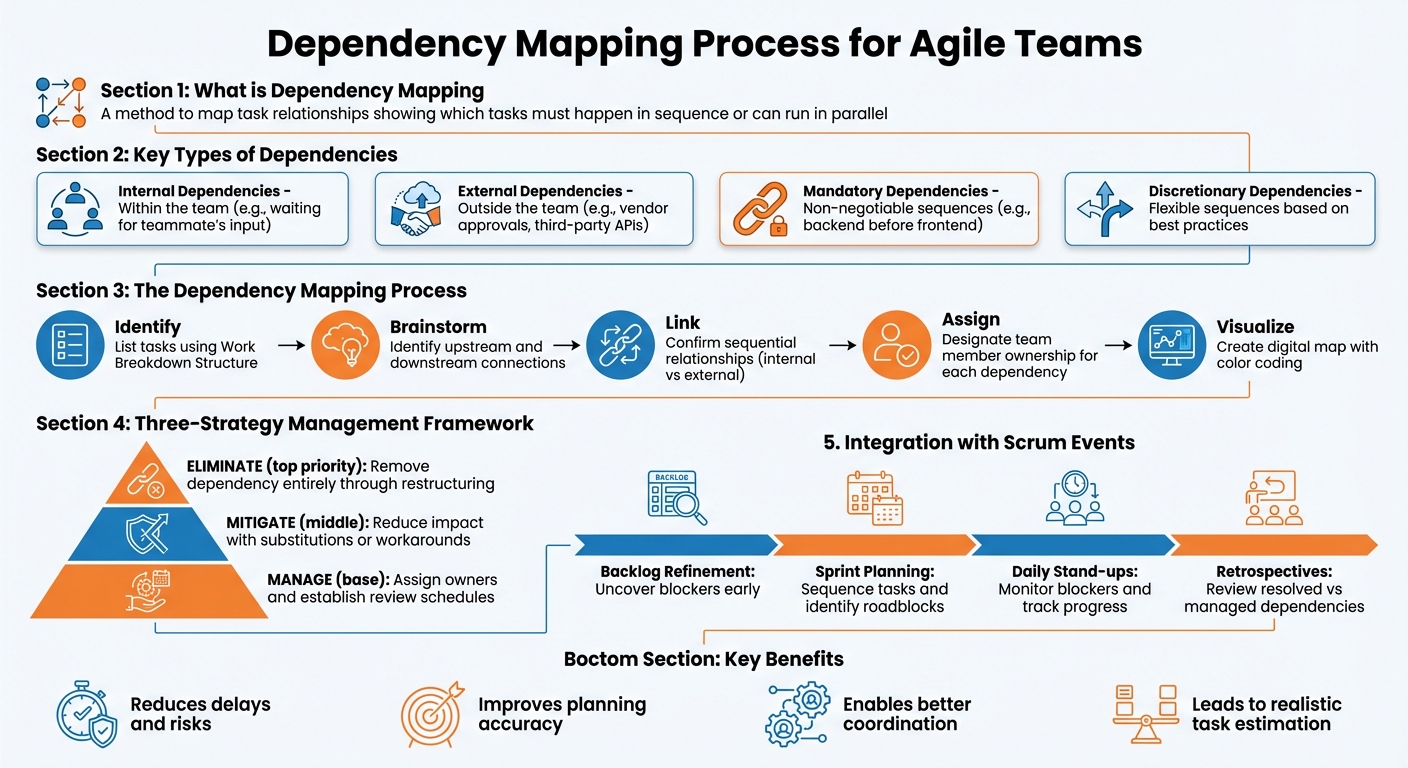
Dependency Mapping Process: From Identification to Management
Types of Dependencies in Agile Projects
Main Dependency Categories
In Agile projects, dependencies generally fall into two main categories: internal and external. Internal dependencies happen within your team. For instance, a writer might need to wait for the editor on the same team to review their work before moving forward. On the other hand, external dependencies involve elements outside your team's control, like third-party vendors, other departments, or even government approvals.
Dependencies can also be classified based on their nature. Mandatory dependencies, often called "hard logic", are non-negotiable and follow a strict sequence. For example, you can't paint walls before constructing them. Discretionary dependencies, or "soft logic", are more flexible and based on best practices. While it’s recommended to paint walls before moving furniture in, this sequence can be adjusted if needed.
Other types include technical dependencies, which arise from system architecture, such as a microservice needing a specific API to function. Business process dependencies are tied to organizational workflows, like needing loan approval before starting construction. Lastly, there are expertise dependencies, which create bottlenecks when a task requires a specific expert who might not be available.
"Dependencies are not inherently bad; in fact, they can be beneficial... But not all dependencies are necessary." - IBM
By understanding these categories, teams can determine which dependencies to eliminate, which to address through architectural changes, and which to manage through better collaboration.
Where Dependencies Show Up in Agile Work
Dependencies can appear across various Agile artifacts. For example, they often emerge in the Product Backlog during refinement sessions, the Sprint Backlog during planning, and within technical elements like APIs or database structures. In scaled Agile environments, tools like the SAFe Program Board help track cross-team dependencies effectively.
Modern development practices have added new layers of complexity to managing dependencies. For example, microservices architecture creates interconnections between independent services communicating via APIs. Cloud computing introduces dependencies between on-premises systems and public cloud services, while open-source development brings reliance on third-party updates. These dynamics highlight the importance of identifying dependencies early to streamline sprint planning and improve delivery timelines. Spotting where dependencies exist is the first step toward managing them effectively.
How to Identify Dependencies Before Sprint Planning
Best Times to Identify Dependencies
The earlier you identify dependencies, the better. During backlog refinement, using the INVEST mnemonic can help uncover blockers before the sprint even begins. Sprint planning then takes it a step further by organizing tasks and identifying any immediate roadblocks. In scaled Agile frameworks, PI (Program Increment) planning provides a structured way for multiple teams to align and create dependency boards, ensuring everyone is on the same page. Catching these issues early keeps sprints on track and improves planning accuracy.
Methods for Finding Dependencies
There are several ways to spot dependencies ahead of time. One method is system impact brainstorming, where the team identifies all upstream and downstream systems that might influence or be influenced by their work. Documenting details like system owners, types of impacts, and specific descriptions ensures nothing gets overlooked.
Visual mapping is another powerful tool. By drawing arrows on a shared canvas - physical or digital - teams can clearly see how tasks connect. A popular technique is the "red string visualization", which uses red lines (real or virtual) to link tasks, making dependencies easy to spot. Additionally, backlog tools that support parent-child relationships can establish hierarchical links between related items for better clarity.
For more complex scenarios, teams can use time-boxed dependency spikes to explore ways to either eliminate or reduce dependencies. Sharing pre-filled dependency worksheets or templates before planning sessions also helps team members come prepared with potential risks already identified. These approaches make it easier to transition into managing cross-team dependencies effectively.
Working with Other Teams on Shared Dependencies
Shared dependencies between teams can slow down delivery, as each added dependency limits task sequencing options and increases the risk of delays. That’s why strong coordination is non-negotiable.
One effective approach is to assign cross-team ambassadors. These representatives act as liaisons between teams, attending "Scrum of Scrums" meetings or even joining other teams' daily standups to ensure alignment and clear communication.
"A dependency is a potential impediment. Some dependencies have an amazing power to consistently crush a team's ability to deliver."
For external dependencies, it’s crucial not to include a Product Backlog Item in a sprint unless the external contributor has committed to delivering their part within the sprint timeframe. If another team’s work is causing delays, consider using inner sourcing - make the necessary changes yourself and submit a pull request to speed things up.
To manage shared dependencies effectively, set up regular feedback loops, assign clear ownership for tasks, and build buffer time into your sprints. These steps help reduce risks and ensure smoother collaboration across teams.
How to Create and Maintain Dependency Maps
What a Dependency Map Includes
Once you've identified dependencies, the next step is to create a visual map to manage them effectively. A dependency map lays out tasks, user stories, or components as nodes connected by arrows that illustrate the workflow. Typically, the arrow points from the predecessor to the successor, making it clear which task needs to be completed first.
To make this map useful, include the standard dependency types:
- Finish-to-Start: Task B can't start until Task A is finished.
- Start-to-Start: Task B can begin once Task A has started.
- Finish-to-Finish: Task B can't be completed until Task A is done.
- Start-to-Finish: Task B can't finish until Task A has started.
Adding color coding can enhance clarity - use one color for internal dependencies and another for external ones. If specific stakeholder groups are involved, assign additional colors for better distinction. Each dependency should include essential details like ownership, a description of its impact, and a risk level (High, Medium, or Low).
Common Formats for Dependency Maps
The format you choose for your dependency map should align with your team's needs and workflows. Here are some popular options:
- Network Diagrams: Great for visualizing complex task flows and identifying critical paths. However, they require frequent updates as relationships between tasks evolve.
- Kanban Boards: Perfect for tracking real-time progress and blockers during a sprint. These are often updated during daily stand-ups.
- Gantt Charts: Useful for seeing tasks in chronological order and understanding timeline impacts.
- Dependency Matrices: Ideal for managing cross-team coordination in larger projects. These are particularly effective when reviewed during planning sessions.
Pick a format that matches your team's review and planning rhythms to ensure the map remains practical and relevant.
"Dependency mapping is a simple visual technique where you identify the tasks involved in a project and determine how they depend and relate to each other."
- Amanda Athuraliya, Communications Specialist, Creately
Steps to Build and Update Your Dependency Map
Start by listing tasks using a Work Breakdown Structure. Then, brainstorm how each system impacts others by identifying upstream and downstream connections. Link tasks by confirming their sequential relationships, and classify each one as either internal or external. Assign ownership by designating a team member responsible for managing or mitigating each dependency. Finally, bring it all together in a digital tool, applying your color codes to make the map easy to interpret.
To keep your dependency map up to date, make it a regular part of your Scrum ceremonies. During Sprint Planning, use the map to sequence work accurately. In Retrospectives, review it to identify recurring challenges. Daily stand-ups are a great time to monitor blockers and external dependencies. Many Agile teams now rely on digital tools for mapping, which helps reduce manual errors. Set a consistent schedule - weekly, monthly, or quarterly - to review and share updates with stakeholders, ensuring the map stays a dynamic and useful resource.
Using Dependency Maps in Sprint Planning
Adding Dependency Maps to Scrum Events
Integrating dependency maps into Scrum events can make them far more effective. For instance, during Sprint Planning, these maps help sequence tasks in a logical order - focusing first on those that unblock high-priority features. This ensures your team doesn’t commit to tasks that can’t begin due to unresolved dependencies. In Daily Stand-ups, the map becomes a tool to track progress and quickly identify new blockers. When it’s time for Retrospectives, you can review which dependencies were resolved versus merely managed, and spot recurring issues that might indicate deeper organizational challenges.
Typically, a dependency mapping session lasts around 60 minutes and works well with groups of 2 to 12 people. Once the map is in place, the next step is actively managing those dependencies.
How to Manage Dependencies
Managing dependencies effectively involves a three-step approach:
- Eliminate: Whenever possible, remove the dependency altogether. This might involve restructuring teams or breaking down work into smaller, self-contained tasks.
- Mitigate: If eliminating the dependency isn’t feasible, reduce its impact. This could mean substituting it with a less critical relationship or introducing a temporary architectural workaround.
- Manage: For dependencies that can’t be avoided, assign clear ownership and establish a regular review schedule - weekly or monthly - to ensure they stay on track.
For particularly tricky dependencies, consider running a spike - a time-boxed effort to prototype solutions or research ways to break down the work. It’s also wise to build buffer time into your sprint planning to handle delays caused by external dependencies. Additionally, marking blockers on Kanban boards makes these challenges visible to everyone involved.
| Strategy | Action | Goal |
|---|---|---|
| Eliminate | Restructure teams or break work into smaller units | Remove the dependency entirely |
| Mitigate | Substitute or implement temporary solutions | Reduce the dependency's impact or risk |
| Manage | Assign owners, set review schedules, and use Kanban boards | Keep the dependency from derailing timelines |
Dependency Mapping and Task Estimation
Once dependencies are mapped and addressed, teams can refine their task estimates with greater accuracy. Visualizing dependencies clarifies hand-offs and external reliance, helping teams avoid over-committing to tasks that might face delays. This clarity also improves capacity planning by accounting for the availability of subject matter experts and external delivery timelines.
Dependency maps can also reveal if too many tasks rely on a single team member, helping to prevent over-allocation and ensuring commitments are achievable. By addressing dependencies early in the sprint, teams can create realistic timelines. During sprint planning, tools like iAmAgile allow for collaborative estimation that incorporates dependency insights. These tools, often mobile-friendly, let teams reference dependency maps in real time, enabling accurate commitments - even when working remotely.
"You can't eliminate, mitigate, or manage what you don't understand in the first place - which is where dependency mapping comes in."
Dependency Mapping with Chris Sims and Season Hughes
Conclusion: Why Dependency Mapping Matters for Agile Teams
Dependency mapping simplifies the way Agile teams plan, estimate, and deliver by making task relationships visible. This clarity helps teams better manage complex projects and boosts predictability. As Brook Appelbaum, Director of Product Marketing at Planview, puts it:
"The goal of any Agile organization isn't to completely eliminate all dependencies, but to... create better systems for dependency management that mitigate the disruption they cause".
By mapping dependencies early, teams can identify the critical path - the sequence of tasks that dictates the shortest possible project timeline. This ensures high-priority work doesn’t get stuck due to missed blockers. The result? Less idle time and fewer delays caused by dependency issues. It also helps teams pinpoint potential single points of failure before they become major problems.
Dependency maps also strengthen cross-team collaboration by providing a shared understanding of how one team’s work affects others. This is particularly important in scaled Agile environments, where multiple teams need to align their efforts. A clear map of dependencies creates a shared foundation, making task estimation more precise and coordination smoother.
Accurate estimation benefits directly from this awareness. When teams recognize hand-offs and external constraints, they can avoid overpromising on tasks that might face delays. Tools like iAmAgile make this process easier by enabling collaborative estimation sessions, where dependency insights are factored in real time - even for remote teams. This approach leads to commitments that are realistic and well-informed, accounting for the bigger picture.
FAQs
How does dependency mapping help Agile teams plan sprints more effectively?
Dependency mapping gives Agile teams a clear, visual way to understand how tasks, stories, and external work items connect. This clarity helps teams spot bottlenecks, identify critical paths, and recognize prerequisites. As a result, work can be sequenced logically, and potential blockers are addressed early. By grasping these connections, teams can prioritize tasks more effectively and approach sprint planning with greater confidence.
When it’s time for sprint planning, a dependency map becomes a valuable collaborative tool. It helps teams decide which tasks should go into the sprint, which can be postponed, and where coordination with other teams might be necessary. This level of transparency also leads to better task estimation. Clear dependencies make it easier to assess effort and capacity accurately. When combined with tools like iAmAgile’s Scrum poker, teams can collaboratively refine their estimates, considering not just the effort involved but also how dependencies might affect the work.
What are the best tools for creating dependency maps in Agile workflows?
Creating dependency maps that work well within Agile workflows becomes much simpler with the right visual tools. Many platforms now offer features designed to help teams spot and manage dependencies more effectively. For instance, tools with drag-and-drop interfaces, color-coded connections, and real-time syncing with issue trackers like Jira can make it easier to see and address blockers or risks as they arise.
Some of these tools also come with pre-built templates for dependency mapping, which can save time and simplify the process. These templates often include collaborative features, allowing teams to align and adjust their plans more efficiently during sprint planning or program increment (PI) sessions. Choosing tools that integrate smoothly with your existing workflows ensures that your dependency maps stay current and useful throughout the Agile process.
How can dependency maps help agile teams manage task bottlenecks?
Dependency maps offer a straightforward way to visualize how tasks are connected, helping teams spot delays caused by dependencies. By identifying these bottlenecks, teams can take action - whether it's shifting priorities, redistributing resources, or tweaking timelines.
This method boosts workflow efficiency and makes sprint planning smoother by tackling potential issues early, ensuring the team stays focused and on schedule.
Ready to improve your team's planning?
Put what you've learned into practice! Make your next planning session more engaging and accurate.
Try for free - no signup required