How to Keep Daily Standups Under 15 Minutes
Published Dec 15, 2025
⦁
10 min read
How to Keep Daily Standups Under 15 Minutes
Want to make your daily standups shorter and more effective? Here’s the key: keep them focused, structured, and disciplined. The goal of a standup is simple - sync up on progress, identify blockers, and plan the day ahead. To stick to the 15-minute limit, follow these tips:
- Set clear goals: Share updates, flag blockers, and avoid problem-solving during the meeting.
- Stick to a format: Use one method (e.g., three questions, walking the board) and follow it consistently.
- Avoid derailers: Use a “parking lot” for off-topic discussions and save them for later.
- Use timeboxing: Allocate 30–90 seconds per person and enforce the time limit with a visible timer.
- Prepare in advance: Team members should review their tasks and blockers before the meeting.
- Leverage visual tools: Shared boards like Kanban keep updates concise and on track.
Key takeaway: A well-run standup is about alignment, not lengthy updates. With structure, preparation, and time management, you can keep these meetings under 15 minutes while improving team productivity.
Master Daily Stand-Ups: Run Effective Scrum Meetings in 15 Minutes
Set Clear Goals and Ground Rules
When a standup meeting lacks a clear purpose, it often drags on longer than necessary. Every team member should know the meeting’s primary focus: aligning on progress toward the sprint goal, identifying blockers, and planning the next 24 hours. It’s not meant to be a status report or a problem-solving session.
Define the Purpose of Your Standup
The standup’s purpose is simple: share updates, flag blockers, and outline the day ahead. Problem-solving and in-depth discussions should happen outside of this time. Many teams stick to the tried-and-true three-question format:
- What did you accomplish yesterday?
- What are you working on today?
- Do you have any blockers?
Let’s do the math: if each team member takes about 30 seconds to respond, an eight-person team can wrap up in under 15 minutes. With this clear purpose in mind, setting rules can help maintain focus and efficiency.
Set Ground Rules for Efficiency
Ground rules are essential for keeping standups short and effective. Start on time, every time. Encourage team members to keep their updates to 1–2 minutes and steer clear of side conversations. If you’re meeting in person, standing up can naturally encourage brevity. And holding the meeting at the same time every day helps establish a routine. For distributed teams, it’s important to coordinate a time that works across overlapping time zones.
Use a Parking Lot for Follow-Up Topics
A “parking lot” is a handy way to prevent the meeting from getting derailed. It’s essentially a list - on a whiteboard, sticky notes, or a digital tool - for capturing topics that require deeper discussion. If a subject comes up that takes more than a minute to explain, jot it down and move on. Assign follow-ups right after the standup. Teams using this method often report significant time savings. For example, some have reduced their standup durations from 25 minutes to just 12 by parking about 30% of the discussions for later.
Choose a Standup Format That Works
Comparison of Daily Standup Meeting Formats
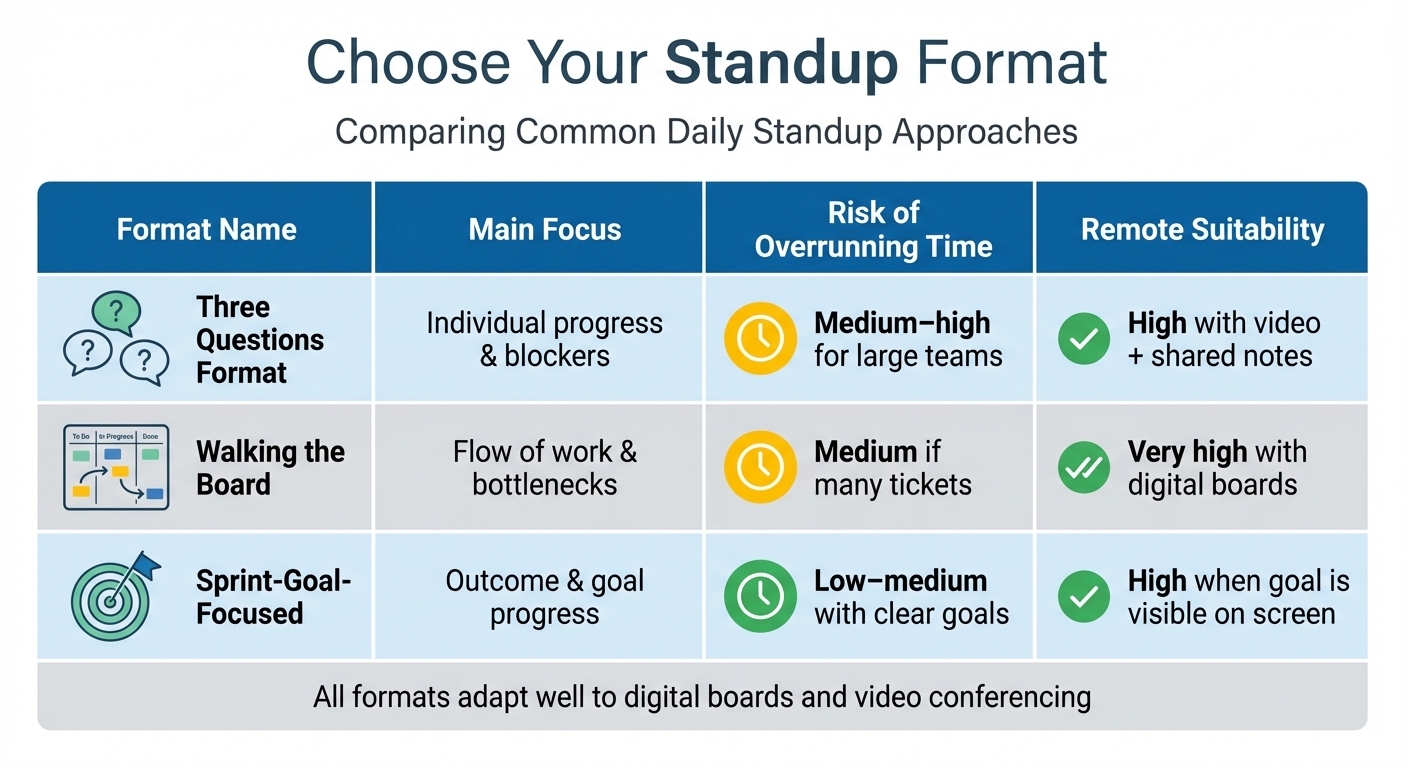
Standups aren’t one-size-fits-all. The format you pick shapes how updates are shared and ensures discussions stay quick and focused. The three-questions format has everyone answer: "What did I do yesterday?", "What will I do today?", and "What blockers do I have?" in a round-robin style. Walking the board shifts focus to the Kanban board itself, reviewing tasks in each column instead of spotlighting individuals. Meanwhile, a sprint-goal-focused format starts with the sprint goal and highlights only the work that directly contributes to achieving that goal.
Compare Common Standup Formats
Each format has its strengths and challenges. The three-questions approach is straightforward but can feel like a status update if the team isn’t disciplined - this is especially true for larger teams. Walking the board keeps attention on workflow and bottlenecks, though it can drag if the board is cluttered or poorly maintained. Sprint-goal-focused standups align updates with outcomes, but they rely on having a clear, measurable goal and a skilled facilitator to avoid slipping into task-by-task updates.
| Format | Main focus | Risk of overrunning time | Remote suitability |
|---|---|---|---|
| Three questions | Individual progress & blockers | Medium–high for large teams | High with video + shared notes |
| Walking the board | Flow of work & bottlenecks | Medium if many tickets | Very high with digital boards |
| Sprint-goal-focused | Outcome & goal progress | Low–medium with clear goals | High when goal is visible on screen |
All formats adapt well to digital boards and video conferencing setups.
Pick One Format and Stick to It
Consistency is key to saving time. When the team uses the same format daily, everyone knows what to prepare and how much time they have to speak. A good approach is to try one format for two weeks, ensuring standups stay under 15 minutes. Use a retrospective to ask: "Did this make our mornings smoother?" and "What slowed us down?". Once the team agrees on a format, document it as the default - same time, same platform, same agenda. Any changes should be intentional and discussed during retrospectives, not decided on the fly in the middle of a standup.
A consistent format naturally supports better visual management.
Use Visual Tools Like Kanban Boards
Pairing a consistent standup format with visual tools keeps discussions grounded in work items. Tools like Kanban boards provide a shared focus point, helping the team stay on track and avoid unrelated tangents. Whether displayed on a large screen in a meeting room or screen-shared for remote teams, the board allows the facilitator to move from left to right, focusing on stalled or high-priority tasks while skipping items that are progressing smoothly.
Digital boards also cut down on unnecessary verbal updates by showing real-time status. Features like filters for "Today" or "Blocked" items help facilitators zero in on what matters most, while swimlanes - grouping tasks by priority or owner - ensure the team addresses critical work first. For distributed teams, having everything on a shared board ensures that even those working asynchronously or in different time zones can review what was discussed.
Apply Timeboxing and Facilitation Techniques
Once you've established your format and chosen your visual tools, the next step is managing time effectively. Without a clear plan, standups can easily stretch beyond the intended 15 minutes. Timeboxing is a simple yet effective approach: set a 15-minute limit and allocate 30–90 seconds per team member. For example, in a seven-member U.S. team, you could dedicate 1 minute to the meeting goal, 7–10 minutes for updates, 2–3 minutes for parked topics, and 1 minute for wrap-up. Sticking to this structure consistently trains team members to be concise and focused.
Use a Timer to Enforce Time Limits
A visible countdown timer can help everyone stay aware of the time. Start the timer as soon as the standup begins and make sure it’s easy to see - whether it’s displayed on a TV screen in a conference room or shared via digital meeting tools for remote teams. When the timer hits zero, the meeting ends. This reinforces punctuality and keeps discussions from running over. For remote teams, lightweight web timers or built-in features in meeting platforms work well. For in-person meetings, a phone timer on speaker or a wall-mounted option gets the job done.
How the Scrum Master Keeps Things on Track
The Scrum Master - or whoever facilitates the meeting - plays a critical role in maintaining the timebox. They start the meeting on time, even if some team members are late, and remind everyone that the goal is to keep the session under 15 minutes. Their job is to ensure the focus stays on syncing up, identifying blockers, and planning the day. If someone goes over their allotted time, the Scrum Master steps in, saying something like, “Let’s park that for later,” and moves the discussion forward. They also encourage team members to address the group rather than directing updates solely to the facilitator. Additionally, they ensure blockers are clearly identified and assigned for follow-up after the standup.
Have Team Members Prepare in Advance
Preparation is key to keeping standups efficient. Team members should review their sprint board, progress, and tasks for the day before the meeting. This allows them to deliver a quick and clear update. A simple format could be: “Yesterday I completed X and moved Y to done; today I’ll work on Z and collaborate with A; my blockers are B and C, and I need help from D.” Tools like Jira, Trello, or Asana make it easy to update statuses and flag blockers ahead of time. With practice, this preparation helps everyone shift from lengthy explanations to concise summaries, keeping updates under a minute. This habit not only keeps standups short but also fosters continuous improvement over time.
Avoid Common Problems That Waste Time
Even with a structured format and timeboxing, standups can sometimes veer off track. To keep things on point, steer clear of problem-solving, lengthy status updates, unrelated discussions, and multitasking.
Identify and Stop Common Derailers
Keep an eye out for signs that the meeting is losing focus: someone talking for more than two or three minutes, screen sharing code or documents, debates over design details, or extended discussions involving only a few team members. When this happens, the facilitator should step in, note that the discussion has drifted, and add the topic to a "parking lot" for follow-up after the standup. This keeps the meeting focused while ensuring important topics aren't ignored.
For remote or hybrid teams, set clear expectations: turn on cameras, mute when not speaking, and avoid distractions like checking email or Slack. Stick to a fixed or rotating speaking order and enforce strict start and end times. By addressing these common pitfalls, standups can stay productive and efficient.
Get Feedback and Improve Regularly
In your sprint retrospectives, include time to evaluate how well the standups are working. Look at metrics like average meeting duration, how often topics are parked for follow-up, late starts, and whether anyone runs out of time to speak. Use simple feedback methods - like quick signals or direct questions - to identify time-wasters and suggest improvements.
From there, try small adjustments, such as limiting speaking time, changing the order of speakers, or experimenting with a different format. Review the results in the next retrospective. This approach aligns with Scrum's inspect-and-adapt principle, helping the team fine-tune the process over time.
Use Agile Tools to Support Your Standups
Agile tools can help keep your standups focused and clear. Well-maintained boards and concise stories save time. For example, when team members refer directly to the board - saying something like, "I’m working on card ABC-123 and moving it to 'In Review' today" - updates stay brief and relevant. Ensure boards are updated daily, enforce WIP (Work In Progress) limits, and keep story details clear.
Using tools like iAmAgile during refinement sessions can also improve standups. These tools help teams create better-sized, more precise stories, reducing confusion mid-sprint. With better estimations, sprint plans become more realistic, cutting down on in-meeting negotiations over scope and priorities. The result? Standups become quick check-ins on progress and blockers, rather than drawn-out planning sessions.
Conclusion
By focusing on clear goals, structured formats, and effective time management, your daily standups can become a powerful tool for team alignment. Keeping these meetings under 15 minutes isn’t about rushing through updates - it’s about maintaining clarity, structure, and discipline. Define the standup’s purpose upfront: synchronize efforts, identify blockers, and plan for the next 24 hours. Stick to a consistent format and use timeboxing to ensure discussions stay on track, with a visible timer and active facilitation to guide the process. Any deeper conversations can be moved to a "parking lot" for later.
Using digital boards and tools like iAmAgile can simplify updates and story refinement, helping standups stay focused on progress. These tools promote a culture of efficiency and make it easier to stick to the meeting’s purpose.
Effective standups bring real benefits. They enhance transparency, speed up problem-solving, and keep the team aligned without wasting time. When done consistently - same time, same format, and always within the 15-minute limit - they boost collaboration, improve sprint velocity, and reduce meeting fatigue. A clear sprint plan and well-sized stories make these quick check-ins energizing and productive.
To ensure your standups remain effective, monitor their duration, gather team feedback, and make adjustments based on insights from retrospectives. Even small changes, like limiting individual speaking time, can lead to noticeable improvements. With the right strategies, standups can become a cornerstone of your team’s productivity and success.
FAQs
How can we address complex topics during standups without going over the 15-minute limit?
To keep standups short and to the point - ideally within 15 minutes - acknowledge any complicated issues that come up but set them aside for a separate follow-up discussion. This way, the meeting stays on track without ignoring important matters that need more time.
Ask team members to stick to essential updates during the standup. Save detailed problem-solving or deep dives for dedicated sessions later. This keeps the meeting focused and ensures everyone stays aligned without unnecessary delays.
How can we make sure everyone is ready for the daily standup?
To make daily standups run smoothly, start by sending out a clear agenda beforehand. This gives everyone a heads-up on what will be discussed and helps them come prepared. Encourage team members to review their tasks and updates in advance - it can save valuable time during the meeting. Leveraging collaborative tools is another smart move to keep everything organized and ensure everyone stays on the same page. These simple steps can help keep your standups focused and productive.
What’s the best way to choose a standup format that fits our team?
The ideal standup format is one that keeps your team both engaged and focused. To achieve this, consider interactive approaches like planning poker - a method that makes discussions not only more dynamic but also enjoyable. Depending on your team’s comfort level with estimation methods, you can use scales such as Fibonacci sequences or T-shirt sizes to match their preferences.
For added efficiency, incorporate tools that promote collaboration and seamlessly integrate into your team’s workflow. This helps ensure your standups stay productive, efficient, and tailored to the way your team operates best.
Ready to improve your team's planning?
Put what you've learned into practice! Make your next planning session more engaging and accurate.
Try for free - no signup required