How Integrated Tools Improve Agile Estimation
Published Jun 22, 2026
⦁
9 min read
How Integrated Tools Improve Agile Estimation
If your team estimates in one place and tracks work in another, you create extra steps, more errors, and weaker forecasts. I’d fix that by using one shared scale, one set of team rules, Slack-based voting, and an automatic sync to Jira or your delivery tool.
Here’s the short version:
- I use one estimation scale for every Sprint, such as Fibonacci or T-shirt sizes.
- I set clear team rules for ready, done, who votes, when sessions happen, and when to split stories.
- I run blind Scrum poker in Slack so remote and in-office teammates see the same discussion and votes.
- I send the final estimate straight into Jira to cut manual entry.
- I review velocity, throughput, cycle time by story size, forecast accuracy, and estimate variance on a set cadence.
- I use retrospectives to compare estimates with delivery results and tune the team’s sizing rules.
A few facts stand out. The article points to manual copy-and-paste as a source of mistakes, and it shows how a single Slack thread keeps the voting history and discussion in one place. It also names a simple rule for disagreement: if votes are far apart and the team still can’t agree after 5 minutes, park the story and move on.
This means the main idea is simple: put estimation, discussion, and record-keeping in one workflow, then use delivery data to improve the next Sprint.
| Area | What I’d do | Why it helps |
|---|---|---|
| Estimation scale | Pick one scale and stick to it | Stops mixed scoring |
| Team rules | Write down voting and splitting rules | Cuts confusion |
| Session flow | Run poker in Slack threads | Keeps context in one place |
| Record of estimate | Sync final points to Jira | Removes manual updates |
| Review cycle | Check planning metrics every Sprint, monthly, or quarterly | Keeps forecasts tied to shipped work |
Below, I’d break down how that workflow works and what to watch once the data starts coming in.
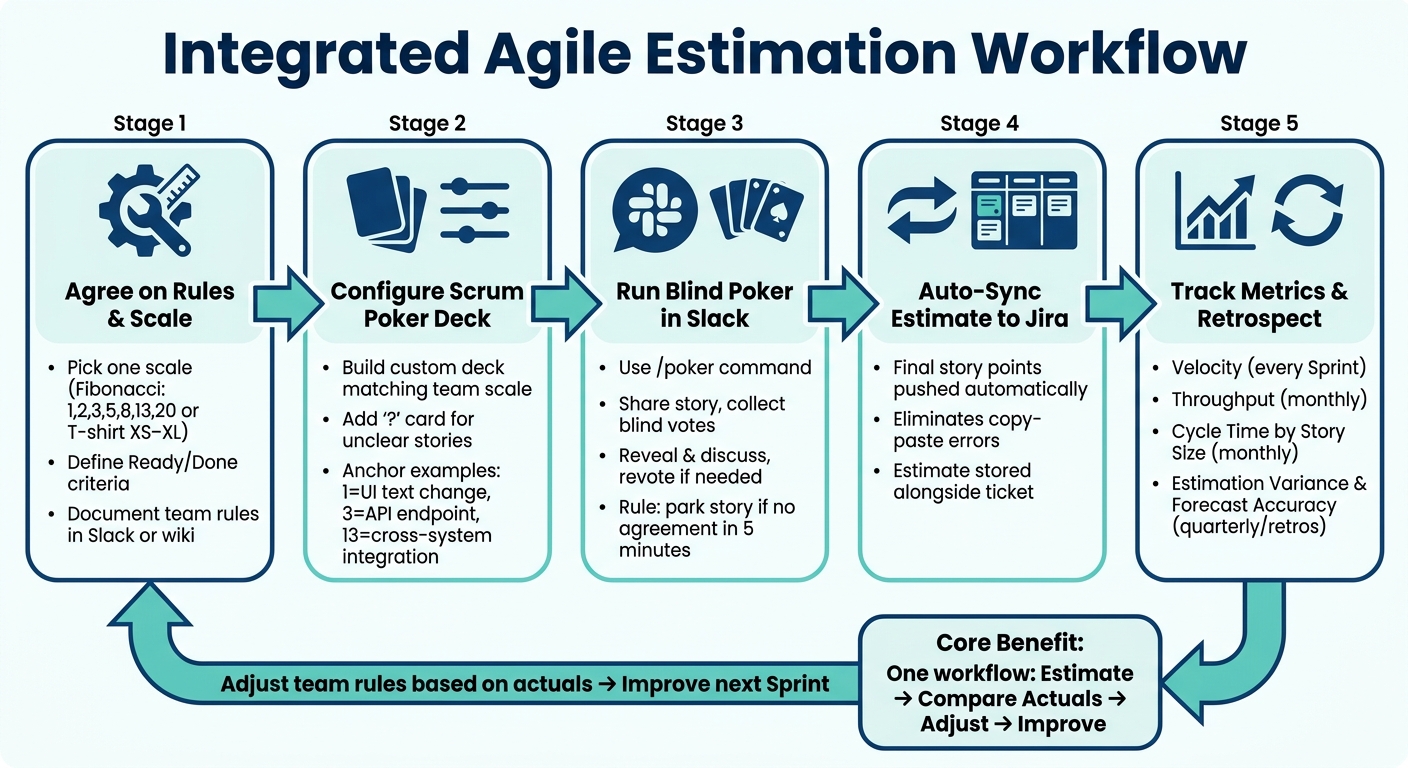
Integrated Agile Estimation Workflow: From Setup to Continuous Improvement
Estimation Session in JIRA - Scrumpy Planning Poker App Review

Set Up the Basics Before You Integrate Tools
Get the team’s estimation rules in place before you connect any tools. If you skip that step, automation doesn’t fix the mess - it just helps the team move through inconsistent estimates faster.
Agree on One Estimation Scale and Team Rules
When people walk into the same estimation session with different ways of thinking, the numbers drift fast. So before you wire anything together, agree on one estimation scale and use it to plan story points per Sprint.
For most teams, Fibonacci or modified Fibonacci is a solid default. A sequence like 1, 2, 3, 5, 8, 13, 20 works well because the gaps get bigger as the work gets less certain. That helps the team avoid fake precision on larger stories. If the backlog is still rough and the team mainly needs rough comparisons, T-shirt sizing (XS through XL) is an easier place to start. You can map those sizes to points later, like S = 3, M = 5, and L = 8.
Story points should mean relative effort, complexity, and uncertainty - not hours or dollars. It also helps to spell out the rest of the ground rules:
- what ready and done mean
- who joins estimation
- when estimation happens in the team’s cadence
- how disagreements get handled
- the story-splitting threshold before Sprint Planning
Write the rules down somewhere easy to find, like a pinned Slack message or a shared team wiki. That way, new team members aren’t left guessing.
Once the rules are set, configure the tool to match them.
Configure Your Scrum Poker Tool to Match Team Practice
After the rules are written, set up the tool so it follows those rules exactly.
In iAmAgile, you can create a custom deck that matches the values your team picked. If your team uses a modified Fibonacci scale, include only those values. Add non-numeric cards like "?" or "Need more info" for cases where the work is still unclear.
It also helps to tie card values to actual backlog examples. For instance: "1 = a simple UI text change," "3 = a straightforward API endpoint," and "13 = a cross-system integration involving a third-party vendor." Those anchors give the team a shared frame of reference across Sprints, and they make life easier for newer team members.
After that, hide or turn off any scales the team doesn’t use. That small setup step cuts down on accidental mixing and keeps Slack sessions clean.
The table below shows the most useful decision boundaries for handling voting patterns during a session:
| Voting Pattern | Example | Action to Take |
|---|---|---|
| Wide divergence | 2, 5, 13, 8, 21 | Discuss extremes; if no agreement in 5 mins, "park" the story. |
| Lone outlier | 5, 5, 5, 5, 13 | Ask the outlier to explain hidden complexities others might miss. |
With the deck lined up to match team practice, Slack sessions tend to move with less friction.
Use Slack-Integrated Scrum Poker for Faster Estimation Sessions
Once your deck and rules are set, move estimation into Slack. It speeds up voting and keeps a clear record. Better yet, the whole voting flow stays in a single Slack thread, so no one has to piece the session together later.
Run a Simple Slack-Based Estimation Workflow
With iAmAgile connected to Slack, type /poker in your estimation channel to open a room and bring in the team. After that, the flow is pretty straightforward:
- Share the story: Post the backlog item in the channel or pull it in from your planning tool.
- Collect votes: Team members submit their estimates in Slack.
- Reveal and discuss: Once everyone has voted, reveal the estimates and talk through any gaps.
- Revote only if the team still disagrees: Run another round to reach alignment.
That makes the tradeoff with manual meetings easy to spot.
Keep Sessions Short with Notifications, Threads, and Mobile Access
Waiting is what drags estimation out. Slack-linked tools send automated nudges to people who still haven't voted, which helps cut delays. Threads also keep the reasoning behind each estimate in one place.
Slack threads make a big difference when a story kicks off a technical debate. Instead of clogging up the main channel, move that discussion into the story thread. You keep the rationale for later and the channel stays clean.
Mobile access also means teammates can vote from anywhere.
Manual Estimation Meetings vs. Slack-Integrated Scrum Poker
| Feature | Manual meetings | Slack poker |
|---|---|---|
| Traceability | Manual entry; notes get lost | Automatic capture; rationale saved |
| Remote collaboration | Video link required | Runs in Slack |
Those saved votes and notes then feed into delivery tracking.
Connect Estimation Data to Delivery Tracking
After the final vote is captured in Slack, send it straight into the delivery system and compare estimates with what actually delivered.
Record Estimates Automatically and Review Delivery Patterns
When the Scrum poker tool syncs with Jira, the final story point lands on the ticket automatically. That cuts out copy-paste work. iAmAgile supports this too, letting teams push confirmed estimates straight to their delivery tracking system with a single click.
Once that record is in place, the team can line up the estimate with what shipped. You can spot estimate variance, oversized stories, and velocity drift without digging through scattered notes. That gives planning a firmer footing and helps teams reset future Sprint forecasts based on what happened, not what they hoped would happen.
Use Integrated Data to Improve Forecasts
Use recent throughput as the baseline for Sprint commitments and release forecasts. In plain terms, plan from actual throughput, not assumptions.
Key Metrics to Track
Track only the metrics that shape planning accuracy.
| Metric | Data Source | Recommended Review Cadence |
|---|---|---|
| Velocity | Jira / Delivery Tracking System | Every Sprint (End of Sprint) |
| Cycle Time by Story Size | Version Control / Task Manager | Monthly |
| Estimation Variance | Estimation Tool vs. Actual Effort | Quarterly / Retrospectives |
| Throughput | Delivery Tracking System | Monthly |
| Forecast Accuracy | Estimation tool + delivery history | Quarterly |
These metrics give the team something concrete to look at in retrospectives and future planning. Instead of relying on gut feel, they can use delivery data to keep estimates in line over time.
Build a Feedback Loop That Improves Accuracy Over Time
Review Estimates in Retrospectives and Refine Team Standards
Use estimate-vs.-actual data in retrospectives to get better at sizing over time. After each Sprint, look at the estimates you recorded and compare them with what the team actually delivered. Then use that information to tune the next planning session.
Compare story points against Sprint results. Pay attention to patterns that keep showing up. Maybe the team often underestimates bug fixes, or maybe certain types of backend work come in lower than expected. When that happens again and again, it's a sign to revisit your estimation rules and the example stories you use during planning.
That simple habit helps the team stop guessing in the dark. Instead, you're learning from your own track record.
Reduce Bias and Improve Team Productivity with Structured Voting
Anchoring bias can pull a group toward the first number said out loud. Blind voting helps prevent that because everyone submits at the same time, and the spread shows up only after all votes are in.
Keep each voting round blind to cut down anchoring bias. That shifts the conversation toward evidence instead of the first number on the table. A Scrum poker tool that supports this setup helps each estimate stand on its own and keeps the discussion more even.
Conclusion: The Core Benefits of Integrated Agile Estimation
This creates a simple loop: Integrated tools create a repeatable loop: estimate, compare with actuals, adjust standards, and improve the next Sprint.
FAQs
How do we choose the right estimation scale?
Choose the estimation scale that fits how your team likes to work, how hard the tasks are, and where you are in the project.
For detailed sprint planning, especially when you want to cut down on bias, the Fibonacci sequence (1, 2, 3, 5, 8, 13, 21) is a common pick. It works well when the team needs to compare effort in a more precise way without pretending every task can be measured exactly.
If your team is newer to estimation, or you just need fast, high-level backlog sizing, T-shirt sizing (XS, S, M, L, XL) is a simpler option. It’s easy to grasp and keeps the conversation moving.
iAmAgile supports both approaches, and it also lets you customize the voting scale to match your team’s style.
What should we do when votes are far apart?
Ask the team members with the highest and lowest estimates to walk through their thinking. That short back-and-forth often surfaces hidden complexity, overlooked details, or a different way of looking at the work.
Then, after a brief 2-to-5 minute discussion, vote again. If the team still can't line up, split the story into smaller parts or set it aside for more refinement. iAmAgile helps with these sessions through customizable voting scales and Slack integration.
Which metrics matter most after estimates sync to Jira?
The sources don’t list specific post-sync Jira metrics.
What they do point to is the need to watch how the sync changes day-to-day workflow, and how past data helps with forecasting. One clear benchmark stands out: teams can cut estimation errors by 20% to 30% when they use historical data well.
It also helps to track the spread of estimates during estimation sessions. That spread can expose different assumptions inside the team before they turn into delivery problems.
And keep an eye on stories estimated at 13 points or higher. That’s often a sign the work is too big or too fuzzy, and it may need to be split into smaller pieces.
Ready to improve your team's planning?
Put what you've learned into practice! Make your next planning session more engaging and accurate.
Try for free - no signup required