Cone of Uncertainty in Agile Estimation
Published Feb 2, 2026
⦁
9 min read

Cone of Uncertainty in Agile Estimation
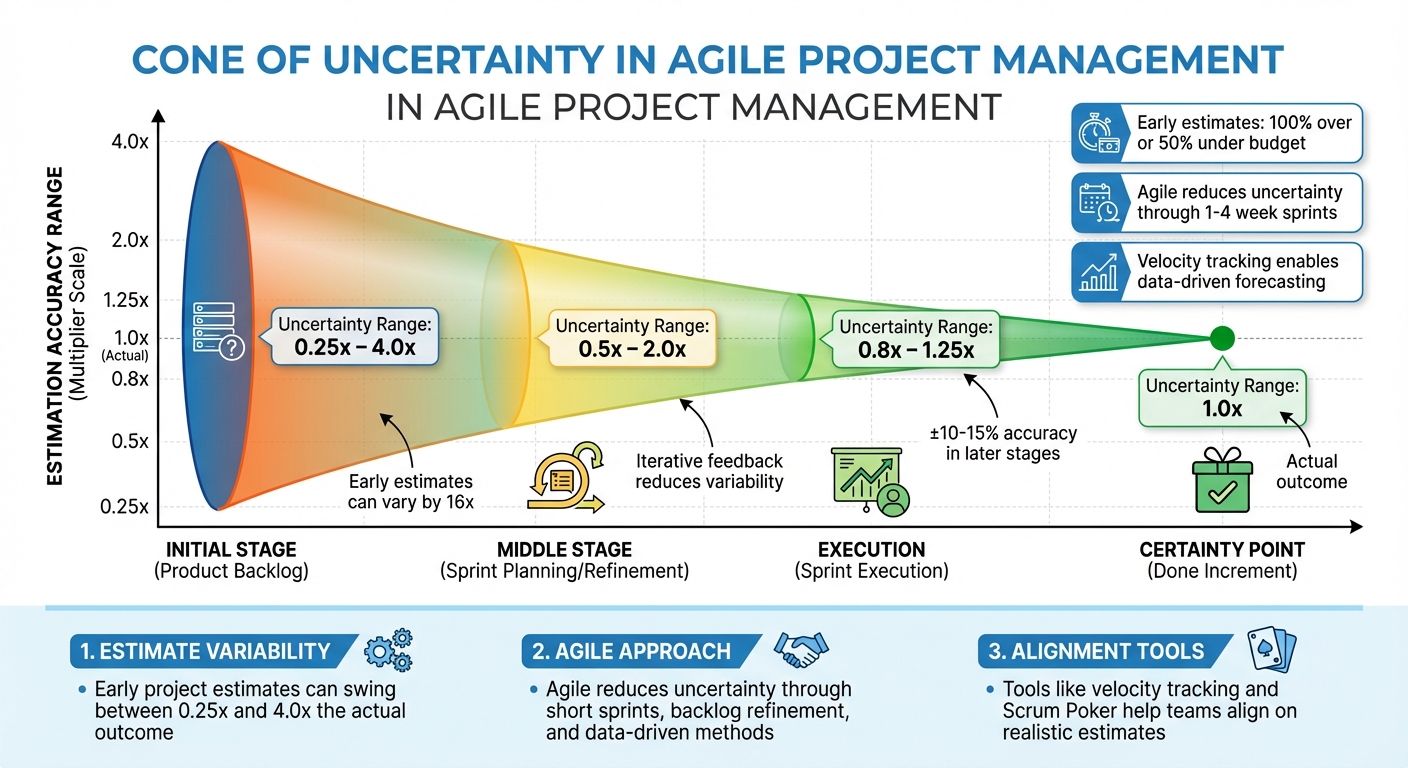
The Cone of Uncertainty explains why project estimates are less accurate at the start and improve over time. Early in a project, estimates can vary by as much as 16x due to limited information. As the project progresses and more is understood, this range narrows significantly - often within ±10-15% during later stages. This concept, originally from the chemical industry, was adapted for software development to help manage expectations and refine planning.
For Agile teams, the Cone of Uncertainty highlights the importance of iterative estimation. Instead of locking in detailed plans early, Agile uses tools like velocity tracking, relative estimation (e.g., Story Points), and collaborative methods like Scrum Poker to refine estimates as clarity improves. By focusing on delivering smaller increments and gathering feedback, teams can reduce variability and improve forecasting accuracy.
Key takeaways:
- Early project estimates can swing between 0.25x and 4.0x the actual outcome.
- Agile reduces uncertainty through short sprints, backlog refinement, and data-driven methods.
- Tools like velocity tracking and Scrum Poker help teams align on realistic estimates.
The Cone of Uncertainty isn't about eliminating variability but managing it effectively through informed decisions and continuous progress.
Cone of Uncertainty: How Estimation Accuracy Improves Through Agile Project Stages
How does Cone of Uncertainty work?
Origins and Development of the Cone of Uncertainty
The Cone of Uncertainty has its roots in chemical engineering. It was first introduced back in 1958 by the founders of what is now known as AACE International (American Association of Cost Engineers). At the time, early cost estimates in projects could swing widely - sometimes going 100% over or 50% under budget.
In 1981, this concept made its way into the software world when Barry Boehm introduced it in his book Software Engineering Economics, where he referred to it as the "Funnel Curve." Later, Steve McConnell popularized the term "Cone of Uncertainty" in his 1997 book Software Project Survival Guide and expanded on it in Software Estimation: Demystifying the Black Art.
From Waterfall Project Management to Agile
In traditional Waterfall project management, the approach to managing uncertainty was all about heavy upfront planning. Teams would spend months gathering requirements, drafting detailed specifications, and striving for a "requirements freeze" before starting development. The idea was that by completing each phase - requirements, design, and implementation - uncertainty would gradually decrease.
But this approach often fell short. Changing requirements and shifting priorities from stakeholders made these detailed upfront plans ineffective. Agile methodologies, like Scrum, turned this approach on its head. Instead of trying to plan away uncertainty, Agile teams tackle it through iterative development - delivering small, functional increments of software during Sprints and using real-world feedback to guide their next steps.
"The cone of uncertainty teaches us that precision comes from completing work, not from more detailed planning." – Hyperdrive Agile
This shift represents a profound change in mindset. Agile teams accept that uncertainty is inevitable and focus on reducing it through ongoing inspection, adaptation, and evidence-driven decisions. However, it’s worth noting that the cone doesn’t automatically narrow. If a project lacks proper control or teams fail to address variability, uncertainty can linger like a "cloud" until the project’s conclusion. This highlights Agile’s emphasis on constant feedback to manage and reduce uncertainty systematically.
How the Cone of Uncertainty Applies to Agile Estimation
In Agile, the Cone of Uncertainty shapes how and when teams estimate their work. Unlike traditional methods that aim for precise estimates early on, Agile teams align their estimation detail with how much they actually know at a given point. Early in a project, when uncertainty is at its highest, teams often use abstract measurements like T-shirt sizes or Fibonacci values to estimate Epics. As the project advances and clarity improves, they move to more detailed methods, such as Story Points for User Stories and even hours for specific tasks.
This approach is summed up well by Agile Coach Tara Hamilton-Whitaker, who says: "The more precise you are, the less accurate you will be". By the time teams reach Sprint Planning and break down stories into tasks, the uncertainty narrows significantly, typically falling within a range of 0.8x to 1.25x.
Uncertainty Reduction Across Agile Stages
Agile teams reduce uncertainty iteratively, not through rigid, sequential phases. The table below highlights how this process compares to traditional Waterfall methods:
| Stage/Phase | Waterfall Approach | Agile Approach | Uncertainty Range |
|---|---|---|---|
| Initial Stage | Requirements (attempts to "freeze" early) | Product Backlog (uses abstract sizing) | 0.25x – 4.0x |
| Middle Stage | Design/Architecture (risks widening if requirements change) | Sprint Planning/Refinement (narrows via iterative feedback) | 0.5x – 2.0x |
| Execution | Coding/Testing (uncertainty remains until end) | Sprint Execution (delivers "Done" increments every 1–4 weeks) | 0.8x – 1.25x |
| Certainty Point | Project Handover (0% uncertainty) | Done Increment (uncertainty reduced per iteration) | 1.0x |
Agile teams narrow this cone not by locking in requirements or sign-offs but through empirical evidence - real progress and feedback from stakeholders.
Impact on Agile Estimation Techniques
The Cone of Uncertainty also explains why Agile teams lean toward relative estimation instead of absolute numbers. The Fibonacci sequence, for example, reflects the increasing unknowns associated with larger tasks. A story estimated at 13 points inherently carries more uncertainty than one at 5 points, and the sequence’s wider gaps acknowledge this reality.
To address these uncertainties, teams often use three-point estimation, which factors in optimistic, realistic, and pessimistic scenarios to calculate a weighted average. This method communicates a range of potential outcomes to stakeholders, replacing false precision with a clear acknowledgment of what the team knows - and what remains uncertain - at each stage of the project. Up next, we’ll dive into practical ways to handle this uncertainty in Agile estimation.
How to Narrow Uncertainty in Agile Estimation
Completely eliminating uncertainty in Agile estimation might be unrealistic, but narrowing it is absolutely achievable. Agile teams rely on practical, evidence-based methods to refine their estimates as projects progress. Let’s explore how these strategies help reduce estimation errors.
Refining Backlogs and Just-in-Time Estimation
The process of backlog refinement is where the uncertainty begins to shrink. Instead of attempting to estimate everything at the start, Agile teams break down larger, more ambiguous Epics into smaller, manageable User Stories closer to implementation. This just-in-time approach ensures that estimates are based on the latest and most accurate information, avoiding outdated assumptions.
"By carrying out refinement at the most opportune moment, just before items are integrated into a sprint, the team ensures that estimates are based on the most recent and relevant information." - Ahmed BEN SALEM, Agile Coach
By the time Sprint Planning rolls around, the level of uncertainty is already reduced. Teams decompose work into smaller tasks with fewer unknowns and less hidden complexity. For example, a three-week Epic may feel overwhelming to estimate, but breaking it into five User Stories - each requiring two to three days - makes it easier to compare against past work. Humans are naturally better at judging relative sizes, which improves the reliability of these smaller estimates.
Using Velocity for Empirical Forecasting
Velocity is a game-changer for Agile teams. It measures the average number of Story Points a team completes per sprint, turning guesswork into data-backed predictions. Within two to three sprints, teams can establish a baseline that reflects their actual capacity rather than theoretical expectations.
Steve McConnell, author of Software Estimation: Demystifying the Black Art, highlights the real purpose of estimation:
"The primary purpose of software estimation is not to predict a project's outcome; it is to determine whether a project's targets are realistic enough to allow the project to be controlled to meet them."
For instance, if a team delivers 25 Story Points per two-week sprint and the backlog contains 200 points, they can estimate completing the work in about eight sprints. Instead of committing to fixed deadlines, teams should communicate probability ranges to account for natural variations in their estimates. Additionally, a sudden drop in velocity can serve as a warning sign of rising complexity or potential roadblocks that need to be addressed.
While velocity provides data-driven insights, collaborative estimation tools add another layer of precision.
Using iAmAgile Scrum Poker for Team Estimation
Collaborative tools like iAmAgile's Scrum Poker platform help teams tackle uncertainty by fostering collective understanding rather than relying on individual opinions. This tool enables consensus-based estimation sessions where team members independently assign Story Points using the Fibonacci sequence. Any significant differences in their estimates spark discussions to uncover hidden assumptions before reaching an agreement.
This process reduces bias by requiring simultaneous input from all team members. For instance, if one developer assigns a Story Point value of 3 while another assigns an 8, it signals the need to clarify differing perspectives and address any ambiguities. This approach aligns perfectly with Agile’s principle of making decisions based on empirical evidence and collaboration.
The platform also integrates with Slack, making it easy to conduct refinement sessions. Teams can customize voting scales, whether they prefer Fibonacci sequences, T-shirt sizes for larger Epics, or other custom ranges. Its mobile-friendly design ensures full participation, even for remote team members.
Beyond estimation, iAmAgile creates a transparent record of decisions. Teams can review past estimates, compare them against actual outcomes, and identify patterns to improve future accuracy. As Agile Coach Piyush Rahate puts it:
"In complex environments, at the very best, we can make forecasts but no predictions."
While tools like iAmAgile can’t guarantee certainty, they empower teams with better data, clearer communication, and stronger collaboration to navigate uncertainty effectively.
Conclusion
The Cone of Uncertainty is an unavoidable aspect of any project. Early on, estimates can vary dramatically - what might seem like a six-month timeline could realistically range anywhere from two months to two years. Acknowledging this variability upfront enables teams to approach planning with greater honesty and flexibility.
The real challenge lies in narrowing this uncertainty over time. The only way to achieve this is through concrete decisions about scope, architecture, and priorities. Agile teams excel at this by working in short, focused sprints, delivering "Done" increments, and using real velocity data to continually refine their forecasts. This hands-on, data-driven approach consistently outperforms theoretical guesswork.
Equally important is maintaining transparency with stakeholders. Providing estimates as ranges rather than fixed numbers fosters trust and aligns expectations. As Stefan Luyten, an Enterprise Architect, explains:
"The 'Theory of the Cone' shows that you can NEVER provide an accurate estimate, but should rather provide a range".
Without disciplined Agile practices - such as continuous integration, test-driven development, and regular customer feedback - teams risk falling into the "Wormhole of Uncertainty", where last-minute surprises derail accurate forecasting. The key to narrowing the cone lies in actively reducing variability through informed decisions and iterative progress.
FAQs
What is the Cone of Uncertainty, and how does it impact Agile project timelines?
The Cone of Uncertainty illustrates how estimates become more reliable as a project advances and additional details emerge. At the start of a project, uncertainty is at its peak, making it harder to predict timelines accurately.
In Agile, this concept is especially useful for managing expectations and improving estimates as the team progresses. By recognizing this natural uncertainty, teams can adjust their plans and minimize the chances of schedule delays by leveraging the insights gained through iterative work.
How do Agile teams handle uncertainty in task estimation?
Agile teams tackle the challenge of estimation uncertainty with the Cone of Uncertainty, a concept that shows how project uncertainty naturally shrinks as more details emerge over time. Since early estimates are often rough, teams account for a range of possible outcomes and continuously refine their predictions as the project moves forward.
To handle this, teams use methods like iterative planning and re-estimation after each sprint or milestone. These practices allow them to adjust based on fresh insights and reduce potential risks. By prioritizing high-value tasks early while postponing less critical work, teams can keep the project scope manageable. The cone also serves as a visual aid to help set realistic expectations with stakeholders, promoting transparency about how estimates evolve over time.
Why is relative estimation used instead of absolute numbers in Agile?
Relative estimation works well in Agile because it embraces the uncertainty that often surrounds the early phases of a project. Instead of assigning fixed numbers to tasks, teams compare them to one another, making the process more flexible and grounded in reality.
This method aligns with the Cone of Uncertainty, a concept that highlights how project details become clearer as work progresses. By using relative estimation, teams can refine their assessments over time, improving accuracy as they gather more information. It also encourages collaboration and adaptability - key principles at the heart of Agile practices.
Ready to improve your team's planning?
Put what you've learned into practice! Make your next planning session more engaging and accurate.
Try for free - no signup required