Estimation Alignment: Best Practices for Agile Teams
Published Jan 26, 2026
⦁
12 min read
Estimation Alignment: Best Practices for Agile Teams
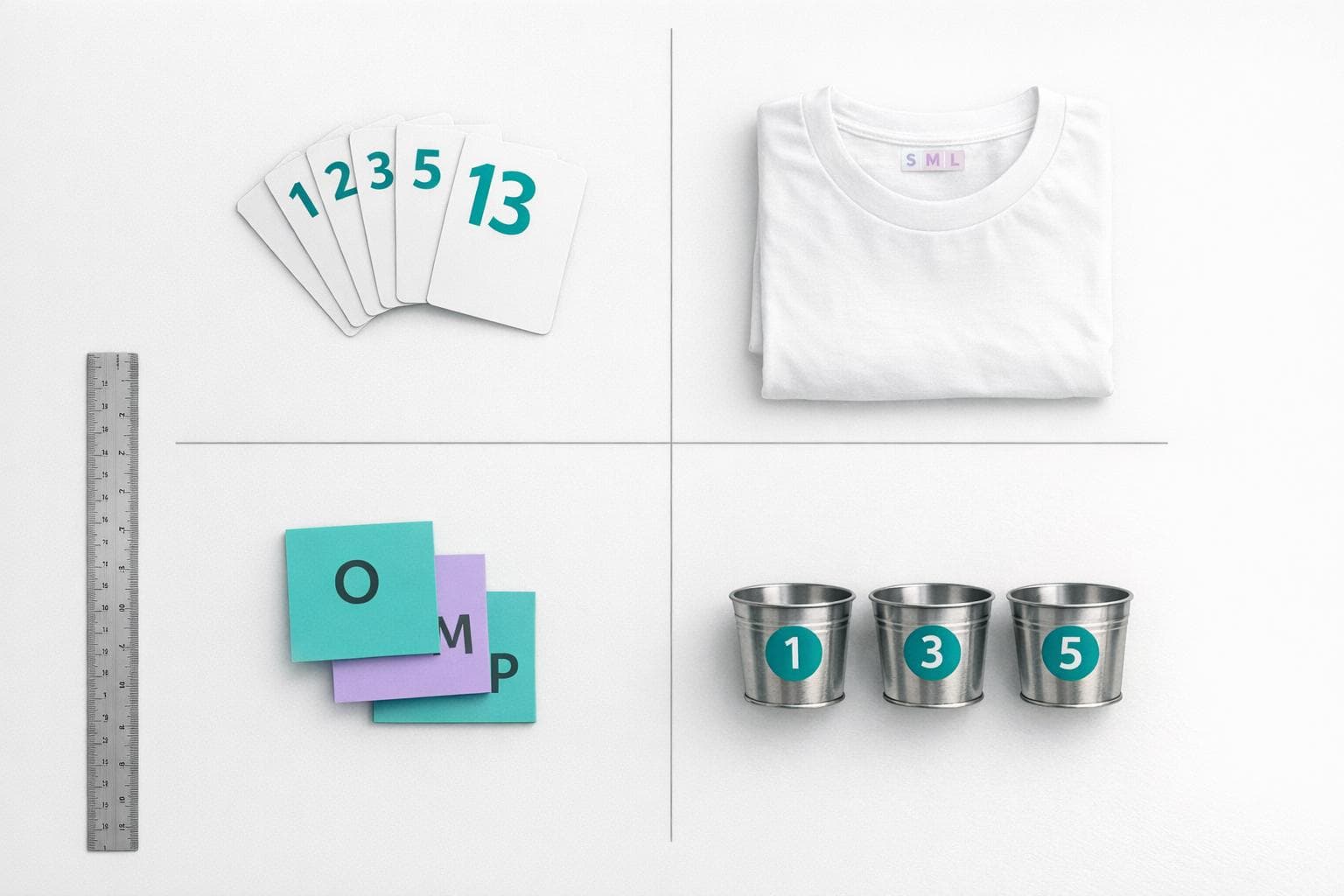
Estimation is a key part of Agile planning. It helps teams set realistic expectations, reduce risks, and improve predictability. But the method you choose depends on your team’s needs and the size or complexity of your backlog. Here’s a quick summary of four popular estimation methods:
- Planning Poker: A collaborative card-based game using Fibonacci numbers. Best for detailed discussions during sprint planning.
- T-Shirt Sizing: Uses sizes (XS, S, M, L, XL) to estimate tasks quickly without numbers. Ideal for early planning or non-technical teams.
- Three-Point Estimation: Combines optimistic, pessimistic, and most likely scenarios to account for risks. Suited for complex or uncertain tasks.
- Bucket System: Groups tasks into predefined "buckets" for fast backlog estimation. Works well for large backlogs.
Each method has strengths and weaknesses. For smaller, detailed tasks, Planning Poker is effective. If speed is a priority, T-Shirt Sizing or the Bucket System may work better. For high-risk tasks, Three-Point Estimation provides a more thoughtful approach. The key is to match the method to the situation, ensuring your team stays efficient and aligned.
Agile Estimation Methods Comparison: Planning Poker vs T-Shirt Sizing vs Three-Point vs Bucket System
The Agile Estimation Trick That's Faster Than Planning Poker
1. Planning Poker
Planning Poker is a collaborative card-based game designed to help teams estimate the effort required for completing tasks. It uses a modified Fibonacci sequence (e.g., 1, 2, 3, 5, 8, 13) to represent the relative effort. The process kicks off with the Product Owner presenting a user story, followed by a discussion to clarify any uncertainties. Once everyone understands the task, each team member privately selects a card that reflects their estimate and reveals it simultaneously. This method prevents anchoring bias, where early opinions influence others.
How It Aligns the Team
The simultaneous reveal encourages open discussion. When estimates differ, the team dives into the reasoning behind the highest and lowest values. This often uncovers hidden complexities or overlooked details. These discussions bring together perspectives from different disciplines, fostering a shared understanding of the task. As James Grenning, the creator of Planning Poker, explains:
"If you can't get consensus, don't sweat it. It is only one story out of many. Defer the story, split it, or take the low estimate."
Most teams can reach consensus within three rounds of voting. Experienced teams often aim to align 60–70% of the time on the first vote.
Keeping It Fast
Despite its detailed nature, Planning Poker is designed to be efficient. Teams with experience can estimate 4–6 stories per hour, keeping discussions limited to 2–3 minutes per story to avoid overanalyzing. If the estimates are close, teams often choose the higher value to keep the session moving.
Balancing Accuracy
Planning Poker benefits from input across multiple experts, which improves accuracy. Research by Magne Jørgensen, Ph.D., at Simula Research Lab, found that:
"the people most competent in solving the task should estimate it".
This process also brings to light assumptions and risks that might otherwise go unnoticed. However, accuracy can decline over time if estimators rely too heavily on unrelated past experiences.
Ideal Scenarios for Planning Poker
Planning Poker shines in situations where tasks are complex and require input from various perspectives. It’s particularly effective during backlog refinement and sprint planning. For new teams, it helps establish a shared understanding, while distributed teams can use digital tools to stay connected.
If a story frequently receives estimates of 13 points or more, it’s a sign that the task should be broken into smaller, more manageable pieces. For those looking for a tool to streamline these sessions, iAmAgile offers a Scrum poker platform that integrates with Slack and includes customizable voting scales. This makes it easy to conduct Planning Poker sessions, whether your team is in the office or remote. Up next, we’ll explore T-Shirt Sizing as another method for quick relative estimation.
2. T-Shirt Sizing
T-Shirt Sizing offers a simple, visual way to estimate tasks during early planning stages, building on the clarity of Planning Poker but using a more intuitive approach.
This method assigns effort and complexity levels to tasks using clothing sizes like XS, S, M, L, XL, and XXL. Instead of debating exact numbers like 5 or 8 points, teams compare tasks to previous ones, asking questions like, "Is this smaller or larger than the Medium task we finished last sprint?" Its simplicity makes it easy for both technical and non-technical team members to participate.
How It Aligns Teams
To avoid anchoring bias, team members make their estimates privately and reveal them at the same time. Any differences in sizing spark discussions, helping the team reach a consensus. If there's uncertainty between two sizes, the group usually opts for the larger size to account for unexpected work.
Efficiency
This approach is quick - teams can save about 80% of the time typically spent on detailed estimations. Since it skips the need for exact numbers, T-Shirt Sizing is perfect for sizing large, unestimated backlogs quickly.
Accuracy Over Time
While T-Shirt Sizing isn't about pinpoint accuracy, it provides a useful directional estimate. Over time, as teams gain experience, they can fine-tune these estimates using past results. Tasks labeled XL or XXL are usually flagged for breaking down into smaller, more manageable pieces.
When to Use It
T-Shirt Sizing shines in early discovery phases, roadmap planning, and when grooming large backlogs with limited information. It's especially helpful for non-technical teams or during initial backlog reviews. Later on, these broad estimates can be translated into Story Points for sprint planning.
Up next, we’ll dive into Three-Point Estimation, a method designed to handle uncertainty in more complex projects.
3. Three-Point Estimation
Three-Point Estimation offers a thoughtful way to forecast tasks by asking teams to define three distinct estimates: an Optimistic estimate (best-case scenario), a Pessimistic estimate (worst-case scenario), and a Most Likely estimate. Instead of relying on a single number, teams use the formula (O+P+M)/3 to calculate an average that incorporates both risk and uncertainty.
Alignment Mechanism
This approach encourages teams to openly discuss potential risks by focusing on the "pessimistic" scenario. It helps counteract optimism bias, where teams might assume tasks will go smoother or faster than past experiences suggest. As Lucid explains:
"By using the three-point system, teams can have conversations about potential challenges early on and manage those in advance".
Such proactive discussions not only improve planning but also foster a sense of shared responsibility among team members.
Speed
Three-Point Estimation requires teams to consider multiple scenarios for each task. This involves answering three key questions: "How long if everything goes right?", "How long if issues arise?", and "What is the most likely outcome?". To ensure efficiency, facilitators should set strict time limits for these discussions to avoid unnecessary complexity.
Accuracy
By accounting for variability, this method creates forecasts that factor in risk. Paul Grew, an Agile Coach at Scrum.org, points out:
"Rather than avoiding uncertainty, it should be acknowledged and measured. This approach leads to better decision-making".
Teams can also pair their estimates with confidence levels, such as stating, "We are 90% confident this task will take between 3 and 8 days".
Best Use Case
This method is ideal for complex or unfamiliar tasks where there's little or no historical data to rely on. It's especially useful for high-stakes work involving external dependencies or when stakeholders require highly reliable forecasts. If the gap between the optimistic and pessimistic estimates is too wide, it may indicate the need to break the task into smaller, more manageable pieces.
4. Bucket System
The Bucket System takes inspiration from techniques like Planning Poker and T-Shirt Sizing but offers a quicker way to handle large backlogs.
This method relies on a divide-and-conquer approach to streamline estimation for teams. Instead of analyzing each item individually, the backlog is sorted into predefined "buckets" labeled with Fibonacci numbers (e.g., 0, 1, 2, 3, 5, 8, 13, 21). With this system, teams can estimate between 50 and 100 items per hour, a significant improvement over Planning Poker, which typically processes just 10–15 items in the same time frame.
Alignment Mechanism
The process starts by choosing a reference story and placing it in the "8" bucket, which acts as a baseline for comparison. Team members then sort the remaining items silently, based on their perceived complexity. This silent sorting step ensures that no single voice dominates the discussion. Once the sorting is done, the team reviews the board together, focusing on any outliers and discussing them until they reach a consensus.
As Mishkin Berteig, President and Co-Founder of BERTEIG, highlights:
"The results are not traceable to individuals and so it encourages group accountability".
Items deemed too complex or unclear are placed in a "catch-all" bucket, such as 21 or 200, signaling the need for further breakdown.
Speed
One of the standout features of the Bucket System is its speed - it can process over 200 items per hour. According to Narasimha Reddy, CEO of StarAgile, these estimates are about 80–85% as accurate as those generated by Planning Poker but take 60–70% less time. This efficiency is achieved by limiting discussions to reference items and outliers, cutting down on unnecessary debates.
Accuracy
While the Bucket System may lack the fine detail of other methods, it compensates with reliability by treating story points as ranges instead of precise numbers. Mike Cohn, Founder of Mountain Goat Software, explains:
"By intentionally leaving some numbers out of the set of acceptable estimates, teams avoid bogging down in discussions of, for example, 15 versus 16".
Skipping intermediate values helps teams avoid getting stuck in minor debates. When stuck between two buckets, rounding up is recommended to account for uncertainty and improve predictability in delivery.
Best Use Case
The Bucket System shines when dealing with large backlogs, typically ranging from 40 to 500 items. It works especially well for early-stage project planning or when stakeholders need quick assessments. For smaller, more detailed backlogs, teams might prefer methods that offer finer granularity.
Strengths and Weaknesses
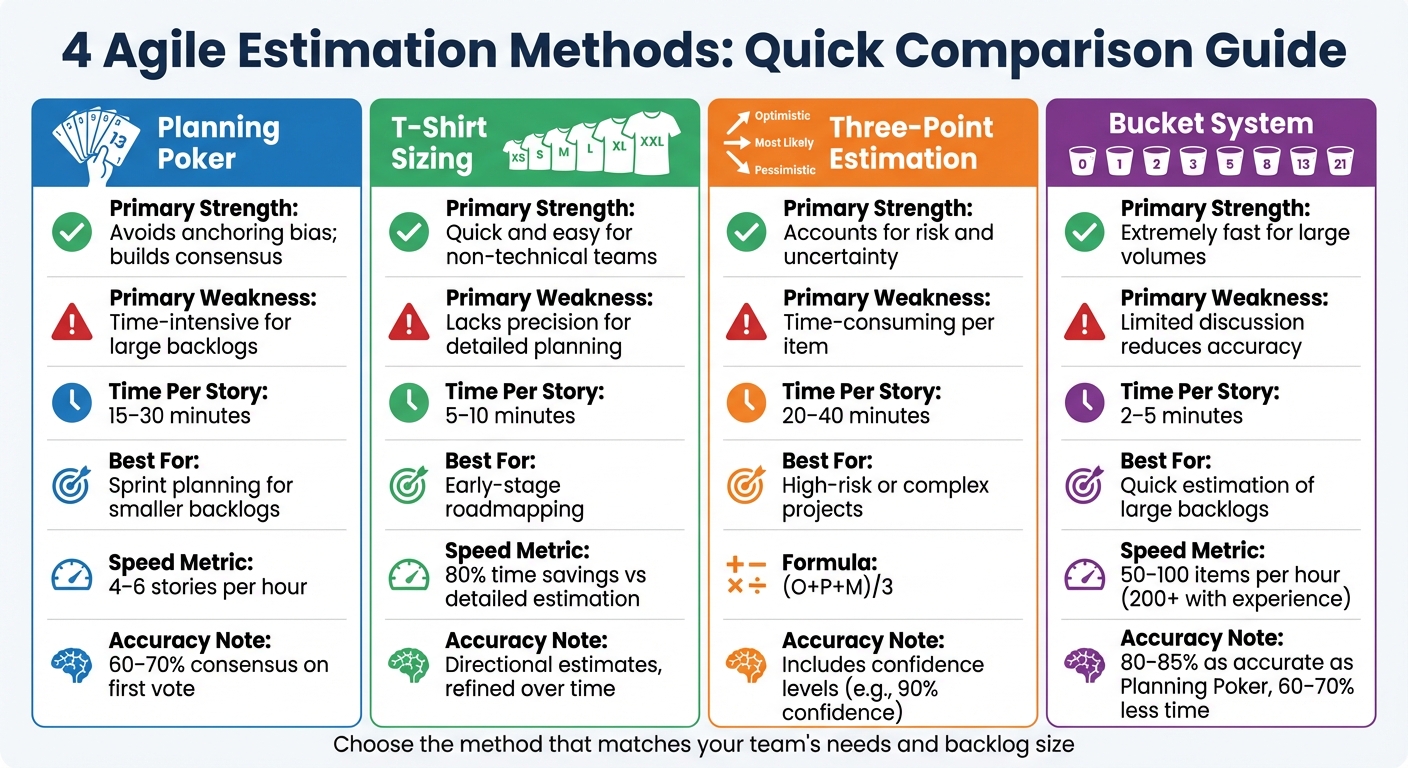
Looking at these estimation methods, it's clear that each comes with its own set of strengths and challenges, making the choice heavily dependent on the specific needs of the team and the task at hand. Planning Poker, for instance, is known for its precision and ability to foster team consensus. But since it takes around 15–30 minutes per story, it can be less practical when dealing with extensive backlogs. On the other hand, T-Shirt Sizing is much quicker, requiring only 5–10 minutes per story, but its broad categories might not provide the level of detail needed for sprint planning.
Three-Point Estimation stands out for its focus on risk assessment, blending best-case, worst-case, and most likely scenarios. However, this thoroughness comes at the cost of time, as it typically requires 20–40 minutes per story, making it better suited for high-uncertainty or complex projects. Lastly, the Bucket System is incredibly fast, taking just 2–5 minutes per story, making it perfect for evaluating large backlogs. The trade-off? It allows less room for detailed discussions, which can sometimes affect accuracy.
| Method | Primary Strength | Primary Weakness | Time Per Story | Best For |
|---|---|---|---|---|
| Planning Poker | Avoids anchoring bias; builds consensus | Time-intensive for large backlogs | 15–30 minutes | Sprint planning for smaller backlogs |
| T-Shirt Sizing | Quick and easy for non-technical teams | Lacks precision for detailed planning | 5–10 minutes | Early-stage roadmapping |
| Three-Point Estimation | Accounts for risk and uncertainty | Time-consuming per item | 20–40 minutes | High-risk or complex projects |
| Bucket System | Extremely fast for large volumes | Limited discussion reduces accuracy | 2–5 minutes | Quick estimation of large backlogs |
These comparisons emphasize that no single method is universally superior - it all depends on the context. For instance, Planning Poker often sparks valuable discussions when team estimates vary widely, uncovering hidden complexities or technical challenges that might otherwise be overlooked.
For distributed teams, leveraging tools designed for remote collaboration can help maintain the interactive and collaborative nature of these methods, even when team members are not physically in the same space.
Ultimately, the best approach is to align the estimation method with the task at hand. Use Planning Poker when precision and team alignment matter most, T-Shirt Sizing for early-stage planning, Three-Point Estimation for tackling high-risk or novel work, and the Bucket System when speed is the priority for large backlogs. This adaptability ensures teams remain agile and focused on continuous improvement.
Conclusion
Picking the right estimation method isn't about finding a universal solution - it’s about aligning the approach to your specific needs. For smaller backlogs and detailed sprint planning, Planning Poker offers the precision and team agreement necessary to move forward. If you're in the early stages of roadmapping or collaborating with non-technical stakeholders, T-Shirt Sizing provides the simplicity and speed to keep things progressing smoothly. For high-risk or complex projects where uncertainty looms large, Three-Point Estimation helps assess risks and communicate realistic confidence levels. And when managing a backlog of over 50 items, the Bucket System allows you to prioritize efficiently without overwhelming your team. Each of these methods plays a role in fostering alignment and clarity across your team.
Estimation isn’t a rigid commitment; it’s a tool to guide decisions. It’s part of an ongoing conversation that evolves as work progresses. Teams should revisit their estimates during retrospectives, using past data - often referred to as "yesterday's weather" - to refine future planning and ensure workloads remain manageable. If your estimates consistently miss the mark, it’s a sign to tweak your process rather than abandon estimation altogether.
For distributed teams, digital tools can make collaboration easier, especially when working across time zones. Asynchronous estimation tools allow teams to maintain the collaborative essence of these methods without requiring everyone to be available at the same time. The focus should remain on relative estimation - comparing tasks to one another rather than attempting to predict exact durations. This approach accommodates differences in developer speeds and acknowledges the inherent unpredictability of complex projects.
The most effective teams adapt their estimation strategies as their projects evolve. Start with broad techniques like T-Shirt Sizing or the Bucket System for high-level planning. Shift to Planning Poker when sprint-level detail is needed, and reserve Three-Point Estimation for tackling new, high-uncertainty tasks. This adaptability ensures your team stays agile and continuously improves along the way.
FAQs
What’s the best way to choose an estimation method for my Agile team?
To choose the most suitable estimation method for your Agile team, start by evaluating your team’s objectives, workflow, and preferences. Some widely used techniques include Planning Poker, an interactive method where team members use cards to estimate effort, and relative sizing, which involves comparing tasks to reference stories to maintain consistency. Additionally, calibration techniques can help fine-tune estimates by aligning them with previous work.
It’s worth experimenting with various methods to determine what fits your team best. Collaborative approaches like Planning Poker can boost engagement and alignment, while data-driven methods might appeal to teams that favor a more analytical style. As you refine your chosen method over time, you’ll likely see better planning accuracy and stronger team cohesion.
What makes Planning Poker a better choice for Agile estimation?
Planning Poker is a standout tool for Agile estimation, blending effectiveness with an engaging approach. It brings the entire team together, encouraging collaboration by involving everyone in the process. This not only allows for a variety of perspectives to come into play but also helps the group reach a consensus, reducing individual bias and leading to more balanced decisions.
One of its strongest features is the private voting system. By keeping individual votes hidden, it reduces the sway of dominant voices and avoids the pitfalls of groupthink. The result? More honest and accurate estimates. On top of that, the gamified aspect of Planning Poker adds a layer of fun, making the process more enjoyable and boosting team morale.
Another benefit is how it fosters meaningful discussions. By encouraging conversations and clarifying requirements, teams can develop a shared understanding of tasks. This leads to better planning accuracy and ensures everyone is on the same page. For Agile teams aiming to simplify their estimation process while keeping it interactive, Planning Poker is a perfect fit.
When is it better to use Three-Point Estimation instead of T-Shirt Sizing in Agile projects?
Three-Point Estimation works well when you need a deeper dive into effort or complexity, especially in situations where understanding a range of possible outcomes is essential - think forecasting or making critical decisions. This approach uses three estimates: optimistic, pessimistic, and most likely. By factoring in these variations, it helps address uncertainty and provides a more balanced view.
On the flip side, T-Shirt Sizing offers a faster, simpler way to categorize tasks into relative sizes like small, medium, or large. It’s great for quick, high-level planning but doesn’t deliver the same level of detail as Three-Point Estimation. If precision and data-backed decisions are what you’re after, Three-Point Estimation is the way to go.
Ready to improve your team's planning?
Put what you've learned into practice! Make your next planning session more engaging and accurate.
Try for free - no signup required