Future of Task Estimation with APIs
Published Apr 13, 2026
⦁
13 min read
Future of Task Estimation with APIs
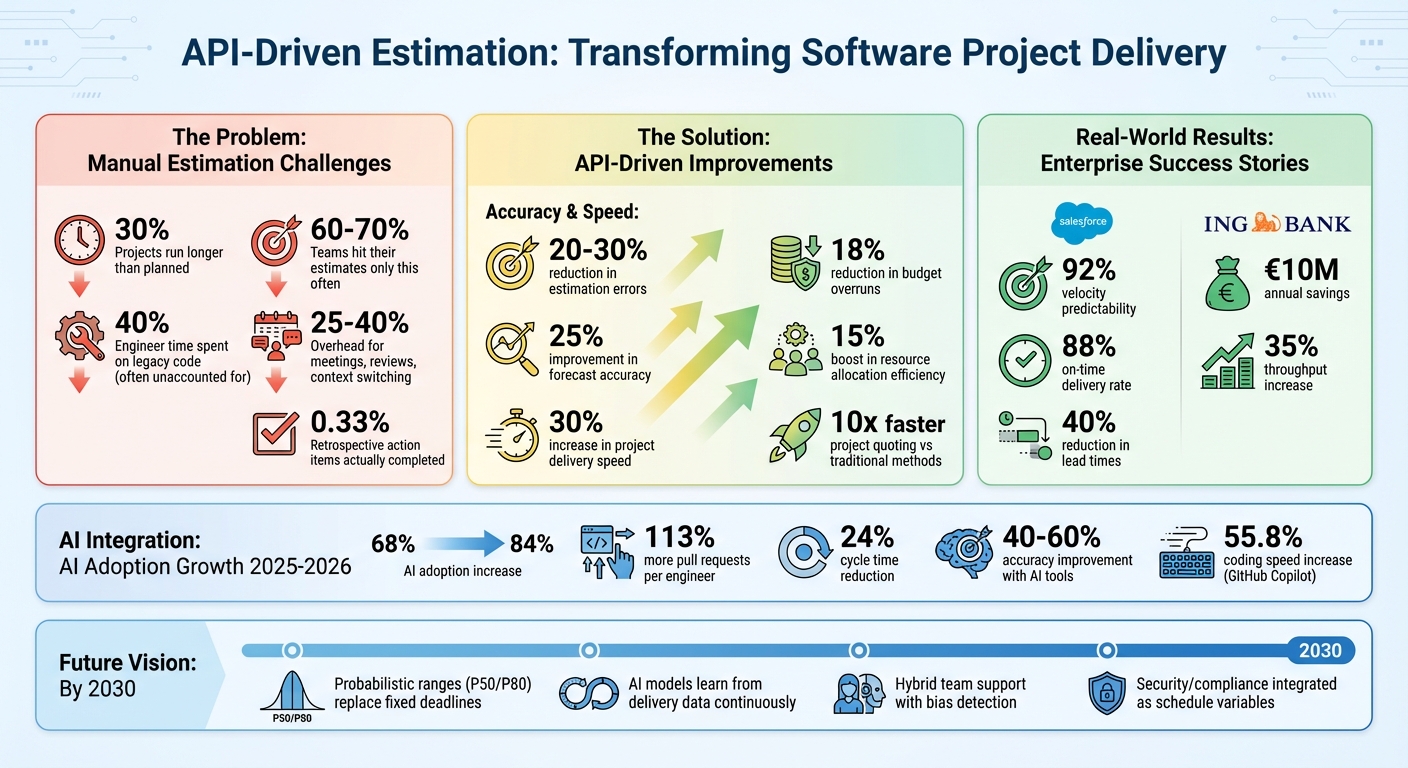
Struggling with accurate task estimation? You’re not alone. Most software projects run 30% longer than planned, with teams hitting their estimates only 60–70% of the time. Manual methods - like spreadsheets or guesswork - are error-prone, time-consuming, and riddled with biases. APIs are changing that by automating estimation, integrating with tools like Jira and GitHub, and using real-world data to improve accuracy.
Key Takeaways:
- Manual estimation issues: Cognitive biases, outdated data, and hidden complexities lead to delays and inefficiencies.
- API-driven solutions: Automation and machine learning reduce errors by 20–30%, improve forecast accuracy by 25%, and speed up project delivery by 30%.
- Modern tools: Platforms like iAmAgile and Dev Time API integrate real-time collaboration tools, reusable components, and predictive analytics.
- Future trends: By 2030, AI-based models will replace static deadlines with probability ranges (P50, P80) and better manage hybrid team dynamics.
APIs are transforming task estimation into a faster, more reliable process. Teams can now focus less on guessing and more on delivering results.
API-Driven Task Estimation: Impact on Project Delivery and Accuracy
Problems with Manual Task Estimation
Why Manual Methods Fall Short
Relying on manual estimation methods often leads to isolated data with no proper context or version control. You’ve probably seen files like "Final_Estimate_v3_REAL_FINAL.xlsx" floating around - these kinds of chaotic naming conventions highlight a bigger issue. Estimation logic gets stuck in individual spreadsheets or, even worse, in the minds of senior developers. When those developers leave, so does their knowledge, leaving teams scrambling to fill the gaps.
But the problems don’t stop there. Manual methods are also riddled with cognitive biases. Anchoring and optimism bias, for instance, can skew early estimates, making them overly simplistic and blind to real-world complexities. Tommy Phan, Founder of devtimate, sums it up perfectly:
"If you are slow to quote, the client assumes you will be slow to code".
Another major flaw is the inability of manual estimates to capture hidden complexities. Engineers spend about 40% of their time wrestling with legacy code - a factor that spreadsheets rarely account for. Add to this the 25–40% overhead for meetings, code reviews, and context switching, and you can see how outdated spreadsheets lead to overlooked updates and lost revenue.
These inefficiencies don’t just cost time and money - they ripple out to affect team dynamics and trust.
How Poor Estimation Affects Team Performance
The flaws in manual estimation methods don’t just hurt productivity - they also undermine team collaboration and morale. For example, during planning poker sessions, teams often rush to agree on a single estimate. Instead of treating differing opinions as valuable insights into potential risks, they treat them as obstacles to be quickly resolved. Sadhana Balaji from Easy Agile points out:
"When estimation becomes a solo activity or a quick management decision, all that context disappears. Work looks simpler than it is, not because anyone lied, but because key voices never got heard".
This lack of communication and understanding creates a vicious cycle. When teams consistently miss deadlines, trust erodes. Stakeholders lose confidence, which forces engineering leaders to pad timelines with overly cautious estimates rather than realistic ones. Team members start inflating their estimates defensively, turning what should be a collaborative process into a negotiation. And even when teams try to address these issues through retrospectives, the action items rarely get implemented - only about 0.33% of them are ever completed because they’re disconnected from the team's main workflow.
The static nature of manual estimation only makes things worse. Yesterday’s estimate becomes outdated almost immediately, yet teams continue to rely on it as if it’s still accurate. Over time, these small cracks in the system grow into major problems.
How APIs Automate and Improve Task Estimation
Real-Time Collaboration Through APIs
APIs turn disconnected estimation tools into a network of systems that work together automatically. Instead of manually moving estimates between platforms, APIs allow seamless data sharing across tools like Slack, Jira, and estimation software. For example, after a planning poker session, the final consensus numbers can be pushed directly into your ticketing system, eliminating the hassle of manual data entry.
Take iAmAgile, for instance. It uses Slack integration to enable real-time collaboration during estimation sessions. This setup lets team members join from anywhere while maintaining the blind voting process that makes planning poker effective. APIs also organize software features into modular components that can be reused in new proposals, ensuring consistent estimations across projects. As Brandon Simmons, a Software Engineer behind the DevTime API, puts it:
"I didn't set out to replace human judgment - just to speed up the 'first pass' estimation so devs can spend more time building and less time guessing."
These real-time capabilities are just the start - automated estimation also brings a noticeable boost in accuracy.
Advantages of Automated Estimation
Automation doesn’t just save time - it also fine-tunes accuracy. Modern estimation APIs use historical data from previous sprints to spot trends that might go unnoticed during manual reviews. Machine learning applied to these APIs has been shown to improve forecasting accuracy by 25% and reduce estimation errors by 20–30%. Some tools even process natural language task descriptions to deliver instant estimates, complete with hour ranges, complexity ratings, and confidence levels.
Consistency is another key benefit. APIs can automatically apply standard adjustments, like a 20% QA buffer or a 15% project management fee, ensuring that complex tasks aren’t undervalued. They can also sync with calendar tools to account for holidays, PTO, and past sick day trends, giving teams a more realistic view of their capacity for upcoming sprints. Achieving this level of precision manually becomes harder as teams grow.
Real-time analytics powered by APIs have led to a 30% increase in project delivery speed and an 18% reduction in budget overruns. Teams also report a 15% boost in resource allocation efficiency when using AI-based tools that monitor live data on sprint velocity and workload distribution. This shift from intuition-driven estimates to data-supported forecasts is helping teams move from "Intuitive Agile" to "Intelligent Agile".
Technologies Shaping API-Based Estimation
New API Tools and Capabilities
Modern AI-assisted estimation tools have come a long way from simple data connectors. They now leverage advanced reasoning models, like GPT, to analyze historical sprint data, uncover patterns in story completion times, and highlight inconsistencies.
Heuristic analysis APIs take this further by using regex pattern matching to identify complexity indicators. For example, keywords such as "OAuth", "Stripe integration", or "database migration" can trigger immediate adjustments to estimation models. In August 2025, Brandon Simmons introduced the Dev Time API, a FastAPI-based service that combines regex heuristics with OpenAI GPT models. This tool converts natural language task descriptions into precise hour ranges, complete with confidence ratings, and integrates seamlessly with platforms like Jira and Trello.
Real-time synchronization has also transformed tools like "Planning Poker 2.0." Using WebSockets and microservices, these tools ensure that votes and comments are instantly updated. Advanced APIs now support dynamic scaling telemetry, adjusting Fibonacci-based estimates in real time based on live metrics such as code churn and team velocity. Between 2025 and 2026, AI adoption in these workflows surged from 68% to 84%, with teams merging 113% more pull requests per engineer and cutting cycle times by 24%.
These advancements pave the way for platforms like iAmAgile, which seamlessly integrate API-driven estimation into agile workflows.
How iAmAgile Uses API Integration
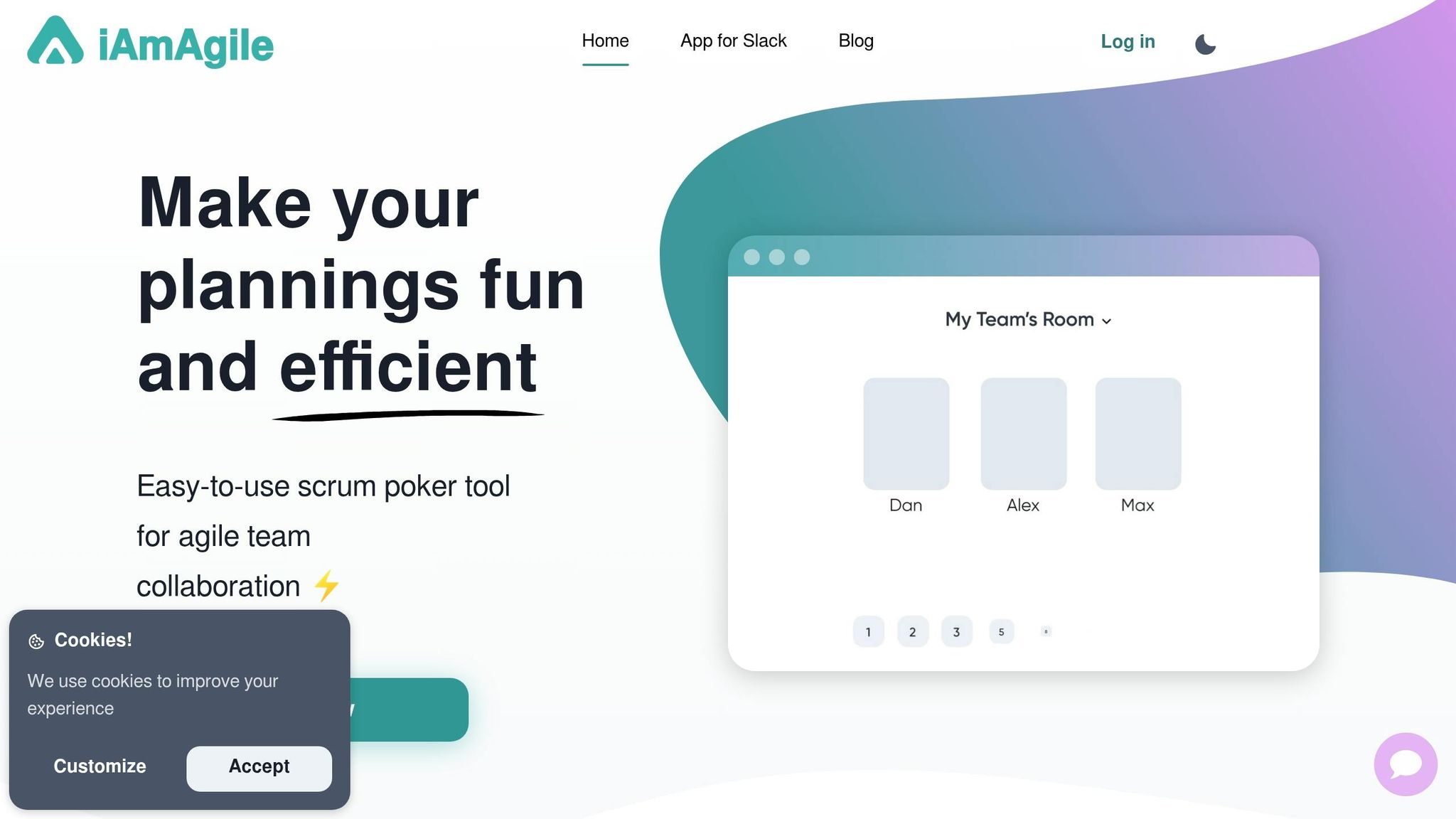
iAmAgile showcases how API-driven estimation can enhance agile processes. Its customizable voting scales, powered by flexible API endpoints, allow teams to tailor estimation methods to their needs - whether they prefer Fibonacci, T-shirt sizing, or entirely custom frameworks. This API-first approach ensures that teams can adapt their estimation models as their processes evolve.
The platform’s responsive API design also supports mobile access, keeping team members connected regardless of location or time zone. This feature is particularly helpful for distributed teams or individuals who travel frequently, ensuring everyone stays aligned and engaged.
What to Expect from API Estimation by 2030
AI-Based Forecasting Models
By 2030, estimation methods will move away from relying on "expert guesses" and embrace adaptive systems that continuously learn from delivery data. Instead of fixed deadlines like "June 15", teams will work with probabilistic ranges - P50 (50% confidence) and P80 (80% confidence) - which better reflect the natural variability in project timelines [21,22].
Organizations already using AI-driven estimation tools are seeing accuracy improvements of 40–60% compared to older methods. Meanwhile, industry data highlights that 60–80% of current software projects exceed their original time estimates by an average of 27%. Machine learning will help close this gap by analyzing planned versus actual performance data, automatically pulled via APIs from tools like task managers, version control systems, and ticketing platforms [21,22].
"Between 2025 and 2030, estimation and scheduling will stop being 'expert guesses with templates' and become living systems that learn from real delivery signals." – Safwan Azeem, Project Management Expert
Future models will also treat dependencies as core data points, using graph-based intelligence to predict where cross-team handoffs might fail. Tools like GitHub Copilot are already speeding up coding tasks by 55.8% in trials, shifting the focus from tracking absolute hours to evaluating complexity - while keeping story points constant.
These advancements will reshape estimation processes to align with the needs of modern, hybrid work environments.
Support for Hybrid Team Structures
As AI systems improve, estimation tools will adapt to address the challenges of hybrid work. Hybrid teams face unique issues in planning, and APIs will evolve to ensure accuracy and fairness across distributed teams. Predictive analytics will help balance the dynamics, treating all team members as remote to prevent in-office participants from dominating planning discussions.
By analyzing historical sprint data, APIs will flag estimation biases linked to specific team members or patterns. For instance, if remote employees tend to underestimate tasks while office-based workers overestimate, the system will highlight these trends and suggest adjustments. This is especially important as 80% of agile teams regularly roll work into the next sprint, with 36% citing dependency delays as the primary reason.
Asynchronous estimation will become the norm for distributed teams. Instead of requiring everyone to coordinate in real-time, APIs will allow team members to contribute estimates independently. The system will identify significant discrepancies and only call for live meetings when necessary. Natural Language Processing (NLP) will further streamline workflows by analyzing unstructured text from Slack, meeting notes, and Jira comments to classify blockers and extract key decisions [21,18]. This ensures alignment without the need for constant real-time collaboration.
Security and compliance will also be integrated into the estimation process as schedule variables rather than last-minute obstacles. Machine learning systems will predict "gate readiness" to avoid late-stage freezes, offering hybrid teams better visibility into potential delays - regardless of their location. These advancements will seamlessly integrate into API infrastructures, reinforcing the role of APIs in driving both AI-powered and hybrid work-friendly estimation workflows.
How to Adopt API-Driven Estimation in Your Team
Evaluating Your Needs and Choosing APIs
To get started with API-driven estimation, it's crucial to first identify your team's specific challenges. Are you struggling with accuracy, managing remote collaboration, or dealing with manual processes? Pinpointing these pain points will help you decide whether you need a simpler tool or a more advanced AI-powered solution.
If you're considering AI, be mindful of the costs. For example, aim to keep AI-related expenses around 1.6% of your total revenue. Also, remember that the cost of AI models can vary dramatically - by as much as 10–25 times - depending on the tier you choose. For simpler tasks, a "Heuristic mode" (regex-based and cost-free) might be sufficient, while "AI mode" is better suited for tasks requiring more nuanced reasoning. For teams just starting out, heuristic approaches often strike the right balance between functionality and cost.
Keep in mind that hidden costs like retries, prompt overhead, and "thinking tokens" can increase expenses by 30–50%. To avoid surprises, set clear budget limits - implement spending caps at 150% of your estimated monthly spend and configure alerts at 50%, 80%, and 100% of your budget. Laying this groundwork ensures a smoother adoption process.
Connecting APIs to Your Agile Tools
Before diving into multiple integrations, start small. Begin with a single API integration to master the basics, like authentication and error handling. For security, use Sanctum tokens or OAuth, and always store API keys in environment variables instead of hardcoding them.
Platforms like iAmAgile (https://iamagile.io) make integration straightforward. For example, you can link it to Slack to enable real-time voting sessions. Team members can join using a session code to submit their estimates instantly. The platform also supports customizable voting scales (like Fibonacci or T-shirt sizes) and is mobile-friendly - perfect for hybrid teams spread across locations and time zones.
To ensure consistency, use OpenAPI or Swagger standards. These act as a "contract" between your estimation tool and Agile platform, keeping data formats uniform across different systems. As Kalin Chernev, a Senior Web Developer, explains:
"The Open API specification makes sense just enough to empower developers and business people to have a common language of how an interface should work. It is as a contract of communication and data format between humans and machines".
If you're building custom integrations, watch out for rate limits (often around 60 requests per minute) to avoid service interruptions during live sessions. Once your integration is in place, thorough testing is key to refining and scaling your setup.
Testing and Expanding Your API Setup
Testing is where you validate your initial integration and prepare for broader adoption. Start with pilot tests during sprint planning before rolling out to the entire team. Use a four-layer testing strategy:
- Contract testing to validate schemas
- Functional testing for business logic
- Security testing for authorization
- Performance testing for latency and throughput
Since API tests are 10–100 times faster than UI tests, they're ideal for quick iterations and scaling.
To maintain consistency, establish reference stories as calibration points. For example, define what a 1-point story looks like (e.g., adding a simple field) versus a 5-point story. Track estimated points against actual effort to identify trends during retrospectives. Keep estimation discussions short - 2–3 minutes per story - and use agreements like defaulting to the higher estimate if consensus isn't reached to keep things moving.
For long-term stability, integrate your estimation tools with your CI/CD pipeline. This allows you to run functional and contract tests on every pull request, ensuring the system remains stable as you add new features or grow your team. Start small - use one team to gather data over two to three sprints - then expand based on measurable improvements in accuracy and planning efficiency.
Conclusion
Agile estimation is undergoing a transformation, driven by innovations like API-based automation. The results speak for themselves: top-performing agile teams are achieving an 88% on-time delivery rate and cutting lead times by 40%. Companies are also quoting projects up to 10 times faster compared to traditional methods. These aren't just theoretical gains - real-world applications demonstrate their impact.
Take Salesforce, for example. Over 18 months leading up to early 2026, Salesforce implemented API-driven Monte Carlo planning across more than 200 engineering teams, achieving an impressive 92% velocity predictability. Similarly, ING Bank's adoption of API-integrated forecasting saved €10 million annually while boosting throughput by 35%.
APIs do more than just enhance speed and accuracy - they empower teams to focus on innovation. When GPT-4 was tested for story point estimation via API, it aligned with human teams' estimates 44% of the time and stayed within one step 79% of the time. This shows that API tools complement human judgment rather than replacing it. Agile expert Mike Cohn from Mountain Goat Software captures this balance perfectly:
"The real choice isn't whether to estimate. It's whether estimates are explicit or implicit, discussed or denied."
The strategies outlined in this guide - from AI-assisted forecasting to database-driven feature libraries - are ready to be implemented. Whether starting small with a Slack integration or building a robust predictive pipeline, the tools are available now. By analyzing past projects, spotting recurring trends, and embracing data-driven methods, teams can position themselves as leaders in agile estimation for years to come. For more expert perspectives, explore the iAmAgile blog.
FAQs
What data does an estimation API need to work well?
To function well, an estimation API needs detailed task information such as the scope of work, complexity, and historical data from similar projects. Important inputs include team velocity, previous delivery timelines, and performance metrics. Adding collaborative elements like story points and real-time updates can make predictions even more precise. Newer methods are also leveraging AI and machine learning to improve forecasts, particularly for intricate or high-risk projects.
How do P50 and P80 dates change sprint planning?
In Agile workflows, P50 and P80 dates are tools used to predict the likelihood of completing work by certain deadlines. A P50 date indicates a 50% chance of finishing the work on time, while a P80 date reflects an 80% likelihood.
During sprint planning, these estimates play a critical role in managing risks and setting achievable goals. P80 dates lean on the cautious side, helping teams avoid overcommitting by accounting for uncertainties and potential delays. On the other hand, P50 dates strike a balance, offering more moderate timelines.
By incorporating these probabilistic estimates, teams can plan with greater accuracy, factoring in dependencies and uncertainties to enhance overall predictability.
How do we roll out API-based estimation without disrupting the team?
To implement API-based estimation effectively, careful planning and a phased introduction are key. Begin by clearly communicating the changes to your team and offering any necessary training. It's also important to seamlessly integrate the process into tools your team already uses, like Jira, to avoid unnecessary complexity.
Incorporating collaborative tools, such as iAmAgile's Scrum poker, can make estimation sessions more interactive and keep the team engaged. Start with small pilot sessions to test the waters and let the team get comfortable with the approach. Gradually scale up from there, ensuring a smooth transition that minimizes any impact on productivity.
Ready to improve your team's planning?
Put what you've learned into practice! Make your next planning session more engaging and accurate.
Try for free - no signup required