Scrum Poker: Boosting Accuracy and Speed in Estimation
Published Jul 20, 2026
⦁
9 min read
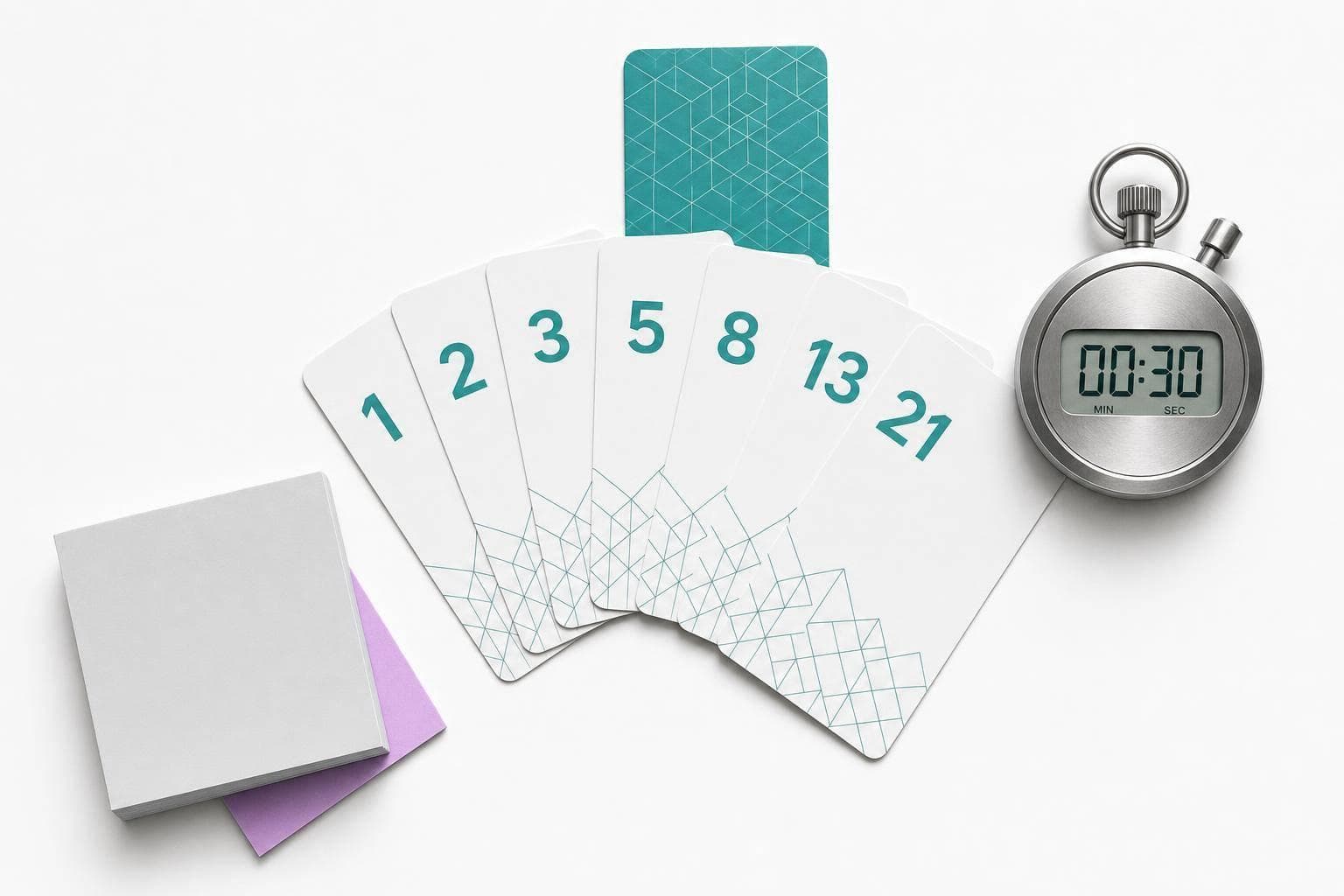
Scrum Poker: Boosting Accuracy and Speed in Estimation
If sprint estimates keep missing the mark, Scrum poker is often the fix. I use it to cut bias, keep planning short, and spot missing work before a sprint starts.
Here’s the short version:
- Private voting stops the first number from steering the group.
- Story points work better than hours for uncertain software work.
- Outlier votes often point to test work, setup, dependencies, or vague scope.
- Timeboxes keep each story moving: about 1–2 minutes to clarify, 10–30 seconds to vote, and 1–4 minutes to discuss and re-vote.
- Ready backlog items and 3–5 reference stories help teams stay consistent.
- Cross-functional input matters because developers alone can miss QA, UX, and deployment effort.
- If a story is still far apart after two rounds, I’d split it, park it, or estimate high and move on.
In plain English: Scrum poker is a simple way to get better estimates without long planning meetings. It works by making everyone vote on their own first, then using vote gaps to find hidden scope. That gives product owners a firmer basis for forecasting and helps teams avoid overcommitting or leaving sprint capacity unused.
A few points stand out:
- Hour estimates can look exact, but they often turn into long debates.
- A story above 13 points is usually too big and should be split before planning.
- A moderate vote spread like 3, 5, 5, 8, 5 often just needs a short talk and a re-vote.
- A large spread like 2, 5, 13, 8, 21 usually means the story is not ready.
| What I look at | What helps |
|---|---|
| Bias in estimates | Private, same-time reveal |
| Slow planning | Short timeboxes per story |
| Vague stories | Backlog refinement before planning |
| Inconsistent sizing | Shared reference stories |
| Hidden work | Ask low and high voters to explain |
| Remote teams | Digital voting tools with same-time reveal (like planning poker in Slack) |
Bottom line: Scrum poker works best when the backlog is ready, the whole team joins, and the group treats estimation as a repeatable team habit instead of a one-time meeting task.
"Planning Poker Explained | Agile Estimation Made Simple for Scrum Teams"
The estimation problems Scrum poker solves
Scrum poker helps teams avoid three estimation traps that show up all the time: anchoring, groupthink, and unclear scope.
Anchoring, groupthink, and unclear scope
Once someone says a number out loud, the rest of the group often drifts toward it. That’s anchoring in action. Add a strong personality to the room, and people may hold back even when they see missing work. Testing, migration, and setup tasks get skipped, and sprint commitments end up off target.
Unclear backlog items create a different mess. Instead of sizing the work, the team starts figuring out what the work even is. That usually leads to bad estimates, especially when requirements are vague, shifting, or poorly documented.
If the team still can’t line up after a few rounds, that’s usually a signal - not a failure. The story likely needs more detail, or it should be split into smaller pieces. Scrum poker brings that problem to the surface fast.
Why hour-based estimates often slow teams down
Hour-based estimates can look precise, but software work rarely behaves that way. Uncertainty, dependencies, and changing requirements make exact numbers shaky from the start.
There’s another issue: hours depend a lot on who’s doing the work. A senior developer and a junior developer may give very different estimates for the same task. That makes team agreement harder and often leads to long debates that don’t change the plan much.
Story points work better because they focus on relative effort and complexity. Hour estimates push teams toward a false sense of precision.
And when teams convert story points back into hours, they bring the same problems right back. It also turns velocity into a time-tracking tool, which misses the point. Velocity should help forecast team capacity, not measure individual output. Scrum poker helps prevent that by keeping estimates relative and discussing them only after everyone votes on their own.
How Scrum poker improves accuracy without slowing planning
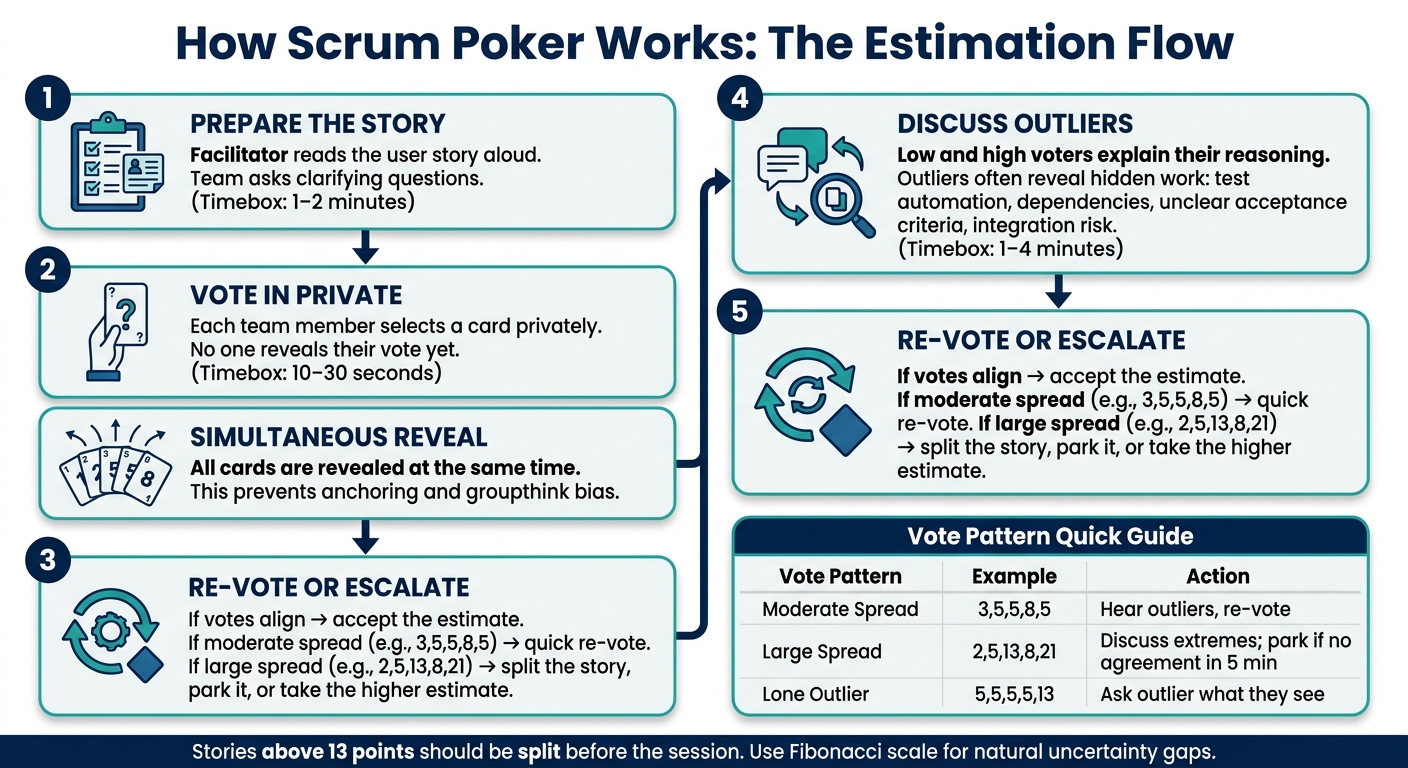
How Scrum Poker Works: Step-by-Step Estimation Process
Once bias and fuzzy scope are under control, the next job is simple: keep estimation moving.
Private voting and simultaneous reveal reduce bias
The facilitator reads the story and its constraints, the team asks a few clarifying questions, and everyone votes in private before the cards are revealed at the same time.
That small change matters a lot. When no one sees the first number before voting, the group is less likely to drift toward it. The result is better estimates without dragging out the conversation.
Fibonacci sizing also helps. The larger gaps between numbers make it easier for people to show uncertainty instead of pretending a story fits into a neat, exact estimate.
How outlier votes surface hidden work
A wide spread in votes isn't bad news. It's often the useful part of the exercise.
Say most of the team votes 3, but one tester votes 13. That gap can point to work the rest of the team hasn't seen yet, like:
- hidden test automation work
- unclear acceptance criteria
- a dependency on another team
- integration risk before the sprint starts
The best move is to ask the outlier to explain their thinking, then use that discussion to tighten the scope. Tight clusters usually mean consensus. A small split may only need a fast re-vote. But a big gap is often a sign to park the story or split it into smaller parts. In practice, that short discussion often brings missing context to the surface before sprint planning ends.
Timeboxing keeps sessions fast and focused
Speed comes from clear limits. Timebox each story:
- 1–2 minutes to clarify
- 10–30 seconds to vote
- 1–4 minutes to discuss outliers and re-vote
If the second vote is still far apart, park the story and move on.
That pace usually depends on three things: backlog items that are ready, shared reference stories, and a tool that makes voting easy.
Practices and tools that make Scrum poker work better
Use ready backlog items and reference stories
Once the voting format is set, the next thing that matters is prep. That’s what keeps the session from dragging. Fast estimation depends on ready stories.
That prep usually happens during backlog refinement before planning. Each story should follow a standard format, include a clear definition of done, and be small enough to fit into one sprint. If a story is above 13 points, split it before the session starts.
Reference stories also help a lot. Pick 3–5 completed stories that the team knows well, often with one example for each common point value, and review them at the start of each session. Use plain, familiar stories as anchors. When people can compare new work to something concrete, estimates stay more steady from sprint to sprint.
That shared baseline also helps the team spot estimates that hide extra work.
Include all roles and review estimation patterns
Reference stories work best when the full team is there. Once stories are ready, input from different roles helps surface work that might otherwise slip by. If only developers estimate, teams often miss testing, UX, and deployment effort. Bringing in QA, design, and DevOps helps uncover that scope before the sprint begins, not halfway through it.
A simple habit can help here: ask each role what it sees before voting. That makes room for testing effort and non-functional requirements instead of letting them fade into the background.
Then, after each sprint, compare the estimates with what the team completed. If the same types of misses keep showing up, bring them into retrospectives and look for patterns.
Support remote sessions with a digital Scrum poker tool
When the team is spread out, a digital tool helps keep the same ground rules in place. iAmAgile is a Scrum poker tool built for agile team collaboration.
It supports simultaneous private voting, so everyone - remote or in the office - submits an estimate at the same time without seeing anyone else’s card first. The voting scale can be customized, which means teams can use Fibonacci, T-shirt sizes, or whatever scale fits their process. It also connects with Slack, so teams can start a session right from their workspace with a /poker command. That means less context switching during planning. Since the platform is mobile-friendly, people can still join when they’re away from their desks.
Structured voting, familiar workflows, and mobile access help keep estimation smooth for both co-located and distributed teams.
When Scrum poker works best and what to watch for
Best-fit situations and common pitfalls
Even with solid estimation habits, Scrum poker only pays off when the setup is right.
Scrum poker gives the most value to cross-functional software teams that estimate relative complexity on a regular basis, most often during sprint planning every one to two weeks. It fits best when the backlog keeps moving and stories vary a lot in complexity. It also works best when people from different disciplines are estimating the same story, because each person spots different risks, gaps, and hidden work.
Things start to fall apart when stories aren't ready. If acceptance criteria are missing, scope is fuzzy, or dependencies aren't defined, the team ends up guessing. That slows the discussion and weakens the estimate. New teams can also struggle at first because story points feel abstract. Another common time sink is arguing over whether a story is a 3 or a 5 when the gap barely matters. If the estimates are next to each other, pick the higher number and keep going.
When votes spread out, that pattern usually tells the team what to do next.
| Voting Pattern | Example | Action to Take |
|---|---|---|
| Moderate spread | 3, 5, 5, 8, 5 | Hear the low and high votes, then re-vote. |
| Large spread | 2, 5, 13, 8, 21 | Discuss the extremes; if no agreement emerges after 5 minutes, park it. |
| Lone outlier | 5, 5, 5, 5, 13 | Ask the outlier what they see. |
If a story still doesn't have a clear estimate after two rounds, split it, park it, or go with the higher estimate. Forcing agreement on a vague item doesn't solve anything. It just delays the actual issue.
Conclusion: Better estimates come from structure, discussion, and consistency
Scrum poker works because it brings together three things that many estimation methods miss: bias reduction through private voting, focused discussion sparked by different estimates, and timeboxed sessions that stop planning from dragging on. Each part supports the others.
Teams that get the most from it don't treat it like a one-off trick. They use it as a calibration habit. Over time, that consistency turns planning poker into a steady forecasting habit. iAmAgile helps distributed teams keep those same ground rules in place.
FAQs
How do we choose story point values?
Start with a baseline. Pick a few recently finished tasks that the team knows well, then use them as reference points. From there, estimate each user story by comparing its volume, complexity, and uncertainty against those baselines.
Most teams use the Fibonacci sequence (1, 2, 3, 5, 8, 13, 21) or T-shirt sizes (XS, S, M, L, XL) for high-level planning. iAmAgile supports customizable voting scales, so your team can use the setup that fits its workflow.
Who should join a Scrum poker session?
A Scrum poker session works best when the full team is in the room. You want developers, QA, and designers there so each angle gets heard.
That usually also means the Product Owner joins to clear up requirements, while a facilitator - often the Scrum Master - keeps the discussion focused and moving. If your team works from different locations, iAmAgile can help everyone collaborate in the same session.
What should we do if votes stay far apart?
If the votes are all over the map, ask the people with the highest and lowest estimates to walk through their thinking. That usually brings hidden complexity, risks, or missed details into the open. Then the team can vote again with a clearer shared view.
If the estimates are still far apart after a few rounds, the task is probably too big or too fuzzy. Break it into smaller parts, or pause it until you have more information and can refine it.
Ready to improve your team's planning?
Put what you've learned into practice! Make your next planning session more engaging and accurate.
Try for free - no signup required