Solving Estimation Errors with Feedback Loops
Published Jul 27, 2026
⦁
11 min read
Solving Estimation Errors with Feedback Loops
Most Scrum estimation problems keep happening because teams don’t compare estimates with what they finished.
I’d sum it up like this: if I want estimates to get better, I need to treat them like forecasts, check them every sprint, and correct the same bias over time. The article’s main point is simple: use sprint data, team discussion, and a no-blame review process to cut repeat estimation misses.
Here’s the short version:
- Story points are not hours. Many teams use Fibonacci for story points to better reflect uncertainty. When I treat them like time, planning gets off track.
- Team bias skews estimates. This often happens when senior people speak first or when teams average far-apart Planning Poker votes.
- Capacity is often lower than expected. Actual coding time may be only 50–60% of theoretical hours after meetings and admin work.
- Carryover is a warning sign. Keeping unfinished work under 10% of sprint commitment is a useful target.
- Past sprint data helps fix future estimates. I can use velocity, cycle time, throughput, and estimate-vs.-actual ratios to recalibrate.
- Team safety matters. If people feel judged for misses, they stop speaking honestly about risk.
A simple example: if a type of task keeps taking 1.5x more effort than expected, I should use that pattern in the next sprint instead of calling it a one-off mistake.
The article then walks through the main error patterns, the sprint events where I can review them, and the team habits that make estimates more steady over time.
Feedback Loops and Agile Scrum Planning for Projects
Common Estimation Errors and the Patterns Behind Them
Most estimation misses don’t come out of nowhere. They usually come from a small set of patterns that show up again and again.
Story Point Misuse That Distorts Forecasts
Story points are not hours. They’re a way to size work based on complexity and uncertainty, not a proxy for how long one person will take to do it.
Once a team starts treating story points like time, forecasts get shaky fast. People begin estimating the person instead of the work, and that throws off planning.
Team Biases That Skew Planning Poker Results
Anchoring often starts when the most senior voice in the room says a number first. The rest of the team then drifts toward that number instead of estimating on their own. That can turn Planning Poker into quiet agreement rather than honest debate, and hard technical problems may get brushed past.
Averaging far-apart cards is another common mistake. If one person plays a 3 and another plays a 13, landing in the middle at 8 may feel like a neat fix. But it skips the part that matters most: the discussion. That kind of gap usually points to a real disagreement about scope or hidden complexity. Smooth it over too fast, and people leave with different ideas of what the work involves.
Metrics That Reveal Estimation Problems Early
If a team keeps missing estimates by the same ratio, use that ratio to reset future forecasts. Track the estimate-to-actual gap each sprint. That’s the clearest sign that estimates are drifting.
These signals help the team spot drift early instead of only talking about it after the sprint is over.
| Estimation Error / Anti-pattern | Typical Cause | Impact |
|---|---|---|
| Treating Story Points as Time | Pressure for exact dates; lack of Agile training | Inaccurate forecasts and loss of flexibility |
| Anchoring / Senior Voice Influence | Most senior member speaking first | Missed risks; groupthink where critical technical hurdles are ignored |
| Averaging Divergent Cards | Avoiding uncomfortable conflict | Masked complexity; team members working from different assumptions |
| Excluding Roles | Viewing estimation as a dev-only task | Hidden work discovered late in the sprint; failed Definition of Done |
| Capacity Overloading | Management pressure; ignoring recent delivery reality | Constant overcommitment; missed sprint goals |
| Unclear Stories | Rushed backlog refinement; PO lack of availability | Unstable estimates and mid-sprint scope changes |
That comparison then becomes the feedback loop for the next sprint.
How Feedback Loops Reduce Estimation Errors
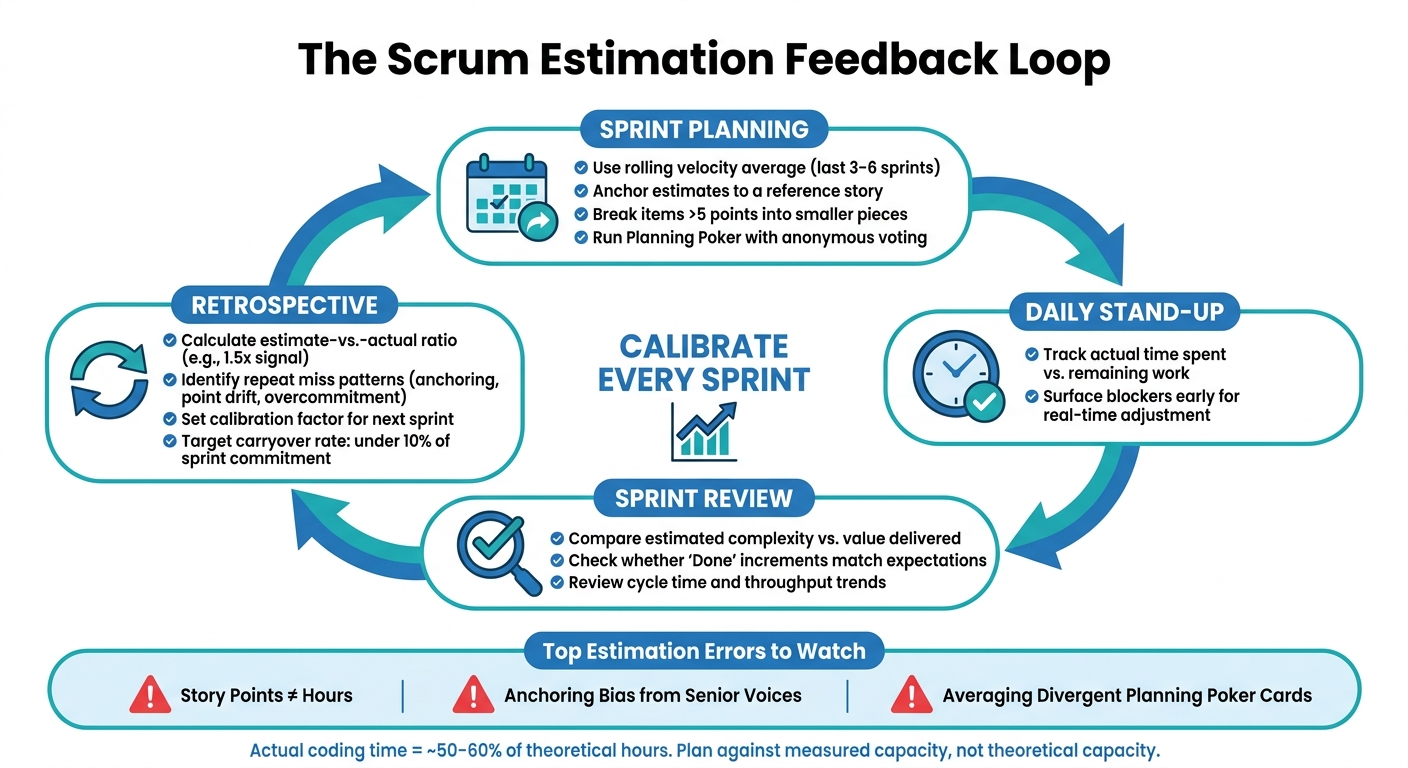
Scrum Estimation Feedback Loop: How to Fix Repeat Misses Every Sprint
A feedback loop is a repeat cycle: compare what the team expected with what actually happened, then use that proof to make the next estimate better. In Scrum, that cycle shows up in sprint planning, the sprint review, and the retrospective. It matters most when the team is dealing with the same misses again and again - story-point drift, anchoring, and overcommitment.
Treat estimation as a calibration process, not a one-time guess.
| Feedback Loop Practice | Agile Event | Data Used | How It Reduces Estimation Error |
|---|---|---|---|
| Velocity-Based Planning | Sprint Planning | Rolling average of past 3–6 sprints | Prevents overcommitment with actual delivery history |
| Task Decomposition | Sprint Planning | Story points / task hours | Small items expose hidden dependencies early |
| Real-Time Tracking | Daily Stand-up | Actual time spent vs. remaining work | Surfaces blockers early so the team can adjust |
| Empirical Review | Sprint Review | Completed "Done" increments | Checks whether estimated complexity matched the value delivered |
| Estimate vs. Actual Analysis | Retrospective | Story points vs. actual time/effort | Produces a calibration ratio to correct team-wide bias |
| Flow Metric Analysis | Retrospective | Cycle time and throughput | Sharpens future capacity forecasts with hard workflow data |
Using Sprint Events to Compare Estimates Against Actual Results
Start with the misses that already show up in planning poker and sprint overcommitment. Then track the estimate-to-actual ratio every sprint. If a 3-point task keeps taking the equivalent of 4.5 hours of effort, that’s a 1.5x ratio. That’s not just a bad guess. It’s a calibration signal for the next round of planning.
Sprint reviews and retrospectives are the best places to make that comparison. In the review, look at whether estimated complexity matched the value delivered. In the retrospective, dig into why some items came in larger or smaller than expected. Common causes include hidden dependencies, technical debt, and unclear scope. Write down the reason for each miss so patterns don’t slip by.
Combining Team Reflection With Delivery Data
Use team judgment first, then check it against delivery data. Reflection works better when it sits next to cycle time, throughput, and carryover rate. Carryover rate - the percentage of unfinished work that rolls into the next sprint - is especially useful. A target of under 10% of total commitment is a reasonable benchmark.
If cycle time keeps creeping up from sprint to sprint, that’s a sign the team needs to change how it sizes or scopes work. Those metrics give the team something concrete to react to, which makes course correction faster.
Feedback Loop Techniques Teams Can Apply Right Now
Once the team can see the gap, these habits help turn feedback into action. Estimation gets better when teams compare estimates with what actually happened and then adjust every sprint.
Calibration Practices for Planning, Reviews, and Retrospectives
In sprint planning, use a reference story to ground new estimates. Pick a completed item that everyone agrees was a 2-point or 5-point task, then size new stories against it. This keeps points from drifting over time. It also helps to break down any item larger than 5 points into smaller pieces that the team can finish in 1–2 days. Smaller work items make hidden complexity show up earlier, before it turns into a nasty end-of-sprint surprise.
During planning poker, wide vote spreads should start a discussion, not lead to an average. If one person votes low and another votes high, the gap is telling you something. Averaging smooths over that signal. Ask the highest and lowest voters to explain their thinking, then keep talking until the team can refine or split the story. That back-and-forth is often where hidden scope and shaky assumptions come out.
In retrospectives, look at 3–5 finished stories of the same size and compare the actual effort. If the team keeps underestimating, track the ratio between estimated time and actual time, then use that ratio as a calibration factor in future planning. Plan against measured capacity, not theoretical capacity.
| Technique | Where Used | Inputs | Feedback Output | Effect on Estimation Accuracy |
|---|---|---|---|---|
| Reference Benchmarking | Sprint Planning | Completed baseline stories | Relative size comparison | Medium; ensures consistency across sprints |
| Outlier Discussion | Planning Poker | High/low votes | Uncovered risks and assumptions | High; prevents hidden scope from slipping through |
| Recent velocity average | Sprint Planning | Average velocity from the last 3–5 sprints | Realistic capacity ceiling | High; prevents overcommitment |
| Compare with past stories | Refinement | Two similar past stories | Validated point value | Medium; prevents point drift over time |
| Calibration Ratio | Retrospective | Estimated vs. actual time | Calibration factor | High; adjusts for chronic optimism bias |
| Cycle time and throughput review | Sprint Review | Cycle time and throughput | Trend-based forecasts | High; improves long-term release reliability |
Using iAmAgile to Support Repeatable Estimation Feedback

iAmAgile helps teams build this feedback loop into their day-to-day work. It offers anonymous Scrum poker in Slack, custom voting scales, and mobile access. It also tracks estimation accuracy over time, so teams can see whether their sizing is getting more reliable or if the same problems keep showing up.
When to Use Flow-Based Forecasting Alongside Story Point Estimates
Story points are useful for sprint-level planning. But for release planning or multi-sprint forecasts, they need a second check.
Use cycle time and throughput to test whether estimates still line up with delivery reality. For release forecasts, use average velocity minus one standard deviation as a conservative planning check. That gives the team a safer range instead of a best-case guess.
Flow metrics don't replace story points. They act more like a gut check for longer-range forecasts. And that same data can support the team habits needed to keep improving. Still, none of this works if people can't question estimates out in the open.
Building a Team Culture That Improves Estimates
The data may show the miss. But culture decides what happens next.
A team only learns from bad estimates when people treat estimates like forecasts, not report cards. If an estimate starts to feel like a judgment of someone's skill, people stop being open about risk and uncertainty. And once that happens, the feedback loop falls apart.
Create Safety to Question Estimates Without Blame
Psychological safety means people can question an estimate without worrying about getting punished for it.
That sounds simple. In practice, it's a big deal.
Keep estimates separate from performance reviews. When a task takes longer than planned, ask why it happened, not who to blame. Treat the miss as data. That's how teams spot patterns instead of hiding them.
When people feel safe enough to speak plainly, estimation gets more honest. And honest estimates are the only kind worth improving.
Once that honesty is in place, the team needs a few ground rules so it doesn't drift back into bad habits.
Set Clear Rules for Ongoing Estimation Improvement
Keep story points relative. Don't turn them into hour targets.
Use retrospectives to compare estimates with actual results, then write down the patterns that show up. Over time, that gives the team a better sizing baseline.
Reviewing estimate accuracy in retrospectives helps teams spot repeat issues, adjust how they size work, and plan with less guesswork.
| Cultural Practice | Behavioral Change | Impact on Feedback Loop Quality | Long-Term Effect on Estimation Accuracy |
|---|---|---|---|
| Anonymous Voting | Team members vote based on their own knowledge rather than following leaders. | Eliminates anchoring bias; provides a true range of perspectives. | Higher initial estimate reliability. |
| Decoupling Points from Performance | Developers admit when a task is more complex than expected. | Encourages honest reporting of misses and actual effort. | Forecasts align with actual team capacity. |
| Empirical Forecasting | Using rolling averages for capacity planning. | Replaces gut-feeling commitments with data-backed reality. | Elimination of chronic overcommitment. |
Conclusion: Use Feedback Loops to Make Estimation More Reliable
That kind of culture turns feedback into steady improvement.
Many estimation errors come from misused story points, unchecked team biases, and too little inspection. The good news is that teams can fix all three with steady habits.
Continuous feedback loops help teams learn from what they actually deliver instead of what they hoped would happen. Calibration, estimate-vs.-actual reviews, and a blameless culture add up over time, leading to more reliable forecasts.
FAQs
How do we measure estimation accuracy without turning story points into hours?
Measure estimation accuracy by looking at historical performance and relative effort, not time. The goal isn’t to guess how many hours a task will take. It’s to see how your team has performed in past sprints and use that pattern to plan with more confidence.
Track velocity to set a baseline for capacity and predictability. That gives you a practical view of how much work the team can usually complete in a sprint, based on what has already happened, not what you hope will happen.
It also helps to review cycle time and throughput. These metrics can show patterns, surface bottlenecks, and make it easier to spot where work slows down. From there, retrospectives give the team a chance to adjust planning based on what past sprints actually show.
Tools like iAmAgile can help support steady relative estimation across the team.
What should we do if our team keeps carrying work over between sprints?
Frequent carryover usually points to overcommitment. In plain terms, the team took on more than it could finish. That often happens because the work was more complex than expected, key dependencies slipped, or time went to non-development work that never made it into the plan.
A better starting point is historical velocity from recent sprints. That gives you a more realistic view of capacity instead of a best-case guess. Then, during retrospectives, look closely at why work stayed unfinished. Was the scope too big? Did another team block progress? Did support work eat up time? Those details matter.
It also helps to break large or unclear stories into smaller tasks. Smaller pieces are easier to estimate, easier to track, and less likely to drift across sprint boundaries.
And estimation shouldn't be a one-and-done exercise. Treat it like a feedback loop: compare estimates with actual outcomes over time, spot patterns, and adjust. If estimates keep missing in the same direction, that's a signal worth paying attention to.
How often should we recalibrate estimates using sprint data?
Set aside 15 to 20 minutes in every sprint retrospective to recalibrate your estimates. Review the metrics, compare the actual effort against the original estimates, and note any patterns or dependencies that slowed the team down.
Do this every sprint, and over 6 to 8 sprints, you'll start to see repeat problems more clearly. That's where planning gets sharper: not from guesswork, but from looking at what happened and adjusting based on it.
Ready to improve your team's planning?
Put what you've learned into practice! Make your next planning session more engaging and accurate.
Try for free - no signup required