Encouraging Quiet Members in Scrum Poker
Published Aug 24, 2026
⦁
9 min read
Encouraging Quiet Members in Scrum Poker
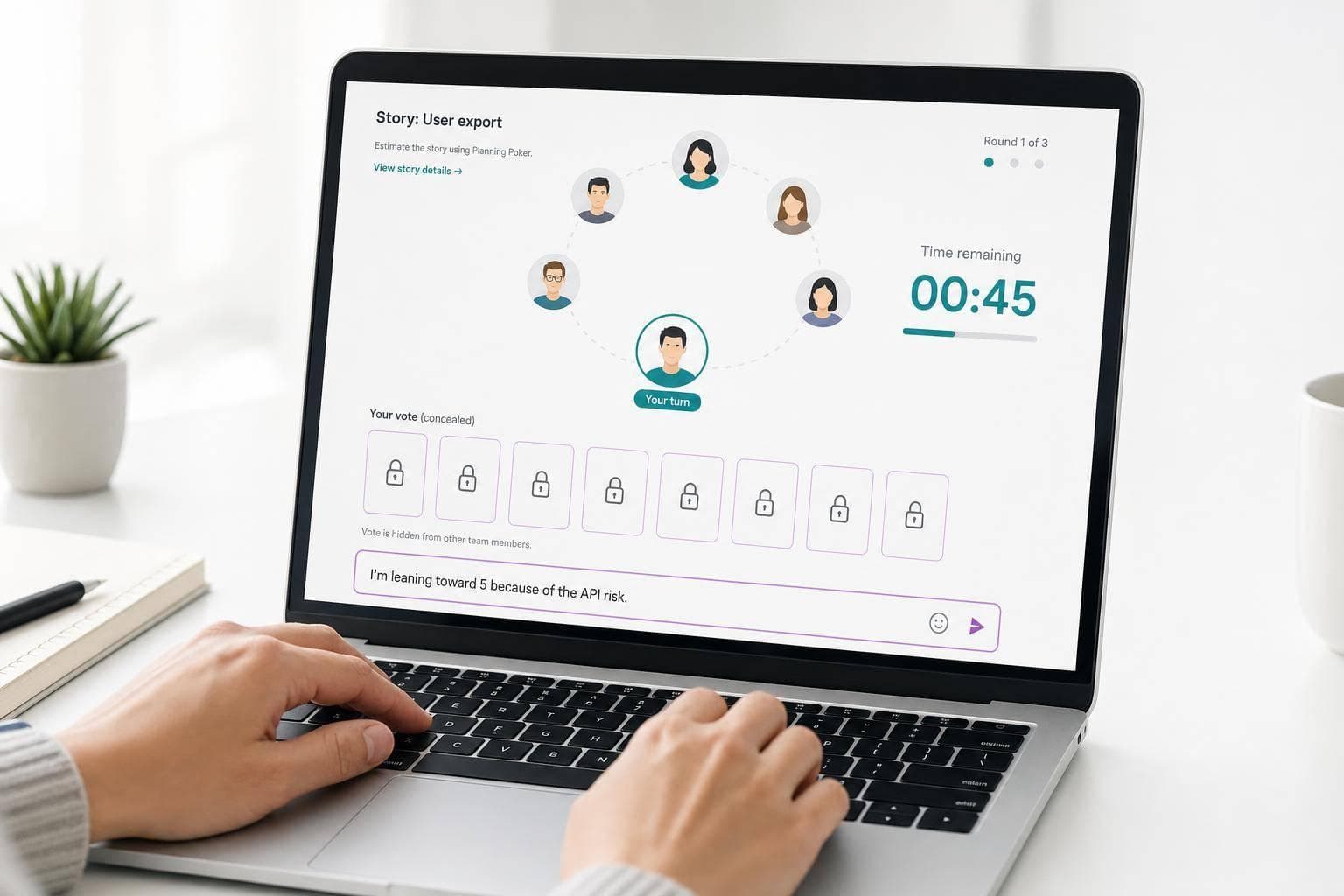
If quiet people do not speak in Scrum Poker, your estimate is weaker from the start. The fix is simple: keep voting private, let everyone speak in turn, use short time limits, and decide fast whether to re-vote, refine, or split the story.
Here’s the short version:
- Private voting first stops early opinions from shaping the room
- Wide vote gaps usually point to different assumptions, risks, or missing detail
- Round-robin turns give each person a clear chance to speak
- 60–90 seconds of silent thinking time helps people prepare before talk starts
- Chat or written notes help remote and quieter teammates join in
- In video meetings, about 48% of people may not speak at all, so verbal-only discussion can miss key input
- 2-minute soft limits and 5-minute hard limits keep one person from taking over
- If the team is still stuck after two rounds, re-vote, send it back to refinement, or split the story
A good Scrum Poker session is not about who talks most. It is about getting each person’s first view, surfacing hidden risk, and ending with a number the team can stand behind.
Equal voice drives engagement #shorts
How Scrum Poker gives everyone equal input before discussion
Scrum Poker Vote Patterns: How to Read the Room & What to Do Next
Scrum Poker works for a simple reason: people commit to an estimate on their own, then reveal at the same time. That means the team gets each person's first take before group pressure starts to nudge opinions around.
Private estimates prevent early influence
The moment someone says a number out loud before others have picked, the round is off track. Early opinions can pull the group in one direction, especially when a senior person speaks first. Junior teammates or quieter people may go along with that view instead of sharing what they think.
Hidden voting cuts that pressure out. A quiet developer might choose 13 while a vocal architect picks 5. Neither person knows the other's estimate until the reveal, which is the whole point.
A simple rule helps here: no numbers, no reactions, no nods until every card is down. If someone speaks too soon, restart the round. It may feel strict, but it protects the process.
For remote teams, using planning poker in Slack with a "3, 2, 1, reveal" countdown helps votes show up together, even with network lag. You still get that same shared snapshot, instead of a messy trickle of answers.
What vote gaps tell you after the reveal
Once the cards are up, the spread becomes useful. Different numbers don't mean the team failed. They usually mean people are working from different assumptions.
Start by asking the highest and lowest voters to explain their thinking in 1–2 minutes each. That short exchange often brings out hidden work, missing risk, or a shortcut the rest of the group hadn't seen.
Use the size of the gap to decide what happens next:
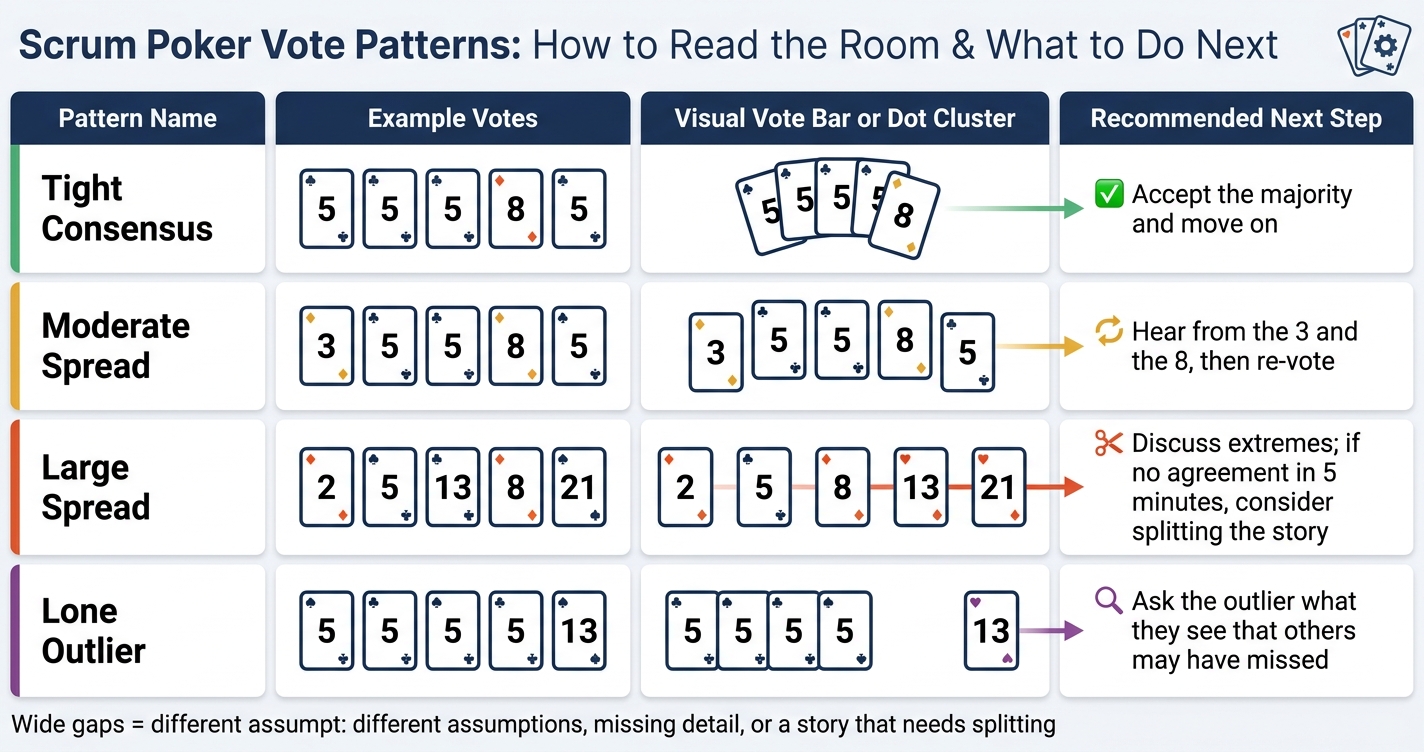
| Vote Pattern | Example | Next Step |
|---|---|---|
| Tight consensus | 5, 5, 5, 8, 5 | Accept the majority and move on |
| Moderate spread | 3, 5, 5, 8, 5 | Hear from the 3 and the 8, then re-vote |
| Large spread | 2, 5, 13, 8, 21 | Discuss the extremes; if no agreement in 5 minutes, consider splitting the story |
| Lone outlier | 5, 5, 5, 5, 13 | Ask the outlier what they see that others may have missed |
That table gives the facilitator a simple way to read the room. A tight cluster usually means the team sees the work in a similar way. A big gap often points to missing detail, mixed assumptions, or a story that's too big and needs to be broken apart.
Facilitation practices that draw quiet members into the conversation
Once the reveal shows that people are working from different assumptions, the facilitator needs to make room for every voice. Good facilitation doesn't mean pushing people to talk. It means setting up the session so speaking feels normal and expected for everyone, not just the most self-assured people in the room. After the vote spread is visible, structure matters more than volume.
Set ground rules for equal speaking time at the start
Before the first card is played, say the norms out loud: one person speaks at a time, no interrupting, keep disagreement respectful, and make sure everyone gets a chance to share before the team lands on a final number. No one speaks until every card is revealed. The goal is to understand the work, not win the estimate debate. That setup matters most when quieter team members might otherwise stay silent.
Clear ground rules make it easier for quieter teammates to join in without pressure. A simple script works well: we'll hear one short comment from each person before we decide, and comments should stay to one or two sentences. Equal speaking time means each person gets a turn before the team decides. Put the rules somewhere people can see them, like the meeting invite or the Scrum Poker board, so the team doesn't have to hash them out again every session.
Use round-robin turns after the card reveal
Open discussion after a reveal often tilts toward the fastest or loudest speakers. Round-robin turns fix that by making the speaking order clear.
After the cards are up, start with the highest and lowest estimators, then move through the group so each person gives a short reaction. Ask brief, concrete questions like:
- "What drove your vote?"
- "What risk do you see?"
That process creates the opening for quieter people instead of waiting for them to jump in on their own. This matters most when the vote spread is wide, because each person gets a set moment to explain what they see without cutting anyone off.
If someone has an outlier estimate, ask that person to explain the assumption behind the card.
Timebox discussion to limit dominant speakers
When people know the discussion window is short, dominant speakers usually get to the point faster, and quieter teammates get a clearer chance to contribute before the conversation wraps up.
If one person starts to take over, thank them and shift to someone who hasn't spoken yet. Set a 2-minute soft limit and 5-minute hard limit per story. Say it before the reveal: we have a few minutes to discuss, then we'll decide whether to revote or move on. If the team still doesn't have consensus after two rounds, park the story for refinement.
Low-pressure ways to support quieter team members
Even after round-robin turns and timeboxing, some teammates still need an easier way in. Good facilitation helps, but it doesn’t solve everything. A few small tactics can lower the pressure without dragging out the round.
Give everyone thinking time before votes and discussion
Add a short, predictable quiet prep phase to every estimation round. After the story and acceptance criteria are read, give the team 60–90 seconds to read, clarify, and vote silently before discussion starts. During that pause, keep attention on understanding the story.
A visible timer on a shared screen for remote sessions, or a phone timer in person, helps the silence feel deliberate instead of awkward. 90 seconds is a good place to start, and teams can adjust if stories are more complex or unclear. Over time, this rhythm helps quieter teammates know they’ll always have protected thinking time before the group starts talking.
Use written or chat-based input when needed
Nearly 48% of participants don’t speak at all during video meetings, so verbal-only discussion can miss useful points of view. In remote Scrum Poker, ask teammates to post a short chat note explaining their vote before discussion begins.
The facilitator can pull up those notes and invite anyone who feels okay doing so to add more. For distributed teams, iAmAgile supports this setup with Slack integration, private voting, written comments, customizable scales, and mobile access. These lower-pressure options keep the discussion open before the team decides what the estimate means.
Handle outlier votes without putting people on the spot
When the spread is wide, ask the lowest and highest voters to share their assumptions first.
Keep the focus on the estimate, not the person who gave it. Ask what factors led to that number, and let the speaker finish before anyone jumps in. If someone doesn’t want to speak, give them an easy out: they can explain it out loud or drop a short summary in chat for the facilitator to read aloud.
Keep estimation moving and end with clear next steps
Once everyone has had a chance to speak, the facilitator still needs to wrap up the round fast. Clear stop rules help the team keep momentum and stop quieter teammates from getting stuck in long, draining debates.
When to re-vote, refine, or split a story
Pick the next step based on what came out of the discussion. Use three stop rules:
- Re-vote when the discussion changes how the team sees the story.
- Return it to refinement when the story is still unclear.
- Split the story when it’s too big or includes more than one outcome.
The key is simple: use the discussion to decide what happens next, not to keep talking in circles.
If the conversation adds nothing new, keep the original vote and move on.
Return the story to refinement when it still feels fuzzy. Repeated uncertainty, "?" votes, or vague acceptance criteria are all signs that the story isn’t ready yet. Write down the open questions and come back to it later.
Split the story when it bundles separate outcomes or when the estimate comes in at 13 points or more. At that size, a story is usually too hard to estimate as a single item. Smaller slices are easier for the whole team to estimate, especially quieter people who may speak less in group discussion.
Key takeaways for Scrum Masters and agile teams
These stop rules protect pace and participation.
The goal is an estimate that reflects the whole team’s understanding. Quiet members need space to contribute without pressure.
Private voting helps prevent anchoring. Structured turns give each person a set moment to speak. Written input and thinking time make it easier for people who don’t jump into open discussion. And clear stop rules - re-vote, return, or split - keep the session from stalling while still protecting space for every voice. Equal input leads to more accurate estimates and better alignment.
FAQs
Why do quiet team members stay silent in Scrum Poker?
Quiet team members may hold back during Scrum Poker when louder voices or senior developers make it hard to speak up. That can happen even when they see a gap, spot a risk, or disagree with an estimate.
A few things tend to drive that silence: fear of judgment, the sense that their input won't matter, different communication styles, and a team climate that doesn't feel safe enough for honest disagreement.
What should a facilitator do when votes are far apart?
Treat big gaps in estimates as a prompt for discussion, not a sign the team is doing something wrong. Start with the people who gave the highest and lowest numbers, and ask them to walk through their thinking first. That often brings hidden complexity, technical risk, or mismatched assumptions to the surface.
Don’t let the most senior person or the loudest voice steer the room. After the discussion, do another round of silent voting. If the team still can’t line up after five minutes, set the story aside for more refinement or create a spike.
When should a story be re-voted, refined, or split?
Re-vote when estimates differ by a fair amount, like 3, 5, 8, and 5. Have the highest and lowest voters explain their thinking, then run the vote again.
If estimates are still spread out after two rounds, if the story is more than 13 points, or if the acceptance criteria aren’t clear, refine it or split it. In many cases, it’s better to park the story for later refinement than force an estimate.
Ready to improve your team's planning?
Put what you've learned into practice! Make your next planning session more engaging and accurate.
Try for free - no signup required