How Planning Poker Builds Team Consensus
Published Sep 21, 2026
⦁
11 min read
How Planning Poker Builds Team Consensus
Planning Poker helps teams agree on estimates by making everyone vote in private, talk through gaps, and settle on a number they can all support. I’d boil it down to this: clear stories, hidden votes, short discussions, and a rule for when to stop.
If I wanted the short version, here’s what matters most:
- Consensus does not mean total agreement. It means the team can support the estimate and move on.
- Private voting cuts bias. No one gets pulled by the first loud voice in the room.
- Big vote gaps are useful. A spread like 3 vs. 13 usually points to different assumptions about scope, risk, testing, or dependencies.
- Good setup matters. The team needs a ready backlog, one scale, clear roles, and simple rules before voting starts.
- The best discussions focus on assumptions, not on defending numbers.
- If the team can’t align after a few rounds, the story likely needs more work - split it, park it, or refine it.
- You can track progress over time by looking at vote spread, re-votes, and estimate changes during the sprint.
A few facts stand out to me from the process:
- Teams often settle estimates in 1 to 3 rounds
- Remote teams usually do better with 2- to 4-minute discussion timeboxes
- A simple rule like choosing the higher number when votes are within one step can keep planning moving
Here’s the core flow in one view:
| Step | What I’d do | Why it helps |
|---|---|---|
| 1 | Start with a clear story and acceptance criteria | Keeps people estimating the same work |
| 2 | Have everyone vote in private | Lowers anchoring and status pressure |
| 3 | Reveal all votes at once | Gives each person equal input |
| 4 | Ask high and low voters to explain assumptions | Finds scope, risk, or test gaps |
| 5 | Re-vote if needed | Moves the group toward alignment |
| 6 | Split or park unclear stories | Stops the team from forcing a bad estimate |
What I like about this method is that it turns estimation into a team conversation instead of a top-down call. The number matters, but the shared understanding matters more. That’s what helps sprint planning feel more steady and less like a guess.
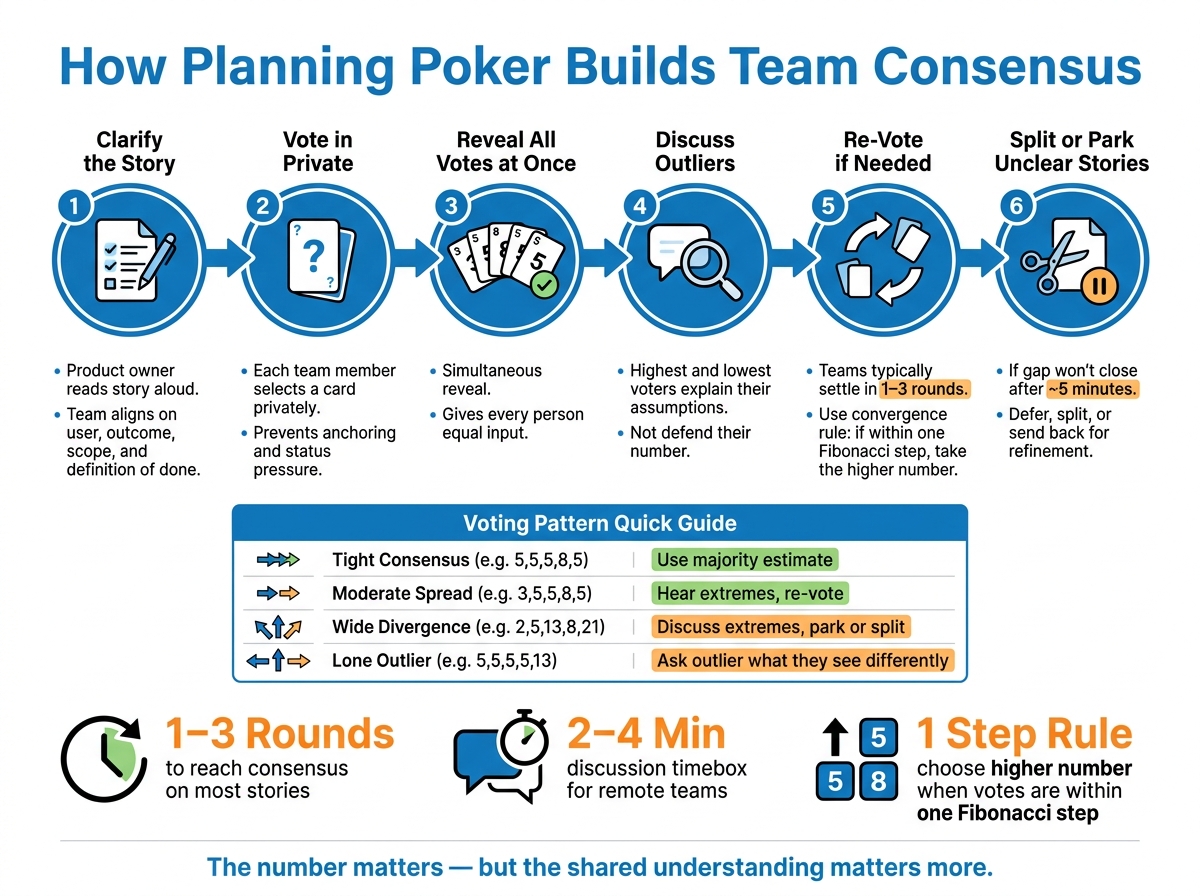
Planning Poker: 6-Step Consensus Process for Agile Teams
Planning Poker Explained: How Agile Teams Estimate Story Points
Set Up Planning Poker Before the Session Starts
Before voting starts, set up the session so every estimate begins from the same starting point.
Prepare the backlog, voting scale, and facilitator role
Get the backlog, scale, roles, and rules ready before the session starts.
Start with a prioritized backlog. The product owner should place the highest-value stories at the top. Each story needs a clear user-facing description and testable acceptance criteria. If a story is vague or too large, split it before the session.
Next, choose one voting scale before the meeting begins. Use Modified Fibonacci for teams estimating by relative size. Use T-shirt sizes for teams that prefer ranges. Whatever scale you pick, write it into the team’s working agreement and set it in your Planning Poker tool so nobody is guessing in the middle of the session.
The Scrum Master facilitates, keeps discussion within the timebox, and records the estimate. Developers and testers estimate. The product owner clarifies scope and answers questions, but doesn’t vote. Put these roles in the meeting invite so there’s no confusion when the session starts.
Set ground rules that make disagreement useful
Before the first vote, the facilitator should set three rules: no criticism of votes, a wide spread is information, and discussion should stay focused on assumptions.
When one person picks 13 and another picks 3, that gap usually means they’re working from different assumptions about scope, dependencies, or risk. That’s the point of the exercise. The team isn’t just picking numbers. It’s surfacing what people see differently.
A practical rule set looks like this:
- The highest and lowest voters speak first after the reveal
- Comments should explain the difference, not defend a number
- Discussion stays timeboxed
- If the team still disagrees after 5 minutes, park or split the story
| Voting Pattern | Example | Action to Take |
|---|---|---|
| Tight consensus | 5, 5, 5, 8, 5 | Use the majority estimate. |
| Moderate spread | 3, 5, 5, 8, 5 | Briefly hear from the 3 and 8, then re-vote |
| Wide divergence | 2, 5, 13, 8, 21 | Discuss extremes, then park or split if needed. |
| Lone outlier | 5, 5, 5, 5, 13 | Ask the outlier what they see that others may have missed |
Use digital tools for hidden votes and quick re-votes
For remote or hybrid teams, the tool matters. Chat-based voting can leak estimates before everyone has committed.
Hidden voting helps keep each person’s input equal until the reveal. A tool like iAmAgile keeps votes hidden until reveal, supports custom scales, and works with Slack and mobile devices.
With the backlog, scale, roles, and rules in place, the team can move into the first vote. Next: clarify the first story, then start the voting round.
How to Run a Planning Poker Session Step by Step
Clarify the story before anyone votes
Before anyone touches a card, the product owner reads the user story out loud and gets the team aligned on four points: who the user is, what result they expect, what is clearly out of scope, and the definition of done.
This matters because estimation falls apart when people are picturing different versions of the same story. If there are open questions about acceptance criteria, treat them as blockers to estimation, not loose ends to clean up later. Once the team is working from the same scope, voting can start.
Vote privately, reveal together, and discuss outliers
Each person picks a card in private and reveals it at the same time. That simultaneous reveal helps prevent anchoring, so no one gets pulled toward the first number said out loud.
After the reveal, the facilitator asks the people with the highest and lowest votes to speak first. Don't defend the number itself. Explain the assumptions behind it.
That shift changes the tone of the discussion. You're not arguing over whether a story is a 3 or an 8. You're finding out why one person saw a small task and another saw risk, missing detail, or extra work. Use that conversation to narrow the gap, then vote again.
Re-vote and decide when the estimate is aligned enough to plan
After a short discussion, the team votes again using the same private reveal process. If the spread is tight, record the estimate. If it's still wide, talk through the extremes and vote again.
If the gap won't close, don't force it. Split the story, park it for later, or get more information. When the same disagreement keeps coming back, the problem is often facilitation, not estimation.
Facilitation Practices That Improve Consensus and Engagement
Prevent anchoring, dominance, and long debates
Once the team knows how Planning Poker works, the facilitator’s job is to keep the discussion fair and on track.
Three habits tend to weaken estimates: someone drops a number before the vote, a senior person pulls the group toward one estimate, or the team gets stuck debating implementation details instead of effort. When that happens, the estimate starts reflecting group pressure more than the story’s actual complexity.
Use the reveal to reset the room, then go straight to the biggest spread. Ask quieter team members to speak before senior voices jump in. That small move can change the whole conversation. It keeps the focus on assumptions, not status.
Timebox each story, and stop once the discussion is no longer changing anyone’s view. If the team drifts into solution design, write it down and move it to a separate technical session. Estimation should stay centered on effort and complexity.
A simple convergence rule can also keep things moving: if estimates fall within one step on the scale, choose the higher number and continue.
Adapt Planning Poker for distributed and hybrid teams
These controls matter even more when the team is remote or hybrid.
Remote sessions usually need more structure. Use shorter time boxes - 2 to 4 minutes per discussion round - and call on quieter participants by name when the spread is wide. A round-robin or raise-hand rule can also stop people from talking over one another on video calls. Keep estimates visible on a shared screen during the discussion so everyone is looking at the same numbers.
For teams working across time zones, tools that fit into the team’s current workflow can cut down on coordination friction. iAmAgile integrates with Slack, supports mobile voting, and lets teams use Fibonacci, T-shirt sizes, or custom scales. That means less time spent figuring out the system and more time spent reaching agreement.
Single-round estimation vs. multi-round Planning Poker
Use the first reveal to judge whether the story is ready or whether it needs another round.
For small, routine stories where votes cluster closely in the first round, one reveal is often enough. Most stories settle within one or two more rounds. If the spread is still wide after that, defer the story, split it, or send it back for refinement.
| Dimension | Single-Round Estimation | Multi-Round Planning Poker |
|---|---|---|
| Speed | Faster; one vote and done | Slower; requires discussion between rounds |
| Shared understanding | Limited; assumptions stay hidden | Stronger; outlier discussion exposes gaps |
| Participation | Equal votes, but less dialogue | More voices heard across rounds |
| Bias reduction | Reduces anchoring via hidden vote | Further reduces dominance through repeated independent votes |
| Confidence in estimate | Lower on complex stories | Higher; team has actively reconciled differences |
Review Results and Improve Your Estimation Process
Track signs of stronger consensus across sprints
After each sprint, check whether the team is getting to agreement faster and with fewer surprises.
Planning Poker is doing its job when the team needs fewer rounds to agree and those estimates stay steady during the sprint.
A few simple signals can tell you a lot from one sprint to the next. Fewer major estimate changes mid-sprint usually means the team understood the work before it started. Narrower vote spreads in the first round - with most estimates falling within one step on the Fibonacci scale - point to a tighter shared view of the work. And faster convergence, measured by how many rounds it takes to reach a steady estimate, shows whether the team is getting to consensus more quickly over time. You can also compare estimated points with delivered work to see whether predictability is getting better.
In Jira, Azure DevOps, or similar tools, a simple custom field or tag for voting rounds and estimate changes is enough. Don’t chase perfect data. Look for patterns.
Bring those patterns into the next retrospective.
Use retrospectives to refine rules, scales, and story preparation
Take a short estimate summary into each retrospective: which stories had the widest spreads, which ones were re-estimated, and where discussion got stuck. That gives the team something concrete to react to instead of going off memory.
Then connect the friction to the cause. Vague acceptance criteria, missing technical input, and an unclear Definition of Ready are common reasons estimation debates drag on. Once you know the cause, the fix is often small. You might require at least two or three acceptance criteria before a story goes into Planning Poker. Or you might add a short technical discovery session for high-risk items during refinement. If confusion keeps showing up, simplify the scale. Fewer options can force clearer choices and cut down on edge-case debates.
Treat each sprint as a shot to make the next session better. One concrete experiment per retro, then a check-in during the next sprint, is enough to move things forward over time. Planning Poker isn’t just about estimating. It helps the team build shared understanding sprint by sprint.
Conclusion: Planning Poker builds agreement through shared discussion
Use the data to choose one change for the next sprint.
Planning Poker improves consensus when the team looks at its own estimation patterns and adjusts. Better agreement usually comes from three things working together: clear stories, safe facilitation, and steady practice - whether your team is in the same room, fully remote, or somewhere in between. The method itself is simple. The hard part is sticking to it.
A practical next step is to pick one upcoming sprint and treat Planning Poker as a deliberate experiment. Define two or three consensus indicators - voting rounds, estimate changes, and vote spread - run sessions with clear facilitation rules, and review the data in your next retrospective. Then choose one thing to adjust and test it in the following sprint. That repeated cycle is how estimation gets better.
FAQs
How many people should join a Planning Poker session?
Planning Poker works best when the full cross-functional team is in the room, usually 5–9 members.
That group often includes developers, QA, designers, the Product Owner, and a facilitator - often the Scrum Master - who keeps the discussion on track and focused.
What should we do when estimates keep changing after planning?
When estimates are all over the place, have the people with the highest and lowest estimates walk through their thinking. That usually brings hidden complexity, missing context, or plain misunderstandings into the open.
If the team still can't agree after a few rounds of voting, that's usually a sign the task is too big or too fuzzy. At that point, it makes sense to:
- split the story into smaller pieces
- set it aside for more refinement
- wait until the team has more information
When should a team skip Planning Poker for a story?
Skip or pause Planning Poker when a story is too large or too complex to estimate as a single unit. That’s often a sign you’re looking at an epic, not a story the team can size in one pass.
It also makes sense to set the item aside or break it into smaller parts when the team still can’t agree after several rounds. The same goes for stories that are missing acceptance criteria, have a fuzzy scope, or depend on other work that hasn’t been defined yet.
Ready to improve your team's planning?
Put what you've learned into practice! Make your next planning session more engaging and accurate.
Try for free - no signup required