5 Steps to Align Teams on Story Point Scales
Published Sep 14, 2026
⦁
10 min read

5 Steps to Align Teams on Story Point Scales
If your team gives the same story 3 points one sprint and 8 points the next, your scale is the problem. I’d fix it with five moves: define the scale, set anchor stories, run private voting, lock in team rules, and review for drift every 4–6 sprints.
Story points work best when they measure relative size, risk, and unknowns - not time. In plain terms, a 5-point story should mean “more work and more risk than a 2-point story,” no matter who is in the room.
Here’s the full playbook in one glance:
- Step 1: Write down what each point value means
- Step 2: Use 3 anchor stories from the last 2–4 sprints
- Step 3: Run planning poker with private voting and a 5–10 minute limit per story
- Step 4: Set team rules to stop point drift and point padding
- Step 5: Recheck the scale after a few sprints and after team or tool changes
A shared point scale helps cut estimation drift, makes sprint planning smoother, and gives velocity a more stable role in forecasting. The goal is not perfect estimates. It’s steady relative sizing that the whole team can use the same way.
| Step | What I’d do | Why it matters |
|---|---|---|
| 1 | Define the point scale in writing | Stops each role from using its own meaning |
| 2 | Match the scale to finished stories | Gives the team a shared baseline |
| 3 | Use planning poker | Surfaces gaps in how people see the work |
| 4 | Set rules for estimation | Keeps points from drifting over time |
| 5 | Recalibrate on a schedule | Keeps velocity and forecasting more stable |
If I wanted one takeaway from this article, it would be this: story points only help when the team uses one shared standard, sprint after sprint.
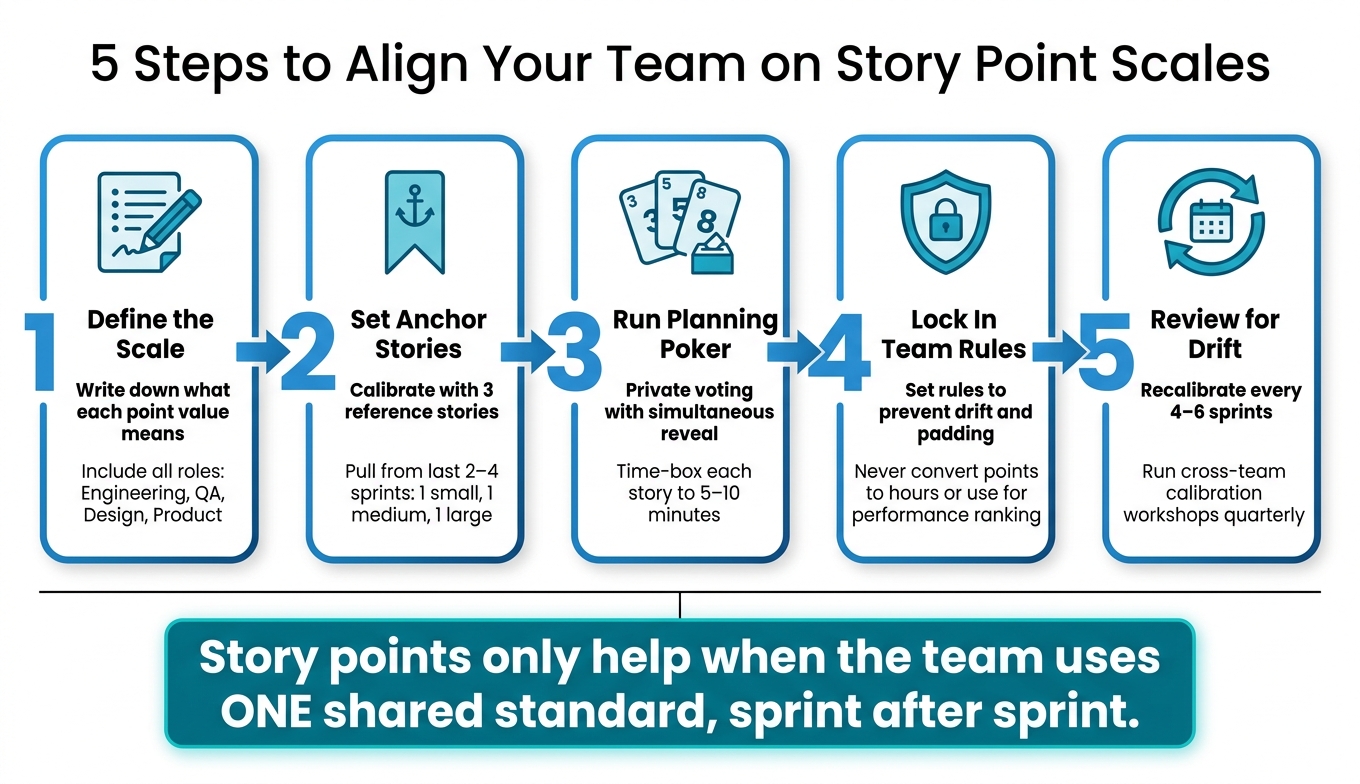
5 Steps to Align Your Team on Story Point Scales
How to Fix Story Point Estimation | Humanizing Work Show
Step 1: Define the scale and write down what each point value means
After you pick a scale, write down what each point means in plain English as a team. That gives everyone the same frame of reference and cuts down on the odds that two people size the same story in two different ways.
A shared scale only works if engineering, QA, design, and product shape it together. Bring all four into the process so each point value reflects the full job, not just coding effort. If one group sets the scale on its own, everyone else may end up using a different meaning.
Story points measure relative size, complexity, dependencies, and uncertainty.
Build a simple story point matrix
The easiest way to make those definitions stick is to create a story point matrix: a short reference table that spells out what each value means for your team. Think of it as your shared sizing cheat sheet. It should stay simple enough to use during planning poker (which you can automate in Slack) without slowing the room down.
Here’s what a practical matrix can look like for a modified Fibonacci-style scale:
| Story Points | Complexity & Uncertainty | Typical Work Pattern | Common Risks |
|---|---|---|---|
| 1 | Very low; no unknowns | Minor text change, simple config update, small bug fix with a known solution | Minimal dependencies, almost no uncertainty |
| 3 | Low; clear requirements | Straightforward feature slice with one known path, basic unit testing needed | Minor integration or test complexity |
| 5 | Moderate; a few moving parts | Small feature involving backend and UI coordination, some QA effort | Dependency management, moderate edge cases |
| 8 | High; noticeable uncertainty | Feature touching several systems or requiring design decisions | Higher coordination cost, increased rework risk |
| 13 | Very high; too uncertain to estimate cleanly | Work that likely needs to be split before delivery | Unclear requirements, significant integration or testing risk |
Keep the matrix short, visible, and current. If a story doesn’t fit any row, split it before estimating. Then use the matrix to calibrate against completed stories in Step 2.
Step 2: Calibrate with reference stories the whole team knows
Once your story point matrix is set, tie it to finished work the whole team remembers. The matrix sets the scale. Reference stories show that the scale holds up in day-to-day work.
Before the team starts sizing new stories, use the matrix to assign each anchor a point value.
Pick three completed stories: one small, one medium, and one large. Pull them from the last 2–4 sprints so the anchors reflect the team’s current architecture, tools, and skill set.
Use completed stories as comparison anchors
When the team sizes a new story, compare it to a known anchor instead of an abstract number. That simple shift makes estimation less fuzzy.
During planning, line each new story up with the closest anchor. This helps the discussion stay on relative effort, complexity, risk, and uncertainty. If votes split, don’t jump straight to the number itself. Ask which anchor feels closer and why.
Keep reference stories visible and up to date
Keep reference stories where everyone can see them during planning. A shared team space with a 5–7 story catalog usually works well. The goal is simple: every role should size work against the same standard.
Each catalog entry should include:
- A short story summary
- The point value
- The main complexity drivers
- Any uncertainty or dependencies
| Story Summary | Points | Key Complexity Drivers | Uncertainty / Dependencies |
|---|---|---|---|
| Add validation to sign-up form | 2 | Simple UI changes, no backend changes, minimal testing | Low uncertainty, no external dependencies |
| Implement user profile edit feature | 5 | CRUD API work, UI forms, moderate regression testing | Dependency on existing user service stability |
| Integrate payment gateway with fraud checks | 8 | Third-party API integration, security considerations, extensive testing | High uncertainty, external provider sandbox issues |
Review the catalog every 3–4 sprints. If an anchor no longer fits its point value, retire it and swap in a more recent example.
Once the anchors are stable, planning poker can check whether the team is using them the same way.
Step 3: Run planning poker sessions that reach real consensus
Once the team has reference stories, planning poker helps you check whether people are sizing new work against those stories in the same way.
The Product Owner or facilitator presents the story. The team asks clarifying questions. Then everyone votes in private using the agreed scale. For example, the team might ask whether cross-browser support is included or whether the work needs integration with the existing API. No one shares a number before the reveal, which helps prevent anchoring. Reveal all votes at the same time. The spread shows where people see the work differently.
Keep discussions focused and time-boxed
Start with the highest and lowest voters. Let them explain their thinking first.
If the spread is wide, stay focused on the gap between those votes. Ask what made someone choose 8 instead of 5. That keeps the discussion tied to the actual work instead of drifting into side debates.
Keep each story on a short timer: 5–10 minutes. A simple flow works well:
- clarifying questions
- one vote
- one outlier discussion
- one revote
If the team still can't agree, split the story.
Use a Scrum poker tool to standardize estimation
For distributed teams, iAmAgile keeps votes private until reveal, supports custom Fibonacci for story points or custom scales, and lets teams run sessions from Slack or mobile.
Once the team can reach the same estimate in a steady way, Step 4 is to keep the scale stable and recalibrate only when drift appears.
Step 4: Keep the scale stable with team rules and regular recalibration
Alignment isn’t the finish line. If the team doesn’t set clear rules, story points start to mean different things from one sprint to the next. Step 4 is about locking the scale in place.
The point here isn’t more process just to have more process. It’s much simpler than that: keep one shared meaning for each point value. Once the team agrees on the scale, these rules help keep that agreement from drifting.
Set rules that prevent scale drift and point inflation
The best guardrail is a short written estimation policy. Think one page, stored in the team wiki, and reviewed when new members join. You can find more Agile insights on our blog to help refine these internal processes. Short is better. Clear is better.
That policy should spell out a few basics:
- Use one agreed sequence, and don’t make up off-scale values.
- Set a hard rule to split oversized stories.
- Require every discipline to vote during estimation so hidden work doesn’t slip through.
One rule needs extra emphasis: never convert points into hours or use points to rank people or teams. Once points turn into a productivity score, people start padding estimates to look better. Or they game story splits to bump velocity.
When those rules are in place, velocity becomes the signal that tells you whether the scale is still holding.
Review velocity and recalibrate across teams when needed
Velocity is the drift check. When the scale stays steady, velocity tends to stay steady too, and forecasting becomes a lot more useful. Big jumps or drops usually mean the scale changed.
After 4–6 sprints, look back at a few completed stories in each retrospective and compare them with your matrix and reference anchors. That shows whether the scale still lines up with the work the team is doing. If a current 5-point story now looks closer to the old 8-point reference, update the matrix or add a new reference story. After a major team or tooling change, run a short recalibration workshop and expect velocity to settle again over 3–5 sprints.
For organizations with multiple agile teams, quarterly cross-team calibration workshops can help stop each team’s scale from drifting in its own direction. Representatives can bring 2–3 completed stories of different sizes, compare what “medium” and “large” looked like in practice, and line that up with the matrix definitions.
Stable scale, split rules, regular review, and full-team voting are what keep estimates consistent.
With the scale stabilized, the last step is to keep using it the same way sprint after sprint.
Conclusion: A 5-step playbook for aligned story point estimation
Five steps. One shared scale. Put them together, and the team gets one clear way to estimate work: define, calibrate, estimate, and stabilize.
That kind of steady alignment makes planning shorter and forecasts easier to trust. Why? Because the team spends less time arguing over point values and more time sizing work against references everyone already knows.
The aim isn't perfect numbers. It's consistent relative sizing.
When velocity stays steady, delivery forecasts and budget planning become easier to rely on. iAmAgile can help distributed teams run planning poker sessions with Slack integration and customizable voting scales.
Treat this playbook like a living practice. Revisit the matrix as the team changes, recalibrate when the work shifts, and keep using the same rules.
FAQs
What if our team is new to story points?
Start with simple methods like T-shirt sizing (XS, S, M, L, XL). It helps your team think in terms of relative effort instead of getting stuck on exact numbers too early.
As the team gets more practice and wants finer detail, you can shift to the Fibonacci sequence.
Run collaborative estimation sessions so everyone has a voice, the team lines up on effort, and hidden complexity comes to the surface. Tools like iAmAgile can help by offering customizable voting scales and an easy-to-use interface.
How do we handle stories that are too big to estimate?
If a story feels too big to estimate, that's usually a sign it's an epic or the requirements are still fuzzy.
The fix is simple: break it into smaller, well-defined pieces. Smaller stories are easier to estimate, track, and manage. They also give the team a clearer sense of what's in scope and what's not.
If your team still can't reach consensus, don't force it. Park the story for now, gather more information, or run a spike to look into the unknowns. Tools like iAmAgile can help keep these conversations collaborative and aligned.
How often should we recalibrate our point scale?
Make recalibration a regular habit. Set aside 15 to 20 minutes in every sprint retrospective to review finished work, compare the actual effort with the original estimates, and look for patterns.
A retrospective is also a good time to revisit one or two stories that were far overestimated or underestimated. That kind of quick check can show where the team’s judgment drifted and what changed along the way.
You can also use backlog refinement sessions and estimation workshops to make adjustments based on the team’s recent experience.
Ready to improve your team's planning?
Put what you've learned into practice! Make your next planning session more engaging and accurate.
Try for free - no signup required