Ultimate Guide to Task Complexity in Agile Estimation
Published Aug 31, 2026
⦁
12 min read

Ultimate Guide to Task Complexity in Agile Estimation
Most sprint estimate misses start with one problem: the team sized the work before it understood the hard parts.
If I had to sum up the article in a few lines, it’s this:
- Complexity is not the same as time
- Teams should judge complexity, effort, risk, uncertainty, and work volume as separate signals
- Story points work best when I compare new work to finished reference stories
- Planning Poker helps the team spot mismatched assumptions before work starts
- Stories that land at 13+ points often need to be split
- Cross-team dependencies are a major source of slip; one cited report says 68% of Agile transformations struggle with them, and 42% report major delays tied to interdependencies
- Teams tend to estimate better when stories are small, assumptions are stated early, and reference stories are reviewed every 3–4 sprints
In plain English: a task can be small but hard, or big but simple. That’s why early estimation should not start with hours. It should start with a shared view of what makes the work hard, what is still unknown, and what “done” means.
A fast way to think about it:
| Signal | Simple question |
|---|---|
| Complexity | How hard is this to build or figure out? |
| Effort | How much hands-on work is there? |
| Risk | What happens if this goes wrong? |
| Uncertainty | How much do we still not know? |
| Work volume | How much stuff is included? |
I’d read the rest of the article as a guide to one main idea: better estimates come from shared judgment, not fake precision. The article explains what drives complexity, how teams use story points without turning them into hours too early, why Fibonacci-style scales are common, and how Planning Poker helps the team talk through gaps before a sprint starts.
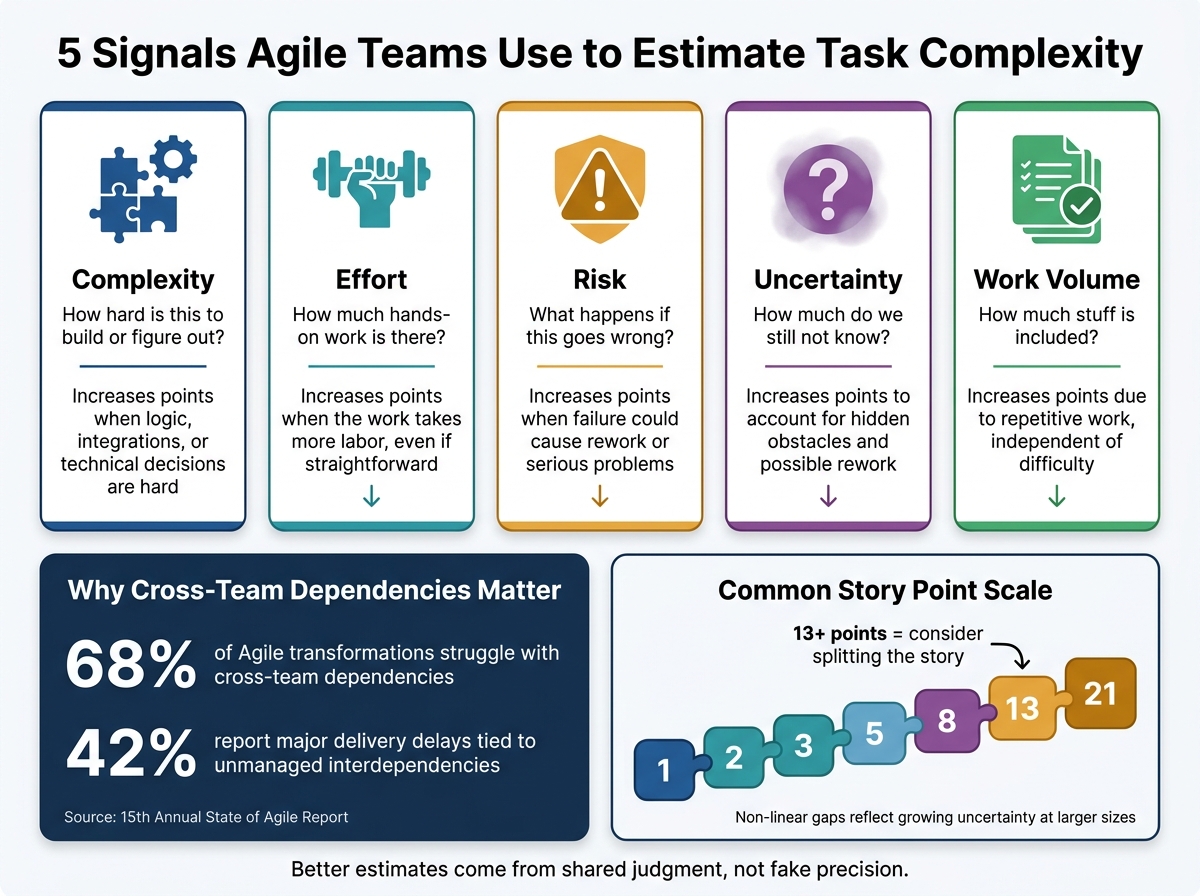
5 Agile Estimation Signals: Complexity vs. Effort, Risk, Uncertainty & Volume
How to Fix Story Point Estimation | Humanizing Work Show
What Task Complexity Means in Agile
In Agile, task complexity is about how hard a story is to deliver. That difficulty usually comes from unknowns, dependencies, technical constraints, and how familiar the team is with the work. And here's the part that trips people up: small work can still be complex, and big work can still be simple. A task doesn't have to be large to be tricky.
That leads to the next step: what makes one task feel more complex than another?
Complexity vs. Effort, Risk, Uncertainty, and Work Volume
These should be treated as separate signals. When teams mash them into one number, estimates get fuzzy and harder to trust.
| Factor | What It Represents | How It Affects Story Points |
|---|---|---|
| Complexity | How difficult the work is to solve or implement | Increases points when logic, integrations, or technical decisions are hard |
| Effort | How much labor the work requires | Increases points when the work takes more hands-on work, even if straightforward |
| Risk | The chance of negative outcomes or rework | Increases points when the work could cause problems if things go wrong |
| Uncertainty | How much is unknown about requirements or approach | Increases points to account for hidden obstacles and possible rework |
| Work Volume | How many steps, screens, fields, or integrations are involved | Increases points due to repetitive work, independent of difficulty |
These are the signals teams look at before sizing a story. For example, a small API integration might have low volume but high complexity. On the flip side, updating 30 UI labels might be high-volume but low-complexity. Same amount of visible "work"? Maybe not. Same kind of difficulty? Definitely not.
Why Agile Teams Avoid Time-Based Estimates for Early Sizing
Hour-based estimates often create false precision. Early in planning, teams usually don't know enough yet about integration issues, hidden dependencies, or technical constraints to estimate time well. If they commit to hours too soon, they can end up boxed in by a number that was mostly a guess.
Relative estimation avoids that trap. Instead of asking, "How many hours will this take?" teams ask, "Is this bigger or smaller than that story we finished last sprint?" That's a much easier call to make, even when requirements are still shifting.
The key idea is simple: relative sizing works because teams compare stories, not hours. Next, it helps to look at the specific factors that drive complexity up.
What Makes a Task More Complex
Most complexity comes from three places: dependencies, clear requirements, and scope.
Dependencies, Unknowns, and Technical Difficulty
Cross-team dependencies are one of the biggest complexity drivers. If a story needs input from security, legal, compliance, or another team before it can ship, that waiting time is part of the complexity. It’s not just extra effort. The 15th Annual State of Agile Report backs this up: 68% of Agile transformations struggle with cross-team dependencies, and 42% report major delivery delays tied to unmanaged interdependencies.
Technical difficulty adds another layer. Work that touches core architecture, several services, or niche skills carries more risk than a small, isolated UI update. Unknowns matter too. If the team can’t agree on how to build something, that’s a warning sign. In that case, run a spike before estimating. If the approach still can’t be described clearly, the item needs more investigation before anyone tries to size it.
Unclear Requirements, Experience Gaps, and Risk
Vague acceptance criteria make work harder in a quiet but painful way. When “done” isn’t clear, edge cases tend to pop up in the middle of the sprint. That usually leads to rework and missed commitments. One study on effort estimation in large projects found that unclear requirements were one of six major factors that hurt estimation accuracy.
Experience gaps have the same effect. That’s why the exact same change can feel like a 3 to one team and an 8 to another. A routine API update in a service the team knows well might be a 3-point story. Put that same kind of change in an unfamiliar microservice with a different tech stack, and an 8 can make perfect sense. The learning curve is part of the work.
Risk also changes the picture. Stories that affect high-volume transactions, regulated data, or customer-facing security should get more points. Not because the code is always tougher, but because the cost of failure is higher. Once the team has a handle on requirements and skills, scope becomes the next thing to check.
Why Large Scope Adds More Than Just More Work
A large story isn’t just a small story with extra tasks piled on. Bigger scope brings more coordination, more edge cases, and more alignment overhead. A story that stretches across several UI flows, backend services, and data changes forces developers, testers, and the Product Owner to stay in sync the whole time. That kind of alignment can get shaky fast.
An industrial case study found that requirements with larger size and scope led to larger effort overruns. It also found that work spread across multiple sites had higher overruns than work handled by co-located teams.
That’s also why split stories often add up to more than the first estimate. It doesn’t mean the team got it wrong. It usually means hidden complexity finally came into view. If a story can’t fit into one sprint, or refinement keeps turning into a debate about what’s “in” and what’s “out,” split it before estimation. Those are the signals that feed directly into relative sizing and Planning Poker.
How Agile Teams Assess Complexity with Story Points
Once a team knows what makes work hard, the next step is turning that into a shared size. Story points do that. They give teams a shared way to judge relative complexity, uncertainty, and risk.
Relative Sizing, Reference Stories, and Baselines
Teams don’t start by guessing hours. They compare new work to work they already know.
If the team already shipped a story everyone agreed was a 5-point story, the next conversation is simple: is this new item easier, about the same, or harder than that one?
That only works if everyone is using the same baseline. Without one, two people can look at the exact same story and size it very differently. That’s why teams use reference stories: real backlog items that are already finished and serve as fixed comparison points.
A solid set of reference stories might include items at the 2, 3, 5, and 8-point levels. Each one should have a short note on why it got that size, such as:
- one integration
- moderate testing
- few unknowns
Keeping those examples visible during estimation helps the team stay calibrated. It also gives new team members something concrete to latch onto instead of starting cold.
Teams should review reference stories after big changes to the stack, team, or workflow. When the baseline stays current, voting gets faster and sizing tends to line up better.
Planning Poker and Team Consensus
Planning poker turns estimation into a structured team discussion and helps cut down on anchoring. Each person picks a point value from the agreed scale, and then everyone reveals at the same time. That way, no single voice steers the room before others have made up their minds.
When estimates are far apart - say 2, 5, and 13 on the same story - that spread is useful. It usually means the team is seeing the work through different lenses. The lowest and highest voters explain first, and that often brings hidden issues to the surface: a dependency someone missed, a compliance step left out of the acceptance criteria, or a test case that suddenly makes the work much bigger. After that, the team votes again until the estimates come together.
| Voting Pattern | Example | What to Do |
|---|---|---|
| Tight consensus | 5, 5, 5, 8, 5 | Take the majority and move on |
| Moderate spread | 3, 5, 5, 8, 5 | Hear from the 3 and 8, then re-vote |
| Wide divergence | 2, 5, 13, 8, 21 | Discuss extremes; if no agreement in 5 minutes, set the story aside |
| Lone outlier | 5, 5, 5, 5, 13 | Ask the outlier to explain - they may have spotted something critical |
This also works well for remote and hybrid teams. iAmAgile keeps remote voting simultaneous, reveals estimates all at once, and can kick off estimation sessions from Slack. That preserves the anti-anchoring effect even when the team is spread across different U.S. states or time zones.
When votes split far apart, the gap usually points to an unknown, a dependency, or a mismatch in assumptions.
Why Story Point Scales Are Non-Linear
Most teams use a Fibonacci-based scale: 1, 2, 3, 5, 8, 13, 21. That non-linear shape is deliberate.
As work gets bigger, uncertainty grows too. So the gaps between values get larger. The difference between 1 and 2 can matter a lot. The difference between 20 and 21 doesn’t tell the team much, and it can create a false sense of precision.
Large values also work like a warning light. If a story comes in at 13 or higher, that’s a cue to pause and ask whether the team understands it well enough to commit. Many teams split stories above 13 before sprint planning. That keeps the backlog centered on items the team can actually plan, instead of burning time arguing over tiny distinctions that don’t add much.
Linear scales sound precise, but they usually promise more than they can give. With a shared scale in place, the next challenge is making sure the estimation session itself runs in a steady, repeatable way.
How to Run Better Estimation Sessions and Improve Accuracy Over Time
Once your team has a shared sizing scale, the next step is to make estimation sessions tighter and more consistent. Relative sizing helps, but the way the team prepares, talks through work, and updates its frame of reference has a big effect on accuracy over time.
Break Down Large Items and Surface Assumptions Before Voting
Split large stories before estimating them. When a story covers too much ground, people often end up debating different versions of the same work without noticing. Smaller, well-split stories improve estimation accuracy because they cut ambiguity, separate complexity, and make dependencies easier to spot.
A good split usually starts with one clear user outcome per story. From there, break the work by workflow step, user scenario, business rule, or integration boundary. So instead of estimating “implement checkout,” you can split it into parts like:
- capture shipping address
- apply tax rules
- process payment via payment gateway
Each slice tightens the acceptance criteria and gives the team a smaller set of unknowns to talk through.
Before voting, do a short assumption round focused on the solution, dependencies, and unknowns. This can save a lot of back-and-forth. If a key assumption is still fuzzy, don’t force an estimate. Turn the item into a time-boxed spike, then bring it back for sizing once the team knows more.
Set Consistent Team Rules and Revisit Reference Stories
Estimation consistency comes from shared team rules. Over time, the team learns, patterns repeat, and the meaning of a story point can drift. What used to feel like a 5 may not feel like a 5 anymore.
A few simple rules help keep things steady:
- Re-estimate only when scope, architecture, or key constraints change in a material way.
- If work grows in the middle of a sprint, split that growth into a new story.
- Estimate only when acceptance criteria and dependencies are clear.
These rules help keep velocity data cleaner, determine how many story points per sprint are realistic, and make comparisons more useful.
Reference stories also need a check-in now and then. Every 3–4 sprints, look back at recently finished work and ask whether your reference stories still match the team’s current experience. After a team completes several integrations with reusable patterns, something that once felt like an 8 may now feel more like a 5. That recalibration helps prevent point inflation and keeps relative sizing tied to the team’s current view of what a 3, 5, or 8 means.
When a Scrum Poker Tool Helps
For remote and hybrid teams, the format of the session matters almost as much as the scale itself. A Scrum poker tool helps most when the team needs to estimate a large backlog in one sitting or keep voting simultaneous across time zones.
iAmAgile supports Slack-based sessions, customizable voting scales, and mobile access. When the tool takes care of vote collection and reveal, the facilitator has more room to focus on the part that matters most: the discussion, especially when estimates split and the outliers need to explain what they’re seeing.
Conclusion: Build a Shared Model for Complexity
After looking at complexity, story sizing, and Planning Poker, the big goal is shared calibration. Complexity shapes story points, but it isn't the only thing that matters. Good Agile teams size work by looking at complexity, effort, uncertainty, risk, and volume together. Planning Poker matters less for the final number and more for the shared understanding it creates.
That calibration gets better when teams keep stories small and keep their baseline up to date. Before voting, make stories small enough to discuss clearly and make assumptions explicit. Keep point rules stable, revisit reference stories on a regular basis, and use sprint data to learn from misses. Research also suggests that expert estimates become less consistent for stories larger than 5 points, which is a strong reminder to split work before estimating when you can.
A shared complexity model isn't a chart or a rulebook. It's the team's judgment, shaped through repeated discussion and steady calibration.
FAQs
How do we separate complexity from effort?
Effort is the total amount of work a task needs. Complexity is different. It’s about how hard the work is to think through and build, like tricky logic, parts that affect each other, or advanced validation rules.
A simple way to estimate both is to use relative estimation, such as Planning Poker. Instead of guessing in a vacuum, the team compares a new task to a baseline they already know. That makes it easier to separate raw workload from difficulty and uncertainty.
It also helps the team spot stories that are doing too much. If one item feels hard to size because it mixes a lot of work, complex logic, and unknowns, that’s often a sign it should be split into smaller pieces.
When should a story be split?
Split a story when it’s too big, too fuzzy, or too thin on detail to estimate with confidence.
A simple rule of thumb: split it if it’s more than 13 story points, if it likely won’t be done in 1 to 2 days, or if the team still has a wide spread in estimates after talking it through. That usually points to hidden complexity or people picturing different things.
How often should we recalibrate story points?
Recalibrate story points every sprint using retrospective data. Set aside 15–20 minutes in each retrospective to compare original estimates with actual effort, then note what slowed the team down.
Done sprint after sprint, this helps the team spot repeat issues within about 6–8 sprints. It also keeps your estimation scale in line with the team’s changing capacity.
Ready to improve your team's planning?
Put what you've learned into practice! Make your next planning session more engaging and accurate.
Try for free - no signup required